


Is 760 a good credit score? For most personal-loan lenders, it already clears the top pricing tier, and it sits one band below Fannie Mae's top mortgage pricing tier. Auto loans are the exception: Experian's own tiering places the best rates one notch above 760, not at it. That single exception is where this article earns its keep, because most content on this topic stops at "760 is excellent" and never asks the harder question: what, specifically, does another 20 or 40 points buy you once you're already there?
The answer depends entirely on which loan you're about to apply for. On a mortgage, the jump from 760 to 780 shaves a small amount off your loan price. On an auto loan, it can matter more than you'd expect, because Experian's top tier starts at 781, not 760.
On a personal loan, there's no published rate grid at all, so the honest answer is "probably a little, but nobody can promise you a number." The sections below work through each one with the actual pricing data, then close on the part that matters most: once you're past 760, your score stops being the lever that moves your rate.
Where 760 Actually Sits
FICO scores run from 300 to 850, and FICO's own bands, published by myFICO, put 740-799 in the "very good" range, with 800 and above labeled "exceptional." A 760 sits at the high end of very good, close enough to exceptional that lenders treat it as functionally elite for underwriting purposes. Is 780 a good credit score, too? It is, and it sits one tier up from 760 in the sense that it clears Fannie Mae's top LLPA band, which starts at 780.
But "one tier up" is doing a lot of work in that sentence, because the size of the gap between those two tiers is exactly what most articles never quantify.
Instead of vague "you'll get the best rates" language, the sections below use the actual pricing tiers that mortgage investors, auto lenders, and personal-loan aggregators publish or report, so you can see what 780 buys over 760 in real percentage points, not marketing copy.
What 760 Buys on a Mortgage: The Fannie Mae Numbers
Conventional mortgages sold to Fannie Mae are priced off a published grid called the Loan-Level Price Adjustment (LLPA) matrix, which sets pricing add-ons by credit score band and loan-to-value (LTV) ratio. Fannie Mae's LLPA matrix splits its top credit tiers at 760-779 and 780 and above. That means a 760 borrower and a 785 borrower are priced on different lines of the same grid, even though both would be described as "very good credit" in plain English.
Here's the honest part: the gap between those two lines is small. Directionally, moving from the 760-779 band into the 780-plus band shaves at most a quarter-point of loan price off across most LTV levels, and none at the lowest LTVs. At every LTV band, the 780-plus tier prices equal to or better than the 760-779 tier, but nowhere does it represent a different world.
This is loan pricing, not your interest rate directly, though pricing differences typically translate into a modest rate difference or a modest change in upfront costs. The exact decimal breakdown by LTV band lives in Fannie Mae's LLPA matrix.
The reason this matters is contrast. myFICO's own Loan Savings Calculator uses 760 as its top mortgage credit tier cutoff, which tells you something important on its own: FICO itself treats 760 as the entry point to its best mortgage tier, not a middling stop along the way.
Compare that to what happens below 760. Moving from a 680 score to a 760 score saves a mortgage borrower roughly $83 a month and more than $29,000 in total interest over the life of a 30-year loan, according to myFICO's published estimates. That's the range where score points are doing real, measurable work. Above 760, you're arguing over the last quarter-point on the grid, not the difference between a good rate and a bad one.
The Auto-Loan Exception: Why 760 Isn't the Ceiling Here
This is the wrinkle that most "is 760 good" content misses entirely, because it cuts against the diminishing-returns framing that holds everywhere else in this article.
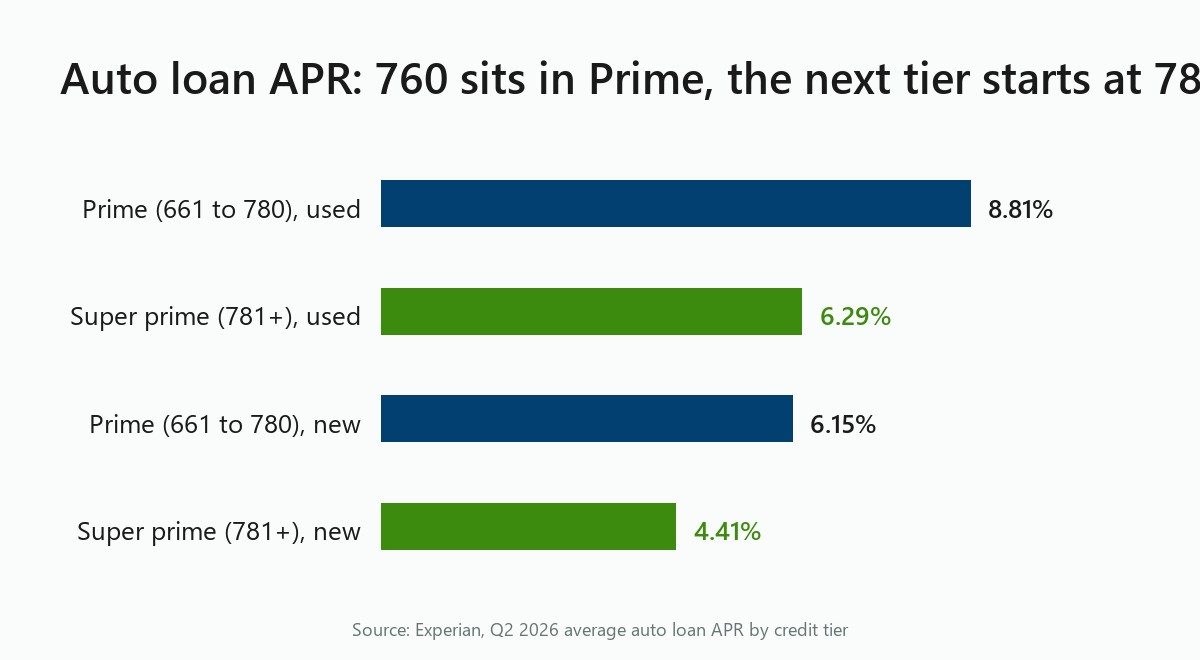
Experian's own tier data sorts borrowers into credit tiers using VantageScore 4.0: super prime starts at 781, prime runs 661-780, near prime 601-660, subprime 501-600, and deep subprime 300-500. Look closely at that boundary. Super prime begins at 781. A 760 score, no matter how you feel about it, sits inside the prime tier, one bracket below the top.
The rate difference between those two tiers is not trivial. In Experian's second-quarter 2026 data, super-prime borrowers averaged 4.41% APR on new-car loans and 6.29% on used, while prime borrowers averaged 6.15% new and 8.81% used. That's a gap of roughly 1.7 percentage points on a new-car loan between the two tier averages, and 760 sits on the prime side of that split.
A borrower at 760 and a borrower at 785 can walk into the same dealership and see meaningfully different financing offers, because the two sit in different Experian tiers with different average pricing.
One caveat worth flagging: Experian's tiers use VantageScore 4.0, while most auto lenders actually pull a FICO Auto Score variant when they underwrite. The two models don't always agree on where a given borrower falls, so your FICO Auto Score 8 or 9 number and your VantageScore could place you on different sides of that 781 line.
The practical takeaway holds regardless: on auto loans specifically, don't assume 760 has already bought you the best available rate. On average, it hasn't.
Personal Loans: Less Standardized, Same Pattern
Personal loans don't have a Fannie Mae-style master grid, and no single authoritative source publishes a universal rate card the way the LLPA matrix does for mortgages. Every lender sets its own tiers, so any "760 versus 780" comparison here is necessarily directional rather than exact.
With that caveat stated plainly: Upstart and other lender-rate roundups suggest unsecured personal-loan APRs run roughly 10-14% for borrowers in the 720-759 range, and roughly 7-10% for borrowers at 760 and above, with 800-plus borrowers seeing lenders' lowest advertised headline rates.
For broader context, Bankrate's tracking of average personal-loan rates put the typical unsecured personal-loan APR around 12.42% at a 700 FICO baseline as of mid-2026, which gives you a sense of where the 720-759 band sits relative to the market average.
The practical read: 760 gets you into the top advertised APR bracket at most personal-loan lenders. Pushing to 780 or higher rarely buys a materially lower rate from there. What it more often buys is a higher approved loan amount, a looser debt-to-income tolerance from the underwriter, or access to a lender's best promotional terms rather than a better headline rate.
If you're deciding whether a personal loan or a different product fits your situation, it's also worth looking at what a credit union charges against what a bank charges at the same score band, a separate comparison.
What Actually Moves Your Rate Once You're Past 760
Once you're sitting at 760 or above, your credit score has mostly finished its job. The Consumer Financial Protection Bureau notes that mortgage rates differ across lenders even for borrowers with identical credit profiles, because risk-based pricing also accounts for loan-to-value ratio, rate-lock length, discount points, and each lender's own risk appetite. The CFPB's own explainer on the factors that shape a mortgage rate makes the same point: credit score is one input among several, not the whole story.
Translate that into practical terms and four variables do most of the remaining work once your score is no longer the constraint.
- Debt-to-income ratio (DTI). Lenders cap how much of your gross income can go toward debt payments, because DTI signals repayment capacity in a way score alone doesn't.
- Loan-to-value ratio (LTV) or down payment size. This is precisely what drives the width of the LLPA gap described above. A larger down payment reduces the lender's exposure and often moves pricing more than an extra 20 points of credit score would.
- Loan amount. Jumbo mortgages, larger personal loans, and higher-balance auto loans get priced against different risk models than smaller loans in the same product category, independent of your score.
- Loan type and lender risk appetite. A credit union, a regional bank, and a national online lender can each price the same 760-score borrower differently, because each lender runs its own risk models and risk appetite.
None of these four levers require you to move your credit score at all. That's the point. Once you've cleared a lender's best-priced score band, whether that's 760 on a personal loan, 780 on a mortgage, or 781, Experian's super-prime line, on an auto loan, the remaining rate variation in your specific offer comes from these structural factors, not from squeezing out a few more FICO points.
So Is It Worth Chasing 780 or 800?
It depends entirely on which loan you're about to apply for next. If a mortgage is on the near-term horizon, pushing from 760 into the 780-plus band buys a real but modest pricing improvement, worth doing if it's easy (paying down a card balance, for instance) but not worth delaying a purchase over.
If an auto loan is next, the calculus changes: getting from 760 to 781 moves you into Experian's super-prime tier, where average new-car APRs run roughly 1.7 percentage points lower than in the prime tier, which makes the climb meaningfully more valuable than it is for a mortgage. If a personal loan is what you need, 760 has likely already put you in the best advertised bracket, and additional points are more likely to expand what you can borrow, or loosen a lender's debt-to-income tolerance, than to shrink your rate.
If none of that changes your calculus and you'd simply like the highest score achievable, chasing 800 is a defensible goal in its own right, and the roadmap for getting there from the mid-720s is laid out separately. But treat that as a different project with a different payoff, not a prerequisite for good loan pricing you've already secured at 760.
For readers still building toward that number, it also helps to know where your starting point actually lands on the FICO scale before deciding how far to push.
The broader lesson generalizes past 760. Score improvements deliver their largest dollar payoff when you're moving out of a weak tier into a strong one, the kind of jump documented when comparing a 580 score against a 680 score on an identical loan amount. Once you're inside the strong tier already, as a 760 borrower is on nearly every product, the marginal dollar per additional point drops sharply, which is exactly the diminishing-returns pattern this article has traced across mortgages, auto loans, and personal loans.
Keep paying your bills on time, and start treating your credit score as one variable among several that together decide what you'll actually end up paying.
Frequently Asked Questions
Is 760 a good credit score for a mortgage?
Yes. A 760 score clears Fannie Mae's second-highest LLPA pricing tier, and myFICO uses 760 as the cutoff for its top mortgage credit tier in its own savings calculator. Moving to 780 or above buys a further, smaller pricing improvement, at most a quarter-point of loan price and none at the lowest LTVs, not a categorically different rate.
Is 780 a good credit score?
It is. On a mortgage, 780 clears Fannie Mae's top LLPA band for a small pricing edge over 760. On a personal loan, it sits in the same top advertised-rate bracket 760 already reached. On auto loans, though, 780 still falls short of Experian's super-prime cutoff of 781, so it can matter more there.
What credit score do you need for the best auto loan rate?
Experian's data puts the super-prime tier, which sees the lowest average APRs, at 781 and above under its VantageScore-based tiering. A 760 score falls in the prime tier just below that line, where average new-car APRs run roughly 1.7 percentage points higher than super-prime rates.
Does going from 760 to 800 actually lower your interest rate?
On most products, the difference is small once you're already at 760, since lenders' pricing grids treat 760 and up as a strong tier. The bigger effect of pushing toward 800 tends to show up in approved loan amounts and underwriting flexibility rather than in a materially lower advertised rate.
What matters more than credit score once you're above 760?
Your debt-to-income ratio matters, since it signals repayment capacity in a way score alone doesn't. Beyond that, the CFPB points to loan-to-value ratio, rate-lock length, discount points, and each lender's own risk appetite as factors that keep moving your rate after your score has cleared a lender's top tier.