


Three browser tabs, three prequalified rates, three different numbers. That's the moment most borrowers hit when they prequalify for a personal loan with several lenders at once: a spread of offers that all claim to know what you'll pay, based on data none of the lenders have actually checked yet. Then one of those offers moves once you apply for real, and the number on the page no longer matches the number you planned around.
That gap is the predictable result of what a prequalification offer is built from, and what it isn't.
The useful question at this stage is what this number actually measures, and how far it can move before you sign anything. Those two questions have concrete answers, and neither of them is explained well by the lenders quoting you the rate in the first place.
What Prequalification Actually Checks
A prequalification form asks for information you type in yourself: your income, your existing monthly debt payments, sometimes your employer and housing cost. None of it gets verified at this stage. Most prequalification tools pair that self-reported data with a soft pull of your credit file, which gives them a general read on your credit history without a full underwriting review. From those two inputs, an algorithm generates an estimated rate, term, and loan amount.
That's the entire model behind the number sitting in your tab: what you told them, and a quick look at your credit. Full underwriting works from a different, deeper set of inputs entirely, and understanding that difference upfront is what keeps a final offer from feeling like a bait and switch when it isn't one.
At the application stage, the lender documents your income with pay stubs, tax returns, or bank statements instead of taking your word for it. They pull a full credit report rather than a soft-pull snapshot, which can surface items the abbreviated check never touched: a missed payment, a recent inquiry from another lender, a balance that wasn't visible in the summary version of your file.
They recalculate your debt-to-income ratio using verified numbers instead of the figure you estimated on the form. And they confirm your employment and identity. Every one of those steps can move the final number away from the prequalified one, and none of them are optional.
Why "Prequalified" Doesn't Mean the Same Thing Everywhere
Part of the confusion is that the word itself isn't standardized. The Consumer Financial Protection Bureau is direct about this: lenders' processes vary widely, and the words they use don't tell you much about a particular lender's process. One lender's "prequalified" might mean a quick check against self-reported figures.
Another's "preapproved" might mean something closer to a verified offer. Neither label is a guaranteed loan, and neither carries a fixed legal meaning across the industry. That's a meaningful distinction to sit with before you start comparing rates across a handful of lenders, because it means you cannot assume two offers labeled the same way were actually generated the same way.
That matters for how you should read the offers stacked in your browser. Two lenders can use different terms for functionally identical processes, or the same term for processes that differ in how much they actually check. The label tells you almost nothing. The underlying data does.
Why the Lender Can Even Check Your Credit Before You Apply
A prequalification check still pulls your credit file, which means it still needs a legal basis under the Fair Credit Reporting Act, the same as a hard pull does. Under 15 U.S.C. § 1681b, a lender typically has that basis one of two ways: the consumer authorizes the check directly, which is what happens when you submit a prequalification form yourself, or the lender extends an unsolicited firm offer of credit under the statute's prescreening provisions.
That's why a prequalification tool can look at your credit before you've signed a loan application. Your authorization covers the prequal check; the full application runs on a separate authorization and a separate, full pull.
How Far a Final Offer Can Move, and Why
The distance between a prequalified rate and a final offer traces directly back to which inputs get verified. Four categories do most of the work.
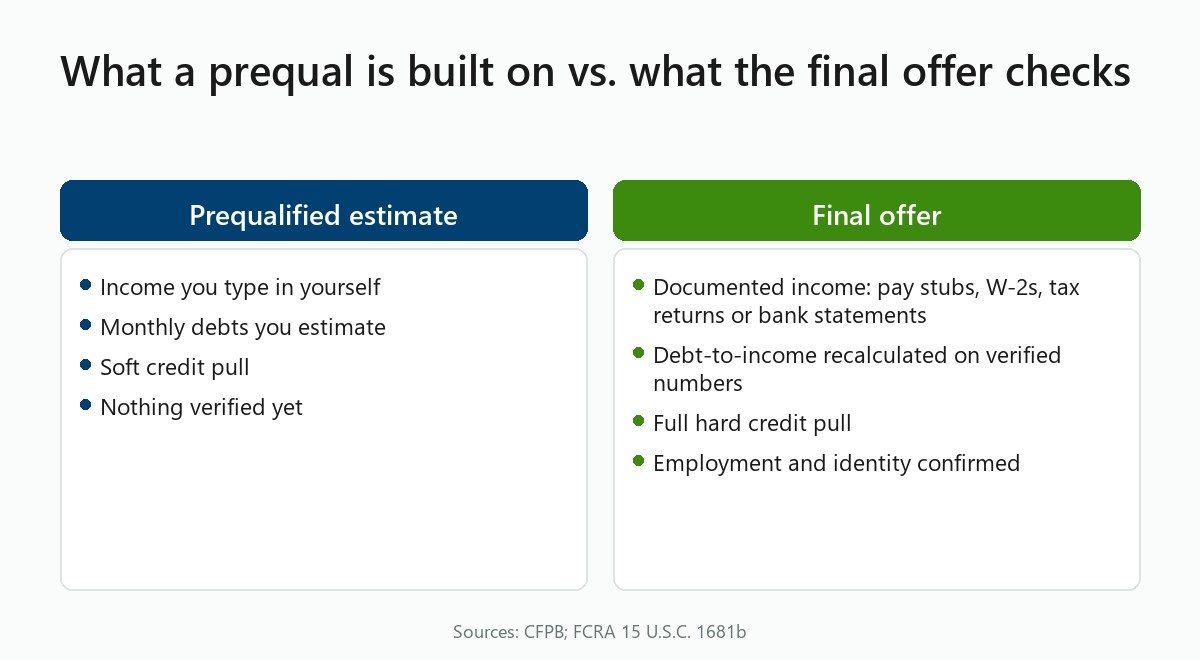
Income is the biggest one. You self-report income on a prequal form, and lenders generally don't check it at that stage. At full application, they want documentation: pay stubs, W-2s, tax returns, or bank statements, depending on how you're employed. If your actual documented income comes in lower than what you estimated, or the lender can't verify it the way you expected, your rate, term, or approved amount can shift, sometimes substantially.
Debt-to-income ratio moves for the same reason. DTI is your monthly debt payments divided by your gross monthly income, and it's one of the core figures a lender uses to judge whether you can absorb another monthly payment. The number you plug into a prequal form is an estimate. The number full underwriting calculates is built from verified income and a verified debt picture pulled from your full credit file, and it's rarely identical to your guess.
The credit pull itself is the third variable. A soft pull gives a lender a general snapshot. A full, hard pull at the application stage can surface things the snapshot didn't: a hard inquiry from another lender you formally applied with, a balance that increased between the two steps, or a derogatory mark that wasn't part of the abbreviated read.
The soft pull was never built to catch that information. Employment and identity verification round out the list. It's a more mechanical check, but a discrepancy here, a job change between prequal and application, for instance, can also affect the final terms.
Put together, this is the honest answer to "why did my rate change": the prequal number was built on an estimate, and the final number is built on a verification. They're measuring the same borrower with different levels of rigor, and rigor tends to find things estimates miss. The prequal figure was doing a narrower job than most borrowers assume, not a dishonest one, and the final offer is the version built to actually be lent against.
Why a Prequalified Applicant Can Still Be Declined
A re-priced offer is the mild outcome. The more consequential one is an outright decline after prequalification, and it happens for reasons that trace back to the same gap between estimated and verified data.
A DTI that comes in materially higher once verified, income that can't be documented at the level you reported, a full credit pull that looks meaningfully different from the soft-pull snapshot, or a change in your financial circumstances between the two steps, a new job, new debt taken on while you were shopping, can all move a lender from "prequalified" to "declined." Being prequalified was always a read on partial, unverified information rather than a guarantee, and full underwriting is where that information either holds up or doesn't.
The confusion is understandable. Borrowers often assume prequalified means approved, and the language on most lender sites doesn't do much to correct that impression. It's worth restating plainly: prequalified means your estimate survived a check against the limited data the lender had on hand at that moment. It doesn't mean the lender has committed to lending you anything, and it doesn't mean the harder look coming at full underwriting will land in the same place.
If you are declined, you have a federal right to know why. Cashzella.com's guide to adverse action notices covers exactly what that disclosure has to include and how to request the specifics.
For a look at what your application is actually being run through once you submit it, see how online lenders process an application in the seconds after you hit submit.
How to Shop Multiple Prequal Offers Without Stacking Hard Inquiries
The practical upside of all this is that prequalification is genuinely useful for comparison shopping, as long as you understand what you're comparing. Since prequal checks typically rely on soft pulls, you can collect estimates from several lenders without the accumulating credit-score impact that comes from multiple hard inquiries.
For the specific mechanics of how soft pulls interact with your score when you shop around, that's covered on the site's rate-shopping guide.
A workable framework looks like this. Collect prequalified offers broadly, since the soft-pull stage doesn't carry the same credit cost that formal applications do. Compare the estimates side by side, treating each one as a starting point rather than a locked-in rate. Then narrow to one or two finalists and move forward with a full application only for those, since that's the stage where a hard pull and real verification enter the picture.
It's also worth remembering why the same borrower gets different prequalified numbers from different lenders in the first place. Underwriting models, risk appetites, and funding costs vary by lender, which is a separate topic covered in detail here.
A wide spread between offers is a sign that lenders price the same risk differently, not that one lender is telling the truth and the others aren't. That difference is exactly what makes collecting several prequal estimates worth doing. A lender that looks expensive on paper for one applicant can look competitive for another, depending entirely on how that lender's model weighs the inputs it was given.
Reading Your Final Offer Against the Prequal Estimate
Once you've narrowed to a finalist and moved through underwriting, the document that matters is the formal disclosure attached to your final offer, not the number you saw at prequalification. That disclosure lays out the actual annual percentage rate, finance charges, and payment schedule you'd be agreeing to.
Cashzella.com's guide to reading that disclosure explains exactly what each section means and how to compare it line by line against the estimate you started with.
Treat the prequal number as the opening estimate it was designed to be, and treat the final disclosure as the actual terms. The distance between the two tells you how much your self-reported data differed from what verification found. Sometimes that distance is nothing. Sometimes it's the difference between a loan that works for your budget and one that doesn't, which is exactly why the comparison is worth doing line by line rather than glancing at the headline rate alone.
This is also the point where a small self-reporting error tends to show up. Borrowers round their income up, forget a recurring debt payment, or estimate housing costs from memory rather than a lease or mortgage statement. That's the nature of filling out a form quickly, not dishonesty.
But every one of those small gaps is exactly what full underwriting is built to catch, and it's why the disclosure, not the prequal screen, is the document to actually plan your budget around.
Why This Matters for Your Next Application
The borrowers who get surprised by a final offer are usually the ones who treated the prequal screen as the finish line instead of the starting point. Collect your estimates, but plan your budget around the number that survives verification, not the one that greeted you in the tab.
Frequently Asked Questions
Is a prequalified personal loan offer guaranteed?
No. A prequalification offer is an estimate, not a binding commitment, as the Consumer Financial Protection Bureau notes in its guidance on prequalification and preapproval letters. It's typically built from self-reported information paired with a soft credit pull. The lender can still adjust the rate or decline the application once it verifies your income, debt, and full credit history.
Does prequalifying for a personal loan hurt my credit?
Usually not. Prequalification typically uses a soft pull, which doesn't affect your score the way a hard inquiry does. For the full explanation of how soft and hard pulls each affect your score, see the site's soft-pull rate-shopping guide.
Why did my prequalified rate go up when I formally applied?
Because the final rate is based on verified data rather than the estimate you provided. Documented income, a full hard-pull credit report, and a recalculated debt-to-income ratio can all differ from what you self-reported at prequalification, and any of them can move your rate.
Can I be denied a personal loan after prequalifying?
Yes. Prequalification is not an approval. A materially higher verified DTI, income that can't be documented, or a hard-pull credit picture that differs from the soft-pull snapshot can all lead to a decline even after a strong prequalified offer. If that happens, you have a federal right to know why, as covered in our guide to adverse action notices.
How many lenders should I prequalify with?
There's no official "safe" number. Because prequalification generally uses a soft pull rather than a hard inquiry, borrowers can reasonably collect estimates from several lenders to compare before formally applying to one or two finalists. Check the site's soft-pull rate-shopping guide for how that process affects your credit.