


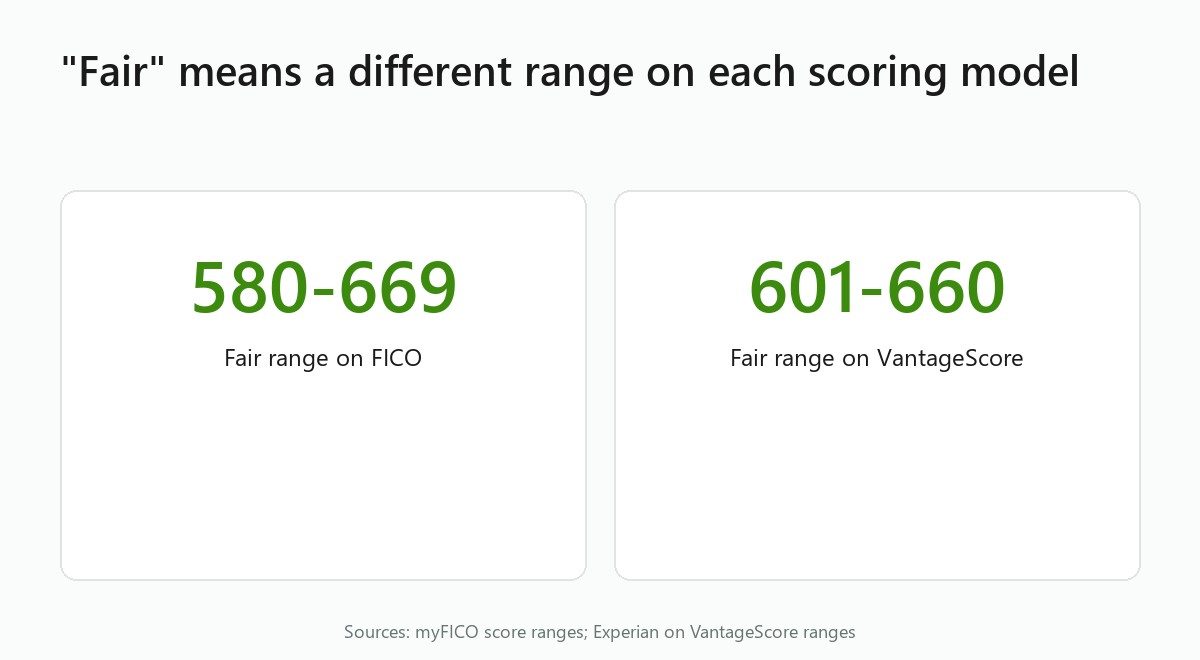
You checked your score, saw the word "fair," and now you're staring at your phone wondering what a fair credit score actually means for you. Here's the answer, right away: FICO defines "Fair" as 580-669. Experian's own VantageScore page puts "Fair" at 601-660. Two scoring models, two slightly different lines in the sand.
That gap matters more than it sounds like it should, because the lender pulling your application might be using either one. A credit union checking your auto loan eligibility and a card issuer running a pre-approval offer could genuinely be looking at two different numbers, built from two different formulas, describing the same underlying you. Both are measuring similar behavior in their own way, and knowing both keeps you from panicking over a number that only tells half the story. Think of a "fair" reading from one app and a "good" reading from another as two snapshots of the same file, taken with two different cameras.
If you're not sure you even have a score yet, that's a different starting point than "fair." Our piece on what credit score you start with walks through that distinction. But if you've got a number and it landed in the fair range, keep reading. You're in a specific, well-documented band with a clear way out.
What Counts as a "Fair" Credit Score?
Think of FICO and VantageScore as two different graders scoring the same test with slightly different rubrics. Both look at your payment history, how much of your available credit you're using, and how long you've had accounts open. They just draw the tier boundaries in different places.
Most people never choose which model gets used on them. The lender does, usually based on which score they've licensed and built their underwriting around. That's part of why it pays to know both charts instead of memorizing just one number from one app and assuming it applies everywhere you go.
Here's how the two models stack up, side by side:
- FICO: Poor below 580, Fair 580-669, Good 670-739, Very Good 740-799, Exceptional 800 and up.
- VantageScore (per Experian): Fair sits at 601-660, with Equifax's own VantageScore 3.0 explainer landing close by at 600-660.
Notice the overlap and the mismatch at the same time. A score of 650 is comfortably a fair credit score under both systems. Push toward the edges of that range, though, and the two models can disagree about where fair ends and good begins. That's two separate businesses building two separate scoring products, each with its own formula and its own history.
Both models lean hardest on the same handful of ingredients, even if the exact math differs between them. According to myFICO's own breakdown of the formula, payment history makes up 35 percent of a FICO score, credit utilization makes up 30 percent, length of credit history is 15 percent, new credit is 10 percent, and credit mix is the final 10 percent.
That's useful to know because it tells you where your effort actually pays off. Chasing a perfect "credit mix" while ignoring a late payment is backward. Fixing the two biggest levers first, paying on time and keeping utilization down, moves the needle the most.
There's one more wrinkle worth knowing, because it trips people up when they're comparing sources online. Some VantageScore charts label this tier "Near Prime" rather than "Fair." So depending on which VantageScore chart you happen to land on, the exact same score range might carry a different label entirely. Same number, different word.
Why does any of this matter to you personally? The lender decides which model it pulls, so you may be scored on either.
You could check your score on an app, see "fair," then apply somewhere that pulls a FICO score, and land in a slightly different spot on the same scale. Knowing both ranges up front keeps you from being blindsided by a number that looks unfamiliar, and it also explains why two apps on your own phone can disagree about your score.
One more thing worth knowing: no federal law sets where these tier lines fall. FICO and VantageScore are private companies, and where they draw "fair" is their own business decision, not something a regulator mandates. What federal law does guarantee is your ability to see what's actually driving that number. The Fair Credit Reporting Act entitles you to a free credit report every year through annualcreditreport.com, along with the right to dispute anything on that report you believe is wrong.
Is 640 a Good Credit Score?
No. A 640 is fair, not good, under both models as commonly published. Under FICO's 580-669 fair band, 640 sits comfortably in the middle. Under Experian's VantageScore reading of 601-660, it's fair there too.
If you were hoping the answer would be yes, I want to be straight with you instead of vague: it isn't, at least not by the definitions the two major scoring companies actually publish.
That's useful information. A 640 tells you exactly where you stand and exactly what tier of loan and card offers you're likely to see. Knowing that now, before you apply for anything, is worth far more than finding out the hard way when an offer comes back with a rate higher than you expected.
It also tells you something encouraging: you're not near the bottom. A 640 has real room above the fair floor and isn't far from the edge of "good" on either model. Small, consistent improvements can move a score in that range, and how fast this moves depends on your file, from your payment history to how long your accounts have been open.
What a Fair Score Actually Costs You
This is the part that turns an abstract number into real dollars, and it plays out differently depending on whether you're looking at a credit card or a personal loan.
Credit cards
Experian's own research, current as of September 2026, put the average credit card interest rate at 19.25 percent. That's a blended average across every credit tier, and it hides a wide spread underneath. Experian's reporting notes that consumers with excellent credit may qualify for rates in the mid-teens or lower, while those with fair or poor credit often see rates in the 20 to 30 percent range.
On a card balance you carry month to month, the difference between a mid-teens rate and a 20-plus percent rate compounds fast, and it compounds specifically on the balance you're least able to pay off quickly. That's the trap of fair credit and high APR together: the rate is highest exactly when your margin for paying it down is tightest.
Personal loans
Personal loans work the same way in principle. A fair score means a meaningfully higher APR than a good score, sometimes enough to change whether the loan even makes financial sense for what you're trying to do. Lenders price personal loan risk heavily off your credit tier, and moving from fair to good credit is one of the biggest levers you have over the rate you're ultimately offered.
If you want the exact dollar math on how much that gap costs over the life of a loan, we broke it down in detail in what 100 FICO points really cost on a $15,000 personal loan. It's worth reading before you sign anything, especially if you're weighing whether to wait a few months and build your score first.
Why lenders price it this way
None of this is personal, even though it can feel that way when a rate quote lands in your inbox. Lenders and card issuers use your score as a shorthand for risk: how likely you are, statistically, to repay on time based on your credit history so far. A fair score sits in the middle of that spectrum, so the pricing sits in the middle too, tilted toward covering more risk than a lender would price into a good or excellent score.
That's exactly why the two numbers in the sections above matter so much. The rate reflects where your file currently stands, and it moves as your file does. Improve the file, and the pricing tends to follow.
How to Move Out of the Fair Band
The good news about fair credit is that it responds to consistent, unglamorous habits. The Consumer Financial Protection Bureau publishes beginner-friendly guidance on rebuilding credit, and it comes down to a handful of concrete moves. Here's how to work through them, one at a time.
- Pay every bill on time, every time. The CFPB is specific about what "on time" means: the payment needs to reach the company by the day it's due, not just get mailed by then. Payment history is the biggest single factor in a FICO score, 35 percent per myFICO, so this step alone does more heavy lifting than anything else on this list.
- Watch your credit utilization. This is the percentage of your available credit you're actually using at any given time. The CFPB notes there isn't one universal magic number here: "Some experts advise using no more than 30 percent of your total credit limit, while others say you should use less than 10 percent." Either way, the direction is the same. Lower usage relative to your limit tends to help.
- Slow down on opening new accounts. Applying for several accounts in a short window can pull your score down, per the CFPB, right when you're trying to build stability instead.
- Consider a secured credit card as an on-ramp. A secured card requires a refundable deposit that typically sets your credit limit. As the CFPB explains, showing you can pay on time may eventually get your limit raised and your deposit refunded. It's a legitimate, low-risk way to build a positive payment record if your options feel limited right now.
- Pull your reports and dispute anything wrong. You're entitled to free credit reports at annualcreditreport.com. Go through them line by line, account by account. An error you don't catch keeps dragging your score down for no good reason.
- Pay your statement balance in full when you can. The CFPB notes that paying balances in full each month, where possible, helps you avoid finance charges stacking on top of whatever you're already carrying, which frees up more of your budget for the habits above.
One thing the CFPB is explicit about: it does not recommend debit or prepaid cards, payday loans, or buy-here-pay-here auto loans as credit-building tools. Steer clear of anything promising a shortcut through one of those routes.
If you want a more structured plan for the near term, we put together a focused breakdown in three proven moves to raise your credit score in 60 days. It picks up right where this list leaves off, with specific actions you can start today rather than a general direction to head in.
A fair score is a starting line. The habits above aren't flashy, but they work, and they're the same handful of moves the CFPB comes back to across all of its rebuild-credit guidance: pay on time, watch utilization, and don't pile up new accounts. Consistency is what moves the number over time, no clever trick or paid fix required.
Frequently Asked Questions
Is a fair credit score bad?
No. Fair sits above poor and below good on both major scoring models. FICO puts it at 580-669, and Experian's VantageScore reading places it at 601-660. It means you have an established credit file with room to improve, not that something is wrong.
Is 640 a good credit score or a fair one?
It's fair, not good, under both FICO and Experian's VantageScore ranges. A 640 falls inside FICO's 580-669 fair band and inside the 601-660 fair range Experian publishes for VantageScore. It's a solid middle-of-the-pack fair score, so treat it as a starting point with real room to grow rather than a red flag.
Why do FICO and VantageScore give different fair ranges?
They're separate companies with separate scoring formulas. Both weigh similar factors, like payment history and credit utilization, but they calculate and label the tiers differently. That's why the same underlying credit behavior can land you in slightly different spots depending on which score a lender pulls.
How much more does fair credit cost on a credit card?
Experian's research shows consumers with fair or poor credit often see credit card APRs in the 20 to 30 percent range, versus mid-teens or lower for excellent credit. Expect the same pattern on personal loans: a fair score typically means a meaningfully higher rate than an excellent score would get.
How long does it take to move from fair to good credit?
There's no fixed timeline, since it depends on your specific credit history and how consistently you apply habits like on-time payments and lower utilization. The CFPB points to on-time payments, mindful utilization, and limiting new account openings as the core levers that move the needle.