


You've applied twice. Maybe three times. Every answer came back the same: denied. If your score sits below 550 and your file carries a recent collection, a charge-off, a repossession, or a bankruptcy discharge, you already know what that feels like, and you're done hearing "just improve your credit" as if that's a plan you can execute by Friday. Getting a personal loan with horrible credit comes down to knowing which routes actually work at your score, in what order, and being honest about the ones that will bury you deeper.
The lenders who declined you weren't being cruel. They were running a formula, and your file didn't clear the bar that formula was built around. Some formulas will clear you; you need to know which ones were built for a borrower in your exact position, and which ones are counting on your desperation to make you sign something you shouldn't.
Every one of those declines should have come with an adverse action notice explaining exactly why, even when the language reads like boilerplate. A separate article on this site walks through what that notice actually discloses and what rights it gives you as a borrower.
What "Horrible Credit" Means to an Underwriter: The Deep Subprime Tier
Most articles about bad credit loans lump every score from 580 to 669 into one bucket and call it a day. That's not your bucket. The Consumer Financial Protection Bureau defines risk tiers on a straight scale: deep subprime sits below 580, subprime runs 580 to 619, near-prime covers 620 to 659, prime is 660 to 719, and super-prime starts at 720, according to the CFPB's borrower risk profile data. Sub-550 sits well inside deep subprime, several tiers below where most "bad credit" articles start.
The number alone rarely tells the whole story either. An underwriter reading a sub-550 file is usually looking at more than a low score: a collection account or two, maybe a charge-off, sometimes a repossession, sometimes a bankruptcy discharge still sitting fresh on the report. Each of those signals something different to a lender, but stacked together they tell a story of recent, serious financial strain rather than one bad month. That's the difference between "bad credit" and "horrible credit." Bad credit means you pay more for money. Horrible credit means most lenders won't offer you money at any price, because their models can't price a risk that steep and still make sense on their books.
Recency matters here too. A charge-off from five years ago that's aged off your active accounts reads very differently to an underwriter than one from five months ago, even if both technically still show on the report.
If a recent Chapter 7 discharge is part of your file, treat that as its own situation with its own timeline and rules, not something to sort out inside a general guide like this one. A separate article on this site walks through exactly how lenders view a post-bankruptcy file and when the waiting period actually ends.
The Routes Ranked by Real Approval Odds at This Tier
No regulator or lender publishes an actual approval-odds percentage by loan type at the sub-550 tier, and this section won't invent one to make the numbers sound more precise than they are. What follows is a qualitative ranking, ordered from most reliable to least reliable: share-secured loans, which come closest to a near-certain approval since they're secured by your own deposit; credit union PALs, where odds hinge on your membership relationship rather than your score alone; co-signed loans, where a strong co-signer's profile carries real weight; and income-based online lenders. Work through them roughly in that order, and stop as soon as one fits your situation.
Share-secured and credit-builder loans (no credit check)
If you have any savings at all, even a few hundred dollars sitting in an account, a share-secured or credit-builder loan is close to a guaranteed yes. Here's the mechanic: you pledge money you already have on deposit as collateral, and the credit union lends against it. There's no credit check involved in most cases, because the credit union is lending you your own money back against your deposit and reporting the payments to the bureaus while you do it. Rates on this type of loan commonly land in the single digits to high single digits APR, since the loan is fully backed by your own deposit and the credit union has almost nothing to lose.
The catch is obvious: you need savings to pledge, and if you're reading this article, cash on hand might be exactly what you don't have right now. But if you can scrape together even a small deposit, this is the closest thing to a sure approval you'll find at a sub-550 score, and every on-time payment reported to the bureaus starts moving that score in the right direction.
Credit union payday alternative loans (PALs), in brief
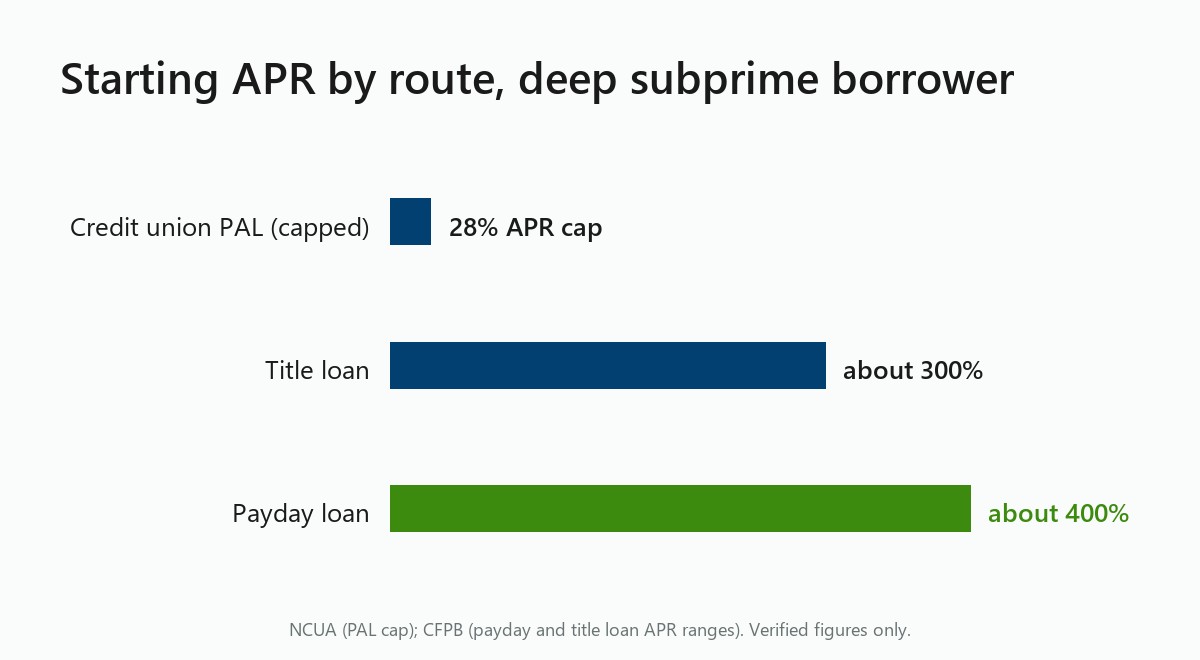
A Payday Alternative Loan (PAL) through a federal credit union is worth a phone call if you don't have savings to pledge, because approval leans on your membership relationship rather than your score alone, and the rate is capped at 28% APR under NCUA rules.
Co-signed or co-borrowed loans
Bring a co-signer with decent credit and steady income to the application, and the odds shift hard in your favor. The lender underwrites two incomes and two credit histories instead of just yours, and the co-signer's numbers can carry weight your own file can't. What you'll pay depends heavily on that co-signer's profile: a co-signer with strong credit can pull your rate down close to what they'd qualify for alone, while a co-signer who's only marginally stronger than you won't move the needle nearly as much.
This is also the route most likely to damage a relationship if it goes wrong. Before you ask anyone to co-sign, have the hard conversation about what happens if you miss a payment. That conversation matters more than the easier one about splitting payments or building credit together. A default hits the co-signer's report the same way it hits yours. A separate article on this site has scripts for that exact conversation, plus what actually happens to a co-signer if a loan goes into default.
Income-based online lenders
Online lenders in this newer category skip the traditional credit-score gate almost entirely and underwrite on cash flow instead: what's actually moving through your bank account, how consistent your deposits are, whether you're covering your bills without bouncing. This is why these lenders can approve borrowers a traditional score-based model would reject outright, and it's a meaningfully better shot than applying to a bank that runs your score first and stops there. Some of these lenders lean closer to a traditional installment structure with tighter underwriting; others accept deeper risk and price for it aggressively.
Here's the part that should make you shop hard before you sign anything: APR ranges published in reviews of these lenders run from roughly 20% up past 190% depending on which one you land with, and that spread holds true across every lender that publishes rates at this tier. Pull quotes from more than one lender before you commit, because the difference between the low end and the high end of that range, on the same loan amount, is the difference between a loan that helps you and one that digs the hole deeper. If you want to understand exactly how these lenders reach a decision without pulling a traditional score, a separate article on this site breaks down online personal loan underwriting step by step.
The Desperation Traps That Make Things Worse
Every route above involves real underwriting, even the fast ones. The routes in this section skip underwriting almost entirely, and that's precisely why they're dangerous for a reader in your position. None of it reports positive payment history in any way that helps you. Instead, they compound the exact problem that got you here, adding fresh derogatories to a file that already has too many.
Payday loans
A typical payday loan runs about $15 in fees for every $100 borrowed, with the whole balance due back in roughly two weeks. Annualize that fee the way an APR calculation does, and it lands close to 400%, a figure the CFPB confirms in its own consumer guidance on payday loan costs. Borrow $500 and the fee alone runs about $75, so you owe roughly $575 when the two weeks are up. Falling short of that balance leads most borrowers straight into a rollover, where the lender charges another round of fees on top of what's already owed. Each rollover repeats the same fee without touching what you originally borrowed, doing nothing to fix the derogatory marks already on your report and adding a fresh one the moment you fall behind.
Car title loans
Title loans work differently: your car is the collateral. The typical APR runs a little lower, around 300%, and that is the least of it. One in five title-loan borrowers has their vehicle seized or repossessed for failing to repay, according to the CFPB. If your car is how you get to work, repossession costs you the income you needed the loan to protect, on top of the vehicle itself. For a borrower already fighting to rebuild, that's a second collapse stacked on the first.
Guaranteed approval loan scams
Anyone advertising "guaranteed approval regardless of credit history" is either lying or setting up an advance-fee scam. Connecticut's Department of Banking has warned about exactly this pattern: online ads promise financial help by guaranteeing credit regardless of your past history, for a fee paid in advance, and once the promoters have your money, they rarely deliver on their promises. The loan never arrives. Your money does, but it goes the other direction. No legitimate lender guarantees approval before it has actually reviewed your application, full stop. If an offer skips straight to guaranteed and asks for money first, that is a trap built specifically for a reader who's tired of hearing no and ready to believe someone who says yes too fast.
That's one warning sign among several. A separate article on this site lays out six more red flags that reveal a loan offer is actually a scam before you hand over a cent.
When the Honest Answer Is 90 Days, Not an Application Today
Each route covered so far assumes you need money now. Sometimes the more honest answer is that you don't, not yet, and applying today just adds another hard inquiry and another denial to a file that's already working against you. If your derogatories are recent and your score is deep in the 500s, spending roughly 90 days on file repair before you apply anywhere can change which of the routes above are even available to you.

That work has a specific shape. Pull your credit reports and dispute anything inaccurate, since a successful dispute can move your score without you doing anything else. Pay down whatever balance you're carrying on any revolving account still open, since utilization affects your score directly. Ask a family member with strong credit and a long account history whether you can be added as an authorized user on one of their cards, which can add positive history to your file. And if you have any delinquent accounts that aren't in collections yet, catch those current before they become one more derogatory mark you'll be explaining later.
If your file only needs light triage rather than a full 90-day rebuild, a separate article on this site walks through a faster, two-week pre-application sprint built for exactly that lighter case. And once you've done the work and you're genuinely loan-ready, another article on this site lays out in dollar terms what the gap between a 580 score and a 680 score actually costs you on a $15,000 loan, so you can see precisely what the repair work is worth before you go back to any lender.
Frequently Asked Questions
Can you get approved for a personal loan with a 500 credit score?
Yes, but not through a traditional score-based lender. A 500 score falls deep inside the CFPB's deep subprime tier, so your realistic paths are a share-secured loan, a co-signed loan, or an income-based online lender that underwrites on cash flow instead of your score alone.
Does applying for a loan hurt an already-low credit score?
A hard inquiry causes a small, temporary dip regardless of your starting score. The bigger risk is applying to several traditional lenders back to back, racking up multiple hard inquiries and denials, which is exactly why ranking your routes by realistic odds before you apply matters.
Is a co-signer always required for a personal loan with horrible credit?
No. A co-signer significantly improves your odds and often your rate, but share-secured loans, credit union PALs, and income-based online lenders can all approve a sub-550 borrower without one, depending on your savings, membership, and income situation.
How fast can a credit union PAL fund once approved?
Funding speed varies by credit union, but PAL loans themselves have set limits: a PAL I runs $200 to $1,000 over a 1 to 6 month term, while a PAL II goes up to $2,000 over a 1 to 12 month term. Both require you to already be a member of the credit union offering them, so funding also depends on whether that membership is already established before you apply.