


Credit unions charged an average of 10.64% on a 36-month unsecured personal loan in the fourth quarter of 2025. Banks charged 12.00% for the same product over the same term. The gap, 1.36 percentage points, comes straight from the National Credit Union Administration's (NCUA) own Q4 2025 rate comparison, and it's the cleanest evidence available that the credit union personal loan rate advantage is a measurable market fact rather than a marketing line.
For a three-year loan of any meaningful size, a rate difference of that magnitude changes the total interest paid well before a single fee enters the picture. It also raises the follow-up question most shoppers skip: what's actually holding bank pricing higher, and does a national average like this one tell you anything about the rate you would personally be quoted.
If a credit union has never made your shortlist of places to get a personal loan, you're in good company. Banks and online lenders spend far more on advertising, so a credit union quote often only enters the conversation after a borrower has already compared three or four commercial offers, if it enters at all. The rate data above suggests that sequence has it backwards, at least as a starting point for shopping.
How Credit Unions' Personal Loan Rates Compare With Bank Averages
Start with what the number is not. The 10.64% figure is a national average spanning every credit tier and every borrower the NCUA tracks for 36-month unsecured fixed-rate personal loans. It is not a rate promised to any single applicant, and it is not the number a lender will quote you the moment you fill out an application. When you compare credit unions' personal loan rates against a specific bank's posted offer, your own credit history, the loan term you choose, and that particular institution's underwriting will move you above or below the average in either direction.
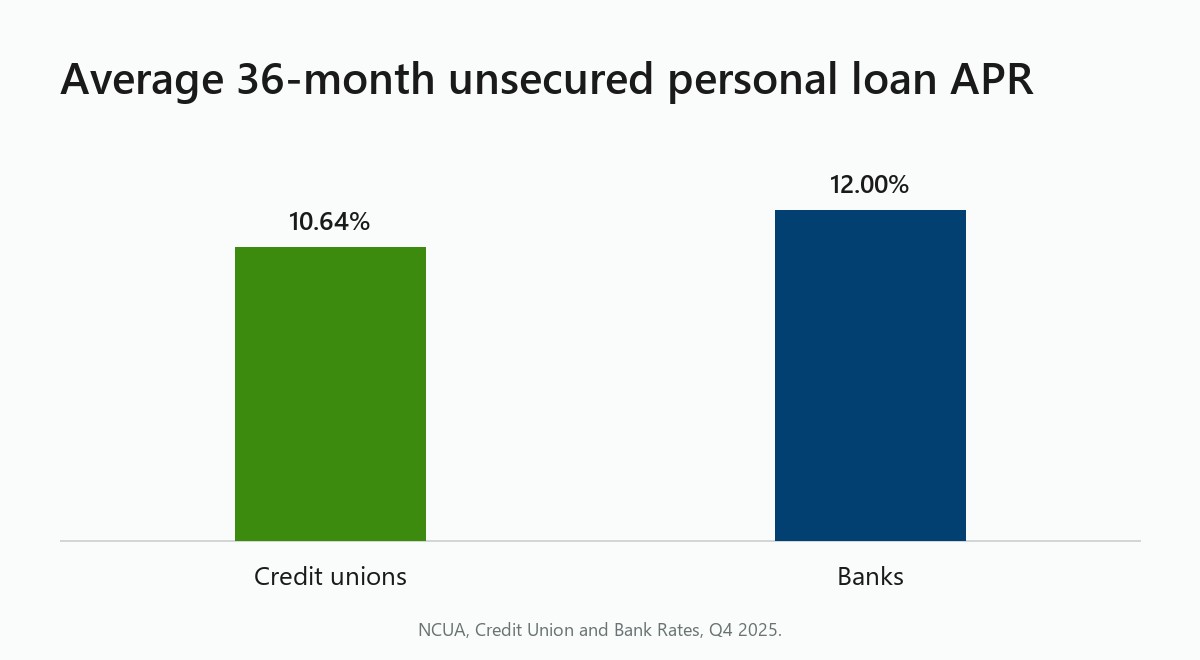
What the average does tell you is direction, and that direction has held steady. Financial-press tracking of the same NCUA series has put the spread in the 1.3 to 1.7 point range over the past year. A gap that persists across multiple quarters, through changing rate environments, points to something structural rather than a one-quarter fluke in the data.
The NCUA compiles this figure from data pulled from S&P Global Market Intelligence, with the Q4 2025 release reflecting figures as of December 26, 2025. A quarterly comparison published by the members' own federal regulator, drawn from S&P Global Market Intelligence data, carries more weight than any single lender's rate page, which is why this comparison anchors the rest of the analysis here.
The Federal 18% Ceiling on Credit Union Lending
Federally chartered credit unions operate under a rate ceiling that banks simply don't have. Under 12 CFR 701.21(c)(7), a federal credit union cannot charge a member more than 15% per year, inclusive of finance charges, unless the NCUA Board determines that money market conditions have risen enough to threaten credit union safety and soundness. When the Board makes that finding, it can authorize a higher temporary ceiling for up to 18 months at a time. The rate it has authorized is 18%.
That temporary 18% ceiling has been in continuous use since 1987, renewed by the NCUA Board roughly every year and a half as conditions require it. The Board most recently extended it through September 10, 2027, in a February 2026 vote, a move confirmed by both America's Credit Unions and the NCUA's own newsroom. Banks and online, non-depository lenders answer to different rate frameworks entirely. Neither is subject to this specific federal usury ceiling, which is part of why bank pricing can sit higher without any institution breaking a rule.
The temporary structure exists on purpose. When money market benchmarks climb, a credit union funding its loans with member deposits faces higher costs on the deposit side too, and a hard 15% ceiling could squeeze that margin past what's sustainable. Authorizing the higher ceiling in 18-month increments, rather than setting one permanent number, lets the NCUA Board loosen the cap when funding costs justify it and step back down toward the 15% statutory base once conditions ease. That flexibility tracks the same broader rate environment shaping 2026 quotes for every lender type, not just credit unions.
Why the ceiling doesn't cover every credit union
The 18% cap applies specifically to federally chartered credit unions under the Federal Credit Union Act. That's the flip side of the scope built into 12 CFR 701.21: state-chartered credit unions simply fall outside this particular federal rule, so they follow their own state's usury limit instead. If the institution you're comparing is state-chartered, the federal ceiling described here isn't automatically the rule governing your quote, so it's worth confirming the charter type before assuming this cap applies to your offer.
The Ownership Structure Behind Lower Credit Union Rates
The rate ceiling explains the top of the range a credit union can legally charge. It doesn't explain why credit unions tend to land so far below that ceiling in practice. The 10.64% average spans both federally and state-chartered institutions, yet it still sits well under the 18% cap that applies specifically to federally chartered credit unions. That gap comes down to who owns the institution.
A credit union is a not-for-profit cooperative, owned by its members rather than by outside shareholders. Banks answer to stockholders who expect a return on their investment, and pricing loans higher is one of the more direct ways to generate one. Credit unions carry no equivalent obligation.
That difference is structural. A cooperative has no shareholders to pay, so retained earnings tend to flow back to the membership through pricing, rather than out the door as dividends. It shows up in lower average loan rates and, often, higher yields on deposits. It's a mechanical consequence of the ownership model, and it's a large part of why the credit union personal loan rate average sits meaningfully under the bank average even in a market where both types of lender are chasing the same borrowers.
Credit Union, Bank, and Online Lender Rates Side by Side
Lined up together, the three main places you can shop a personal loan settle into a clear order, at least at the national average level.
- Credit unions: 10.64% average APR on a 36-month unsecured personal loan, per the NCUA's Q4 2025 rate comparison.
- Banks: 12.00% average APR on the same product and term, from the same NCUA report.
- Online lenders, excellent-credit tier: some advertise promotional rates well under 9% for borrowers with excellent credit who qualify for the lender's best pricing tier and available discounts, though these are lender-set promotional rates rather than averages, and they shift month to month with each lender's own credit and marketing decisions.
The first two figures come from the same regulator-reported dataset and describe an average outcome across the full range of applicants at each type of institution. The third does not work the same way. It describes the best rate a narrow slice of borrowers can qualify for, which is a different kind of number and worth treating with more skepticism than a government average.
That order is not guaranteed for every applicant. It's a reasonable starting map for where to look first, though a borrower with mid-range credit should expect quotes closer to the credit union and bank averages than to any online lender's advertised best case, since promotional pricing is reserved for the applicants a lender competes hardest to win.
When a Bank or Online Lender Still Beats the Credit Union Rate
The credit union advantage is an average, not a guarantee, and averages leave plenty of room at the edges. Two groups of borrowers routinely see that average get outrun.
Strong-credit shoppers chasing a promotional rate
Online lenders build their sharpest pricing around one specific borrower profile: someone with a long, clean credit history, low existing debt, and stable income who can qualify for the lender's lowest advertised tier plus stackable discounts, such as automatic payment enrollment. For that borrower, a promotional rate can land below what even a strong credit union quote would offer. The reason is simple math: the online lender is pricing to win its best-qualified applicants, not averaging across an entire loan book the way the NCUA data does.
It's a common surprise among strong-credit shoppers who assume a not-for-profit lender automatically wins on price, then discover an online lender's fully discounted offer sitting under it once every stackable discount applies. That surprise is really a lesson about how averages work. The NCUA figure blends every credit tier a credit union serves, while a lender advertising a promotional rate is quoting only its top tier, so the two numbers were never measuring the same population of borrowers in the first place.
When membership friction outweighs the savings
Credit unions also carry a cost that never shows up in an APR. You typically have to qualify for membership, often through residency, employer, or association ties, before you can even see a firm rate quote. For a borrower who needs funding on a tight timeline, or who doesn't clear a nearby credit union's membership criteria without extra paperwork, that step is a real cost. Membership friction is the objection that comes up most often when borrowers explain why they never shopped a credit union. If the rate difference between your best credit union quote and your best online quote is small, the time spent establishing membership can outweigh what you'd actually save.
Weigh the friction against the size of the gap, not against the principle of the thing. A borrower comparing a credit union quote that clearly beats the best bank offer is looking at a meaningfully different total cost, worth the extra step of opening a share account. A borrower comparing that same credit union quote against a discounted online offer that undercuts it by a similar margin is often better served skipping the membership process altogether and taking the faster path.
How to Compare a Real Offer Instead of the National Average
None of the figures above are a quote. The only way to know whether a credit union, a bank, or an online lender is genuinely cheaper for you is to line up real numbers for the same loan amount and term at each institution: APR, origination fee, and any prepayment penalty. Two lenders offering what looks like the same headline rate can price a loan very differently once fees and structure enter the picture, which is part of why identical borrowers routinely get different rate quotes from different lenders, a topic covered in more depth in Cashzella's piece on why lenders quote wildly different personal loan rates. Cashzella's rundown of the other numbers to compare besides APR walks through the rest of that checklist in more detail.

Ask each lender for the same disclosure before comparing anything: the annual percentage rate, the total finance charge across the full repayment term, and whether any fee is subtracted from the loan proceeds before the funds reach your account. Credit unions, banks, and online lenders each handle origination costs differently, and two offers that look identical on the advertised rate alone can diverge once that fee structure is accounted for. Cashzella's worked comparison of how origination fees can erase a rate advantage shows exactly how much a single percentage point of upfront cost can change the total cost of a loan.
Run the math on the full cost of the loan, not just the advertised rate. A slightly higher APR paired with no origination fee can beat a lower APR that arrives with a fee subtracted from your loan proceeds up front. That comparison, done properly on an actual offer, matters more than knowing where any single lender type sits on a national chart.
The credit union personal loan rate advantage falls short of universal, but it's real enough to be worth a phone call or two before you accept the first offer that lands in your inbox, especially if your credit sits anywhere short of excellent. Skip the credit union quote entirely and you're negotiating from a weaker position, whether or not you end up borrowing from one.
Frequently Asked Questions
What is the average credit union personal loan rate right now?
The most recent NCUA data, for the fourth quarter of 2025, puts the average credit union personal loan rate for a 36-month unsecured loan at 10.64%, compared with 12.00% at banks. Your actual rate depends on your credit profile and the specific institution.
Why do credit unions offer lower personal loan rates than banks?
Credit unions are not-for-profit cooperatives owned by their members rather than outside shareholders, so retained earnings tend to flow back to members through pricing instead of shareholder dividends. That ownership structure, not the federally chartered rate ceiling, is what keeps the average credit union rate below the average bank rate.
Is there a legal cap on credit union interest rates?
Yes, for federally chartered credit unions. Under 12 CFR 701.21, the statutory base is 15%, with a temporary ceiling of 18% that the NCUA Board can authorize when money market conditions warrant it, most recently extended through September 10, 2027. State-chartered credit unions follow their own state's usury limits instead.
Can an online lender beat a credit union's personal loan rate?
Yes, particularly for borrowers with excellent credit. Some online lenders advertise promotional rates well under 9% for their most qualified applicants, which can undercut even a strong credit union quote. That pricing applies to a narrow slice of borrowers rather than the average applicant.
Do all credit unions charge the same interest rate?
No. The NCUA figures are national averages across every credit tier and loan term, not a guaranteed rate. Individual credit unions set their own pricing within regulatory limits, so the same borrower can see meaningfully different quotes from one credit union to the next.