


If you're behind on credit cards, medical bills, or a personal loan and you live in Texas, you're sitting on two advantages that are unusually strong compared with what most states offer. Texas won't let a creditor touch your paycheck for ordinary consumer debt. It also protects your home from a forced sale no matter how much that home is worth. Neither fact means you're off the hook.
Both of those protections change how urgently you need to act, and which debt relief programs in Texas actually make sense for your situation. I spent 28 years on the other side of a loan desk. I watched people either fix a debt problem in six months or drag it out for six years, and the difference usually came down to whether anyone had explained what the law actually protects.
Texas has consumer-debt protections that are stronger than many states offer. It also has an entire industry of companies that count on you not knowing where those protections stop. Let's get into what's real, what's not, and how to check a company before you hand it a dollar.
What "Debt Relief" Actually Covers Here
Debt relief is an umbrella term. It covers nonprofit credit counseling with a debt management plan, for-profit debt settlement, and a handful of other paths like consolidation loans or bankruptcy that this article won't get into. For the general mechanics and cost tradeoffs between settlement and consolidation, see Debt Relief vs. Debt Consolidation on this site instead of having me repeat it here.
This piece is narrower, and frankly more useful if you live in Texas: how state law shapes your options and your risk. If what you're really after is a loan to consolidate what you owe rather than a program to negotiate it down, Bad Credit Loan in Texas: What Actually Gets Approved on this site walks through that before you spend time on an option that doesn't fit.
Option 1: Nonprofit Credit Counseling and Debt Management Plans
A debt management plan, or DMP, is not debt forgiveness. Nobody erases what you owe. Instead, a nonprofit credit counseling agency negotiates with your creditors to lower your interest rate and waive some fees, and you make one monthly payment to the agency, which distributes it to your creditors.
You still pay back the full principal. What changes is the interest that's been bleeding you dry every month. According to the NFCC, these plans typically run three to five years through accredited nonprofit agencies.
The National Foundation for Credit Counseling has more than 1,500 certified counselors and has served over 35 million people since 2006, according to the NFCC. That scale matters. It means you're dealing with an established network rather than a company that popped up last year and could vanish next.
Here's the thing an underwriter would tell you straight. A DMP works because it's a concession, not a rescue. Your creditors agree to take less in finance charges because the alternative is you defaulting entirely and them getting nothing, which is a far more stable arrangement than a settlement company promising your debt will disappear for pennies on the dollar.
I've reviewed plenty of files where a DMP was the quiet fix nobody noticed. The consumer kept making one payment a month, on time, for four years, and came out the other side with the debt gone. No lawsuit, no collections calls, no surprise court summons. That's the appeal of a concession model: it's boring, and boring is exactly what you want after a stretch of missed payments.
Option 2: Debt Settlement Companies, and the Texas Rules Around Them
Debt settlement works differently. A for-profit company has you stop paying your creditors and instead deposit money into a dedicated account. Once enough builds up, the company negotiates with each creditor to accept a lump sum for less than you owe.
Sounds appealing on paper. In practice, it's where I've watched the most Texas consumers get burned, and it's also where Texas law puts up the most guardrails.
Any company providing a debt management service to a Texas consumer has to register with the Office of Consumer Credit Commissioner under Texas Finance Code Chapter 394. That's not optional, and it doesn't matter where the company is headquartered (§394.204).
Registered providers also have to post a surety bond or carry insurance. If the company holds client money in a trust account, that bond runs $25,000 to $100,000 depending on the account's average balance (§394.206, same source). A company that can't tell you it's registered and bonded isn't one you should be sending money to.
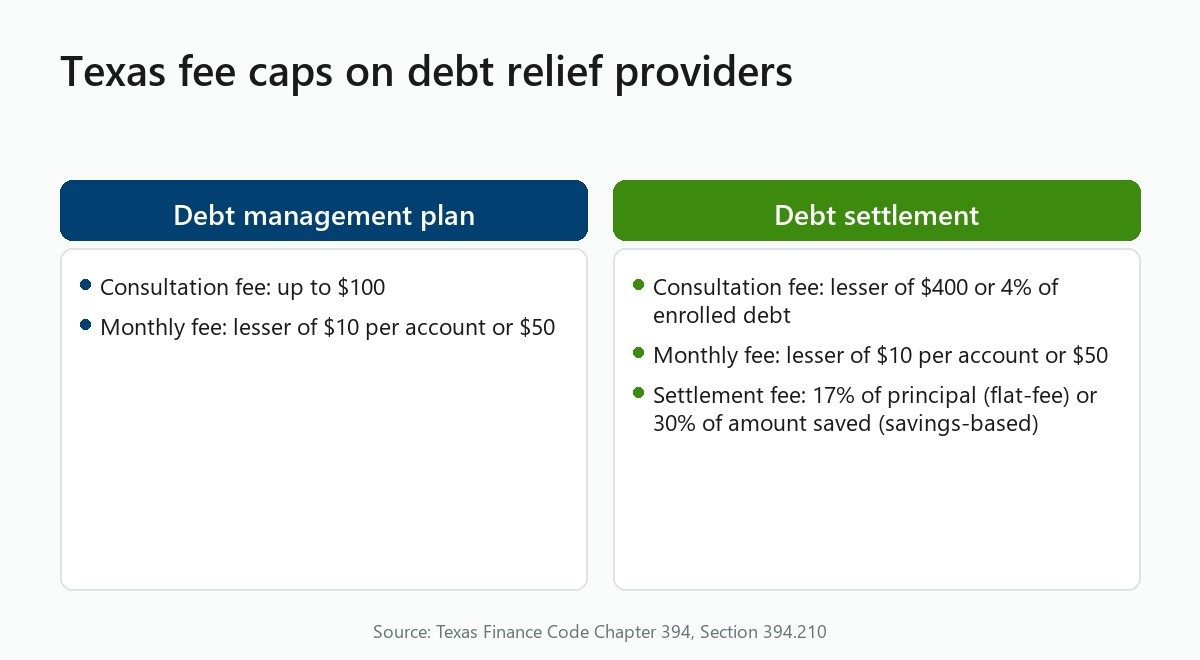
The fees are capped too, and the cap depends on which kind of plan you're in. For a DMP-style plan, the consultation fee can't exceed $100, and the monthly service fee is capped at the lesser of $10 per remaining account or $50.
For a settlement-style plan, the consultation fee is capped at the lesser of $400 or 4% of your enrolled debt, with the same $10-per-account, $50-max monthly service fee. The settlement fee itself follows one of two caps depending on the model the company uses: 17% of your total principal debt under a flat-fee model, or 30% of the amount actually saved, meaning what you owed minus what you actually paid, under a savings-based model (§394.210, same source).
Ask which model a company uses before you sign anything. The two produce very different bills on a large balance, and a company that dodges the question is a company you should walk away from.
Texas law also spells out what a debt management provider cannot do. It can't buy your debt, lend you money, take a security interest in your property, or offer you a gift or bonus for signing up. It can't claim legal authority it doesn't have without attorney supervision, and it can't engage in unconscionable, unfair, or deceptive practices, period (§394.212, same source).
It also can't collect a fee from you at all until you've signed a compliant agreement (§394.210(c), same source). If a company wants money before paperwork, walk.
Why Texas Law Changes the Calculus, and the Part Everyone Skips
What actually separates a Texas reader's decision from someone in Ohio or Georgia is one constitutional line. The Texas Constitution, Article 16, Section 28, says current wages for personal service can't be garnished, with two narrow exceptions: court-ordered child support and spousal maintenance.
Read that again. It says wages. Not debt. Not lawsuits.
That's a real protection, and few states offer as much. But I've sat across the desk from too many Texans who heard "no wage garnishment" and translated it in their head to "I'm untouchable." You're not.
That wage protection is state-specific. Beyond the child support and spousal maintenance exceptions the constitution itself carves out, federal collectors can still garnish wages for federal student loans and IRS tax debt regardless of what Texas says. And even for ordinary credit card or medical debt, the BBB complaints below show what can still happen: a creditor suing or attempting to garnish a debtor who had already enrolled in a debt relief program, wage protection notwithstanding.
Texas bars wage garnishment. It does not make you judgment-proof. Those are two different things, and mixing them up is the single most expensive mistake I've watched Texas borrowers make.
This isn't theoretical. A Texas consumer filed a BBB complaint against DebtBlue, a debt relief company in Richardson, saying the company claimed it could fix their credit issues, but a creditor garnished them anyway despite the consumer sending court paperwork and other documentation to try to stop it.
Another consumer filed a BBB complaint against American Debt Relief LLC in Plano, saying they enrolled in 2022 and finished making payments in December 2025. Then they received a court summons and a garnishment attempt from a creditor the company was supposed to have already settled with. The consumer reported that more than $6,000 had been sitting unsettled in the program's savings account for over a year.
As the consumer described it, they did everything right in a state with strong wage protections, and still ended up sued because a settlement company sat on their money. Wage protection didn't save them from a lawsuit. Nothing about Texas law was going to.
The one piece of good news that does hold up is your homestead. Under the Texas Constitution and Texas Property Code Section 41.002, an urban homestead is protected up to 10 contiguous acres, and a rural homestead is protected up to 200 acres for a family or 100 acres for a single adult who isn't otherwise entitled to a homestead.
Unlike states that cap the protection at a fixed dollar value, Texas puts no ceiling on how much your home is worth. The limit is acreage, not price. A judgment creditor generally can't force the sale of your homestead to collect on ordinary unsecured debt.
That's real leverage if you're weighing whether to fight a debt in court versus settle it fast out of fear of losing your house. In Texas, for most unsecured creditors, your house was never on the table to begin with.
How to Check a Provider Before You Sign Anything
Before you enroll with any debt settlement or debt management company operating in Texas, run this checklist:
- Confirm OCCC registration. Go to the OCCC's debt management and settlement providers page and use the ALECS Licensee Search tool to verify the company is currently registered, not just claiming to be.
- Ask which fee model they use, flat-fee or savings-based, and get the exact percentage in writing before you sign. The two caps produce very different totals on a large balance.
- Check their complaint history with the Better Business Bureau in the city where they're based, and actually read the complaints, not just the star rating.
- Confirm in writing that no fee will be charged before you've signed a compliant agreement. A company asking for money up front, before paperwork, is telling you something about how it operates.
- Ask directly where your money sits while you're enrolled and how often you can check the balance. In the American Debt Relief complaint above, the consumer reported that thousands of dollars sat unsettled in the program account for over a year with no one flagging it.
None of these steps is hard. A registered, bonded provider has something to lose if it mishandles your account; an unregistered one has nothing on the line but your money.
One more habit worth building: ask for a plain-language explanation of what happens to your account if the company itself shuts down mid-program. A registered Texas provider should have an answer ready. If the person on the phone can't tell you, that's a red flag worth treating as a dealbreaker, not a detail to sort out later.
Who Should Consider Which Path
Match the path to how far behind you actually are, not to which company called you first. A manageable balance with steady income usually points toward a nonprofit DMP through an accredited agency; a balance so far gone that a DMP payment isn't realistic is where settlement starts to make sense, with eyes open about the risk.
A DMP is usually the safer, more predictable route when you can commit to a steady monthly payment for three to five years. Your principal doesn't shrink, but your risk of a lawsuit stays low because you're still paying every creditor, just on better terms.
When settlement is genuinely your best remaining option, understand what you're signing up for. Confirm OCCC registration first, know your fee model going in, and go in clear-eyed that Texas's wage garnishment bar doesn't protect you from being sued while your settlement company works through your accounts one by one.
Frequently Asked Questions
Does Texas really not garnish wages for credit card debt?
Texas does not allow wage garnishment for credit card debt. The Texas Constitution, Article 16, Section 28, bars garnishment of current wages for personal service, with exceptions only for court-ordered child support and spousal maintenance. This protection covers wages specifically under Texas law and does not apply to federal debts like student loans.
Can a debt settlement company still sue me in Texas?
The settlement company itself typically won't sue you, but your original creditor or a debt buyer can, at any point while you're enrolled, even though your wages stay protected. Consumers who filed BBB complaints against DebtBlue and American Debt Relief LLC in Texas reported being sued or facing garnishment attempts while enrolled in a debt relief program.
Is my house safe if I stop paying credit cards?
In most cases, yes. Property Code Section 41.002 protects your home from forced sale by an unsecured judgment creditor, up to 10 acres in a city or town and up to 200 acres for a rural family, or 100 for a single adult.
How do I know if a debt relief company is legitimate in Texas?
Check its registration status through the OCCC's Licensee Search tool before enrolling. A legitimate provider will be registered, bonded, upfront about its fee structure, and won't collect a fee before you've signed a compliant agreement.