


You refreshed your credit app expecting a number, and there it is: 720. Your first reaction is probably relief. Your second reaction, if you're anything like most people I talk to, is "okay, but what does that actually get me?" That second question is the one nobody answers clearly, and it's the one that matters once you sit down to apply for a loan.
Most articles on this topic stop at the verdict. They tell you 720 is good, hand you a generic list of score-improvement tips, and send you on your way without ever showing you what that number actually does at the point of sale, whether you're signing mortgage paperwork, standing at a dealership finance desk, or clicking through a personal loan application. This one holds still on that comparison instead of rushing past it.
Yes, 720 is a good credit score. FICO's own band chart places 720 in its "Good" range, which runs from 670 to 739. You're not scraping by, and you're not at the top of the scale either.
You're solidly in the middle of the group lenders treat as low-risk, and that matters more than you might think once you compare a 680 score, a 720 score, and a 760-plus score against actual loan pricing.
Where 720 Sits on the FICO and VantageScore Scale
A 720 credit score lands in FICO's "Good" band, one tier below "Very Good" (740-799) and two tiers below "Exceptional" (800-850), according to FICO's own credit education page. The mortgage data later in this article is bucketed by FICO score, so this band chart is worth memorizing first.
FICO isn't the only scoring model out there. VantageScore tells a different story about the same number.
Equifax's published VantageScore 3.0 breakdown puts 720 in the "Very Good" tier, which covers 716 to 747. Under that chart, "Good" only goes up to 715, and "Excellent" starts at 748. Your 720 stayed the same number; the label attached to it is the only thing that changed between charts.
So which is it, Good or Very Good? Both, depending on which report you're looking at. FICO and VantageScore built separate models with separate cutoffs, and they never sat down to agree on where "good" ends and "very good" begins.
There isn't a tidy way to resolve that discrepancy. Just know that both labels are accurate and both show up on real credit reports. Whichever report you pulled to see your 720, the label printed on it simply reflects that model's cutoffs.
One more wrinkle worth knowing about: some lenders, especially auto lenders, layer their own risk-tier language (super prime, prime, near prime) on top of whatever score model they pull, and those tiers show up in the auto pricing data below. Keep that distinction in your back pocket, because it explains why a 720 sometimes gets treated the same as a 680 at the dealership, even though VantageScore's band chart labels a 680 "Good" and a 720 "Very Good."
720 vs. 680 vs. 760+: The Pricing Grid
What a 720 buys you across the three loan types most people shop for, personal loans, auto loans, and mortgages, comes down to the most recent sourced tier data for each. None of the three data sets isolates a clean 720 figure, so the numbers below are flagged exactly where they blur together and where they don't.
Personal Loans
Start here, because this is the product where the data is thinnest. As of August 2026, NerdWallet's tracked personal loan APR data showed an average of 14.70% for borrowers with scores of 720 and above, compared to 26.96% for borrowers under 630, which puts 720 in a much better pricing tier than someone rebuilding credit from scratch.
What it doesn't tell you is how a 680 or a 760 compares within that range. NerdWallet publishes "720+" as one broad tier, not broken into 680, 720, and 760 sub-bands. So if you're wondering whether crossing from 680 to 720, or from 720 to 760, moves your personal loan rate by a specific number of points, the publicly tracked data doesn't split it out that finely. Any individual lender's offer will vary, and the industry average simply doesn't isolate a clean 720 figure.
Auto Loans
The auto data tells a surprising story, the kind of thing that never makes it into the "720 is good" articles that stop at the verdict. Experian's State of the Automotive Finance Market report for Q2 2026 uses VantageScore 4.0-based risk tiers, which is worth flagging since your 720 might have come from a FICO report instead. Here's how the tiers break down:
- Super Prime (781+): 4.41% new-car APR, 6.29% used-car APR
- Prime (661-780): 6.15% new-car APR, 8.81% used-car APR
- Near Prime (601-660): 9.71% new-car APR, 13.93% used-car APR
- Subprime (501-600): 13.52% new-car APR, 19.10% used-car APR
- Deep Subprime (300-500): 16.11% new-car APR, 21.62% used-car APR
Source: Experian's automotive finance market report, cited above.
Notice where 720 lands. It's inside the "Prime" tier, which stretches all the way from 661 to 780. A 680 score sits in that exact same tier, and so does a 760.
Experian's own data doesn't break "Prime" into sub-bands, which means a 720 scorer and a 680 scorer are tracked at the same average auto rate. Neither one crosses into meaningfully cheaper territory until they hit 781, where "Super Prime" kicks in and the new-car rate drops from 6.15% to 4.41%.
That gap is the only rate jump left above 720 on an auto loan, and it lands at 781, a full 61 points above 720, which is a longer climb than most people expect when they hear that a 720 is already "good."
Mortgages
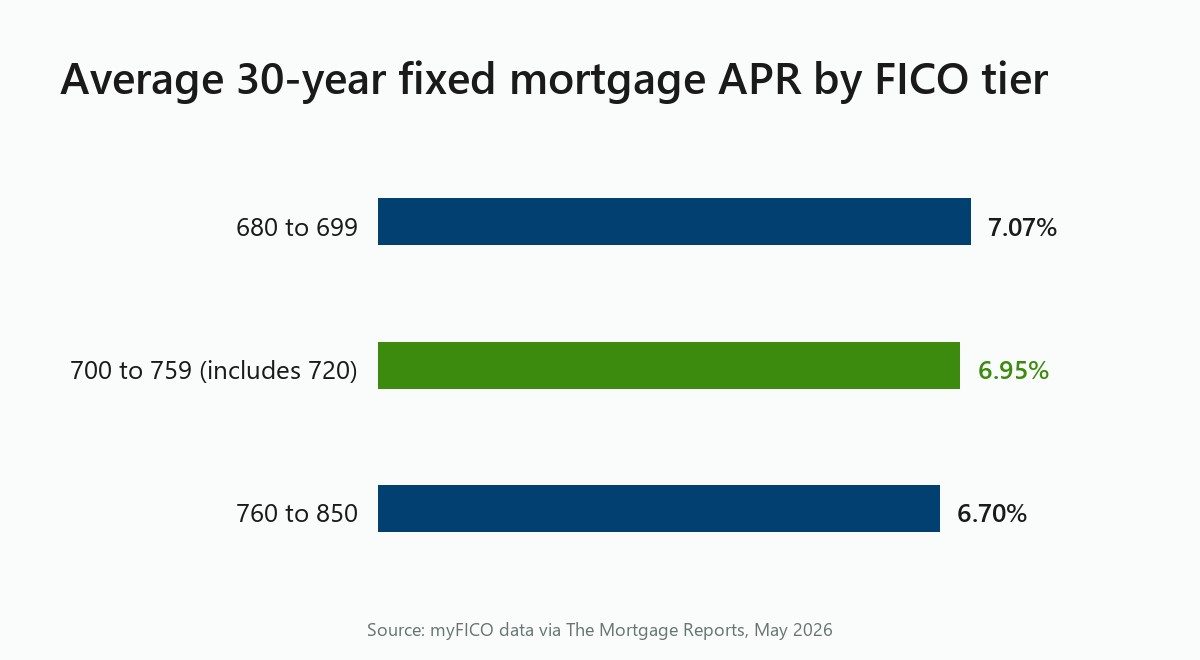
The mortgage data is the cleanest of the three, and it comes from myFICO's Loan Savings Calculator for a 30-year fixed conventional mortgage, reported via themortgagereports.com and dated May 2026:
- 760-850: 6.70% APR
- 700-759: 6.95% APR
- 680-699: 7.07% APR
- 660-679: 7.11% APR
- 640-659: 7.21% APR
- 620-639: 7.36% APR
Source: themortgagereports.com, citing myFICO.
A 720 falls inside the "700-759" band, right alongside a 705 score and a 750 score. myFICO's published tiers don't isolate 720 on its own, so a 720 borrower and a 750 borrower would show up at the same 6.95% average rate in this data.
What the table does show clearly is the shape of the curve around you. A 680 scorer averages around 7.07%. A 720 scorer averages around 6.95%. A 760-plus scorer averages around 6.70%.
Moving from 680 to 720 saves about 0.12 points of APR. Moving from 720 to 760 saves 0.25, twice as much. On a 30-year mortgage, that kind of gap adds up to serious money over the life of the loan, even though the monthly payment difference looks small enough to shrug off at first glance.
What a 720 Score Clears Easily
Put the pricing grid aside for a second and look at approval instead: 720 clears most of the common bars without much drama.
Most online and bank personal loan lenders set their prime pricing cutoffs well below 720, so approval itself is rarely the obstacle at this score. Auto financing works the same way: 720 lands you squarely in Experian's "Prime" risk tier, which means dealership and bank financing at prime rates rather than steeper near-prime or subprime pricing.
Mortgages follow the same pattern. A 720 clears typical minimum score requirements for conventional loans with room to spare, and it's generally enough to be considered for jumbo loan products too, assuming your income and assets check out. With a 20% down payment and a score above 720, you're also inside the group of borrowers mortgage lenders commonly advertise their "best rate" pricing to, even though you're not yet at the very top of that group.
None of these are the tightest squeeze at 720, because you're past the part of the scale where lenders start asking harder questions about whether to approve you at all. That question mostly gets asked of scores well below where you're sitting now.
Where More Points Still Buy You Something
So if 720 clears the door on all three products, is there still a reason to chase more points? Sometimes, and it depends entirely on which product you're financing next.
For a mortgage, crossing from the "700-759" band into "760-850" drops your average rate from 6.95% to 6.70%, a 25 basis-point improvement that compounds meaningfully across a 30-year term. Mortgage lenders commonly add pricing breakpoints at 740 and 760, as themortgagereports.com notes, which lines up with the sourced tier data: getting from 720 to 760 is the next real move on a home loan.
The math points somewhere else entirely for an auto loan. The Experian data shows almost nothing changes between 680 and 780, since both sit inside the same "Prime" tier. The real cliff is at 781, where you cross into "Super Prime" and the new-car rate falls from 6.15% to 4.41%.
If a car purchase is what's next on your list, obsess over 781 instead of 720. That gap is bigger than most drivers expect once they see it written out.
A personal loan gets you the same honest answer twice: the sourced data doesn't break out a specific next threshold above 720. NerdWallet's tracked average only confirms the broad "720+" tier at 14.70%.
Whether a 760 or 800 scorer gets a meaningfully better personal loan rate isn't something the publicly available tier data isolates. If that threshold exists, it hasn't shown up in the sourced tables yet.
Is Chasing More Points Worth It From Here?
More points are worth chasing or not depending on what you're financing next.
If a mortgage is on your near-term horizon, closing the gap between 720 and 760 is worth real effort. A quarter-point of APR on a home loan isn't pocket change once you multiply it across 30 years of payments.
Shopping for a car changes the math completely. Chasing a handful of points between 720 and 780 won't move your rate, because Experian's data shows the whole "Prime" tier gets priced the same. Your energy is better spent elsewhere unless you're within realistic striking distance of 781.
And if a personal loan is the goal, 720 already puts you in the best publicly tracked tier NerdWallet reports, so further climbing is more about long-term financial health than a guaranteed rate drop on this specific product.
If, after working through that, you've decided the climb toward 800 makes sense for your goals, we've written our full plan for climbing from the 720s to 800. This article was about what 720 already buys you today. That one walks through how to move higher, step by step.
It's also worth remembering that the dollar cost of credit score gaps isn't unique to the top of the scale. The same pattern plays out lower down too. If you want to see what a 100-point gap costs at the bottom of the scale, that comparison runs the same dollar math on a $15,000 loan at 580 and 680.
Frequently Asked Questions
Is a 720 credit score good enough to buy a house?
Yes. A 720 clears typical minimum score requirements for conventional mortgages, and myFICO's tier data shows it lands in the "700-759" band averaging 6.95% APR, compared to 7.07% for a 680 score. You're well past the point where approval itself becomes a concern for most conventional lenders, even though you're a step below the top rate tier.
Does a 720 credit score get a better car loan rate than a 680?
Not according to Experian's tracked data. Both scores fall inside the same "Prime" risk tier (661-780), which is priced the same on average across new and used car loans. The real rate improvement happens at 781, where "Super Prime" pricing begins and the new-car average drops to 4.41%.
Why does FICO call 720 "Good" while other sources call it "Very Good"?
FICO's own band chart places 720 in its "Good" range, 670-739. Equifax's published VantageScore 3.0 chart places the same number in "Very Good," 716-747. Both labels are accurate for their respective scoring models; they simply use different cutoffs. Which one you see depends entirely on which model your lender or credit app is pulling from.
What's the next credit score milestone after 720?
It depends on what you're financing. In myFICO's tier data, 760 is the next pricing breakpoint. For an auto loan, 781 is the threshold that unlocks "Super Prime" rates. For a personal loan, the publicly tracked tier data doesn't isolate a specific next threshold above 720.
Should I delay a loan application to improve my score first?
That depends on your timeline and which product you need. If a mortgage isn't urgent and you're close to 760, waiting could save real money over 30 years. For an auto loan or personal loan, 720 already clears what this article covers, so the case for delaying is weaker, unless you're close to 781.