


A $10,000 loan repaid over three years can cost a state employee anywhere from $952 to $6,487 in interest, depending on which of three products she signs, and most of that spread sits inside a single payroll-deduction lender's own credit-scored range. Same principal, same term, wildly different outcomes. Anyone shopping for a state employee personal loan should start with one question: why does the repayment method change the rate?
State and local government payrolls draw three distinct categories of lender, and each prices risk differently because each collects money differently. A state employee credit union lends to people it already knows through the employer relationship. A payroll-deduction, or "allotment," lender collects repayment before the paycheck ever reaches the employee's bank account. An ordinary unsecured personal loan lender gets none of that; it relies on an ACH debit the borrower could, in theory, walk away from.
Understanding that mechanical difference explains almost everything else in this comparison.
The Three Products State Employees Actually Get Pitched
Start with the credit union. State employee credit unions restrict membership to people connected to state employment, typically the employee, sometimes household members, and occasionally workers at "select employee groups" the credit union has added over time. North Carolina's State Employees' Credit Union (SECU) is the largest example of this model, and it requires a connection to NC state employment before anyone can even apply for membership, let alone a loan, according to SECU's own membership eligibility page. This is a closed-shop lender: it prices based on a member base connected to state employment, not the open market.
Next is the payroll-deduction lender, a category most borrowers have never heard of until a workplace flyer or benefits portal introduces them to it. Kashable is the clearest example: a specialty lender built specifically for government and public-sector employees, repaid through a voluntary payroll allotment set up at the employer's payroll office. Kashable discloses an APR range of 6.00% to 35.99%, loan amounts from $500 to $30,000, and terms of 6 to 36 months, with an origination fee example of $225 shown on a $5,000 loan, a cost that adds to the total cash outlay beyond the interest-only figures below. It advertises no prepayment penalty and operates in all 50 states plus DC and Puerto Rico, excluding West Virginia, though active-duty military members and their dependents are excluded from the product, per Kashable's government-employee lending page.
TrueConnect, now rebranded as BeneMoney, sits in the same category but with a different underwriting philosophy. It is an employer-sponsored, no-credit-check product used by public-sector employers such as cities, counties, and school districts, offered in fixed tiers of $1,000, $1,500, or $2,000 repaid over up to 12 months through payroll deduction. Its rate is commonly quoted around 24.99% APR, though the exact rate varies by the sponsoring employer's specific program. TrueConnect also advertises no prepayment penalty, and payments are reported to the credit bureaus, according to TrueConnect's own program description.
Third is the product most people default to without thinking about it: an ordinary unsecured personal loan from a bank, credit union outside the state-employee system, or online lender. Nothing about this loan knows or cares that the borrower works for state government. It underwrites on credit history, income, and debt-to-income ratio, the same as it would for anyone else, and it collects through a standard ACH debit that the borrower authorizes and can revoke.
Why Payroll Deduction Changes What a Lender Is Willing to Offer
Every lender's pricing model starts with the same question: what is the probability this loan does not get repaid? An ordinary personal loan lender answers that question using credit score, income verification, and debt ratios, then prices the uncertainty into the rate. A payroll-deduction lender answers a materially easier version of that question, because it has already engineered much of the default risk out of the transaction before the first payment is due.
How the FTC's wage-assignment rule makes it legal
Payroll deduction sounds, on first read, like wage garnishment, and borrowers are right to want to know the difference. The FTC's Credit Practices Rule bars a lender from taking a wage assignment as security for a loan unless the arrangement meets one of three conditions: it is revocable at the debtor's will, it is a payroll deduction plan commencing at the time of the loan transaction, or it is limited to wages already earned, under the FTC's Credit Practices Rule at 16 CFR 444.2. That structure is what separates a lawful, voluntary payroll-deduction loan from an involuntary wage garnishment ordered by a court.
Utah codifies a nearly identical standard in state law: a creditor there cannot take a wage assignment unless it is revocable at will, structured as a payroll deduction plan, or limited to wages already earned, per Utah's wage assignment statute. Several states add their own consumer protections around wage assignment on top of the federal floor, though the specifics vary by jurisdiction and a borrower should check her own state's consumer finance code before assuming any one rule applies.
What "near-guaranteed repayment" does to a lender's pricing
Once a lender knows the deduction happens before the borrower ever sees the paycheck, the actuarial math shifts. This is the same logic that lets employer-sponsored TrueConnect skip credit checks entirely and still offer a flat rate: the collection mechanism does more of the risk-reduction work that a credit score would otherwise have to do. Kashable, by contrast, still underwrites by credit tier and prices its 6.00% to 35.99% range accordingly, but it markets the payroll-deduction structure as the reason it can extend credit to near-prime and subprime government workers at rates well below payday or storefront installment lending. The mechanism still leaves risk on the table, but it lets the lender serve near-prime-and-below borrowers it might otherwise decline, because it is no longer betting entirely on the borrower's willingness to keep making a voluntary ACH payment every month.
Rate and Cost Comparison: $10,000 Over 3 Years, Three Ways
Numbers make this concrete. Run the same $10,000 loan over 36 months through each product type and the differences stop being abstract.
- Credit union average, 10.64% APR (NCUA): monthly payment $325.66, total of payments $11,724, total interest $1,724.
- General-market personal loan baseline, 12.42% APR for a 700 FICO borrower (Bankrate): monthly payment $334.14, total of payments $12,029, total interest $2,029.
- Payroll-deduction lender (Kashable-style), low end at 6.00% APR: monthly payment $304.22, total of payments $10,952, total interest $952.
- Payroll-deduction lender (Kashable-style), high end at 35.99% APR: monthly payment $457.98, total of payments $16,487, total interest $6,487.
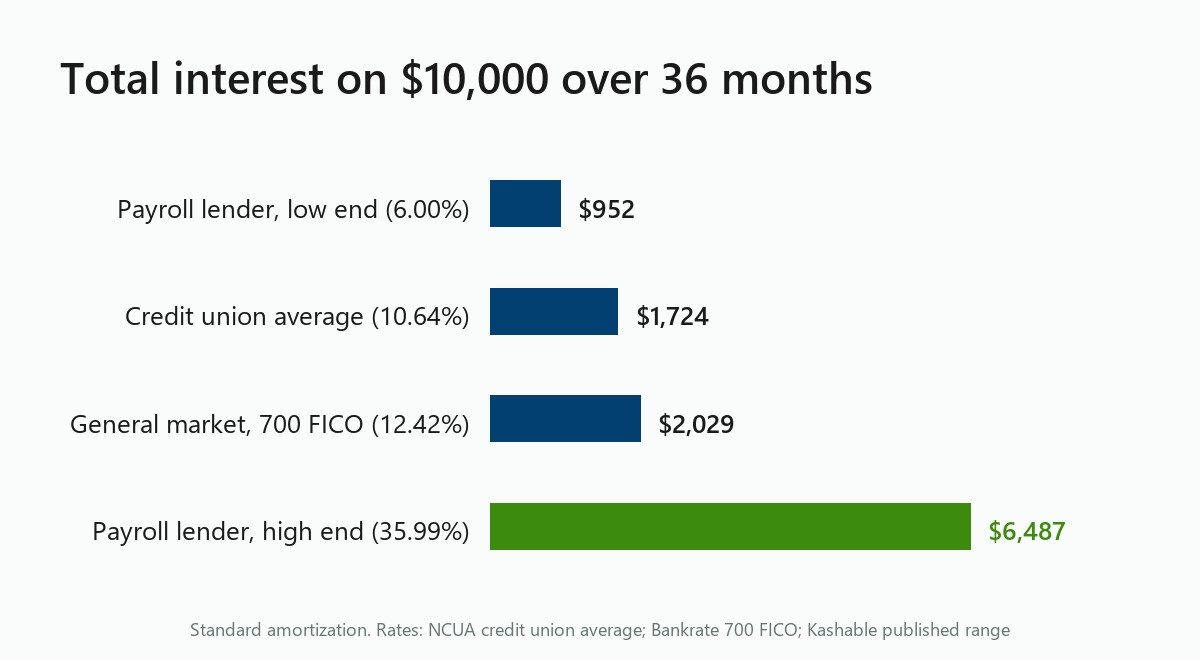
The credit union average of 10.64% APR against a 12.00% average at banks for the same 36-month unsecured term (NCUA) makes the membership-based model look like the cheapest reliable option, and for many borrowers it is. The Kashable range shown here works differently: it is a credit-scored spread, the same way any lender prices risk across a borrower pool, rather than one flat number every applicant receives. A state employee with strong credit could land near the 6.00% end and beat every other option on this list.
A borrower with thinner or damaged credit could land near 35.99% and pay more than triple what the credit union would have charged for the identical $10,000. The payroll-deduction structure widens the acceptance window; the price inside that window still swings hard on credit quality.
For readers who want the deeper mechanics of how credit unions price against banks generally, our comparison of credit union and bank personal loan rates covers that ground in more detail, and the step-by-step breakdown of how a personal loan moves from application to payoff is useful context for anyone comparing offers side by side for the first time.
State Employee Credit Unions: The Membership Catch
The credit union's pricing advantage comes with a gate most general personal loan shoppers never have to clear: eligibility. The 10.64% figure is NCUA's national average across all credit unions; this comparison does not have a verified rate for a state-employee credit union specifically. You cannot simply apply to SECU or a comparable state employee credit union the way you would apply to an online lender. Membership requires the qualifying connection to state employment, and that connection determines whether the credit union's rates are even available to you at all.
A regulatory nuance gets flattened in a lot of comparison content: federally chartered credit unions are capped by the NCUA's temporary 18% interest-rate ceiling on federal credit union loans, a cap that has been extended through September 10, 2027 (NCUA). That ceiling binds federally chartered credit unions specifically.
State-chartered credit unions, and SECU of North Carolina is the highest-profile state-employee example of a state charter, instead follow their home state's credit union act and usury rules, which can set a different ceiling than the federal one. A borrower assuming every state employee credit union operates under the same 18% federal cap is making an assumption the charter type does not support. Confirm the charter and the applicable rate ceiling before treating any credit union's advertised range as fixed.
Payroll-Deduction Lenders: The Legitimate Kind vs. the Kind to Avoid
Kashable and TrueConnect are both real, disclosed, named products marketed specifically to public employees, and both advertise no prepayment penalty. That last detail deserves attention, because it becomes the clearest diagnostic tool a borrower has when a less scrupulous version of this product shows up at a workplace benefits fair or in an unsolicited email.
Red flags specific to lenders targeting public employees
A handful of patterns separate a legitimate payroll-deduction offer from one worth walking away from.
- Guaranteed-approval marketing. A legitimate employer-sponsored, no-credit-check program like TrueConnect still verifies employment and sets fixed loan tiers; a product promising approval regardless of income or employment is sidestepping the underwriting process that legitimate lenders in this category disclose openly.
- Pressure to sign at the workplace. A legitimate program does not need a same-day signature during a break room pitch. Take the paperwork home.
- Marketing that leads with the per-paycheck deduction instead of the APR. Federal Truth in Lending disclosure rules require every dollar amount, the APR, finance charge, amount financed, and payment schedule, to be disclosed regardless of whether repayment happens by ACH or payroll deduction (TILA/Reg Z disclosure requirements). A pitch built around "just $40 out of every paycheck" and silent on the APR is designed to obscure a number the law already requires the lender to show you.
- A prepayment penalty. Both named lenders here advertise none; a lender that charges one should explain why.
- A wage assignment that fits none of the three FTC exceptions. Revocable at will, a payroll deduction plan starting at the time of the loan transaction, or limited to wages already earned: a clause that meets none of these three is not the lawful structure this article has described.
There is one more practical difference to know before signing anything: how you get out. Because a payroll-deduction loan is collected at the payroll or HR level, stopping or disputing it requires revoking the authorization with the employer's payroll office, or invoking the loan's own cancellation terms, not simply calling the lender. An ordinary personal loan's ACH debit works differently: a borrower can revoke that authorization directly with her own bank (12 CFR 1005.10).
That's a meaningfully different dispute path. Ask a payroll-deduction lender directly, before signing, exactly what the cancellation process looks like and how long it takes.
Who Should Pick Which Option
Each of these three products wins under a specific set of circumstances. A state employee who already qualifies for a state employee credit union and has decent credit should usually start there. The 10.64% national average across all credit unions (NCUA), though not a state-employee-specific figure, beats the 12.42% general-market baseline for a 700 FICO borrower (Bankrate) often enough to make clearing the eligibility hurdle worthwhile.
A borrower with thin, damaged, or rebuilding credit who does not qualify for competitive general-market pricing, and who wants a fixed, predictable structure, may find a payroll-deduction product genuinely competitive, particularly through an employer-sponsored, no-credit-check program like TrueConnect where one is offered, since that model does not price by credit tier the way Kashable does. TrueConnect's tiers top out at $2,000, so it fits smaller needs rather than a $10,000 loan. General-market personal loan rates vary widely by credit tier, and for a borrower priced poorly on the open market, the payroll-deduction mechanism can be the more affordable route rather than the more expensive one.
A borrower with strong, established credit and access to competitive general-market offers may find the ordinary personal loan route perfectly adequate, especially given the flexibility of an ACH-based repayment she can revoke directly with her bank rather than through a third-party payroll office. For anyone still shopping the general market, our rate-environment breakdown for where personal loan pricing stands this year is worth reading before locking in an offer, and our guide to spotting a personal loan scam covers red flags beyond the payroll-deduction category specifically.
Before signing anything with a payroll-deduction lender, ask payroll directly how cancellation works and how long it takes. That answer says as much about the loan as the rate does.
Frequently Asked Questions
What is a state employee personal loan?
A state employee personal loan usually means one of three products: a state employee credit union loan restricted to people connected to state employment, a payroll-deduction (allotment) loan repaid through the employer's payroll office, or an ordinary unsecured personal loan open to any qualified borrower.
Is a payroll-deduction loan the same as wage garnishment?
No. Wage garnishment is court-ordered and involuntary. A payroll-deduction loan is a voluntary arrangement the borrower authorizes, and under the FTC's Credit Practices Rule (16 CFR 444.2) it must be revocable at the borrower's will, structured as a payroll deduction plan starting at the transaction, or limited to wages already earned.
Can I qualify for a state employee credit union loan without working for the state?
Generally no. Membership at a state employee credit union such as SECU of North Carolina requires a connection to state employment, whether as the employee, in some cases a household member, or an employee of a select group the credit union has added.
How do I stop a payroll-deduction loan once it starts?
Because the deduction is set up through your employer's payroll office rather than a direct bank authorization, canceling it typically requires contacting payroll or HR to revoke the authorization, or following the loan's own cancellation terms, a different process than revoking an ACH debit directly with your bank (12 CFR 1005.10).
Are payroll-deduction loans cheaper than ordinary personal loans?
It depends on your credit tier. Kashable's disclosed range runs from 6.00% to 35.99% APR, which can beat or badly trail the general-market baseline of roughly 12.42% APR (Bankrate). Employer-sponsored programs like TrueConnect quote a flat rate commonly around 24.99% APR, though it varies by the sponsoring employer's program.