


You check your score after finally paying off that credit card, or maybe after a lender pulled it for an auto loan application you weren't expecting to need. The number staring back is 670. It feels significant, but you're not sure why. Is that actually good, or is it one of those numbers that sounds fine until a lender tells you otherwise?
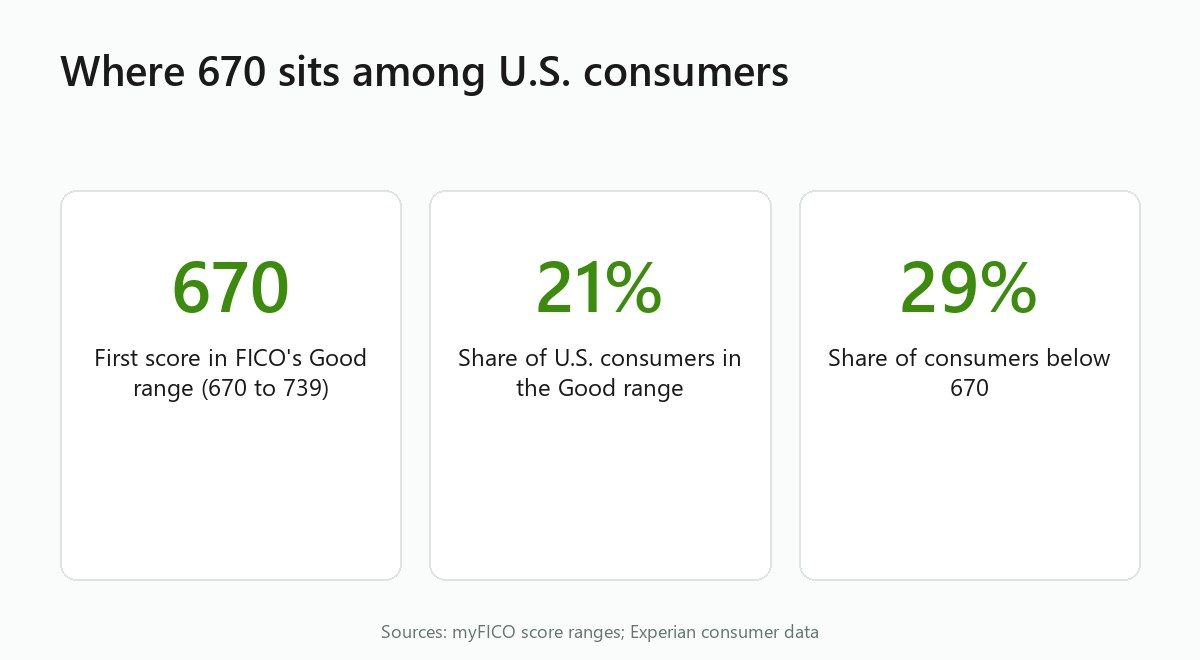
So, is 670 a good credit score? Yes. It's the exact number where FICO's "Good" tier begins. According to myFICO's official score ranges, the bands break down like this: Poor is below 580, Fair runs from 580 to 669, Good starts at 670 and runs to 739, Very Good covers 740 to 799, and Exceptional is 800 and above.
Land on 670, and you've crossed out of Fair and into Good, even if you're sitting right at the doorstep of that tier rather than deep inside it. That single-point boundary matters more than it looks like it should. A 669 and a 670 are one point apart, but they live in different categories entirely. Let's walk through what that actually means for you.
What Changes at 670 (and What Doesn't Yet)
Crossing into Good widens your options. It doesn't flip a switch that suddenly makes every lender roll out a red carpet. Experian's own consumer data describes borrowers with a Good score as "eligible for a broad variety of credit products, although they may not charge you the lowest-available interest rates." Read that twice, because it's the most honest summary of what a 670 buys you: access, alongside pricing that still has room to improve.
Think of it like clearing a minimum height requirement for a ride at an amusement park. You're in. You can get on. But being tall enough to ride doesn't mean you get the front seat.
Lenders reserve their sharpest rates and most flexible terms for scores well above 670, often in the Very Good and Exceptional tiers. Below 670, some lenders decline the application or route it to subprime pricing; at 670, you become a candidate for a broad range of credit products. That's a real shift, and it matters even before you climb any higher.
Picture two versions of the same loan application, filed by the same person at two different points. In the first version, the score sits at 655. The application is more likely to be declined or routed to subprime pricing.
In the second version, after a stretch of on-time payments and lower balances, the same person applies with a 670. More lenders are willing to underwrite the loan at all, and some of them price it through their standard tier instead of their subprime one. The exact lenders, the exact pricing tiers, and the exact terms all vary by institution. The direction of the shift, from fewer options to more, from automatic subprime routing to a real shot at standard pricing, is what crossing 670 tends to buy a borrower.
Context helps here too. Experian reports that 21% of U.S. consumers fall into the Good range, and 29% of consumers sit below 670 entirely. So a 670 already puts you ahead of nearly a third of the country.
It also helps to know that the national average FICO Score sits in the low 700s, per FICO's own research. That means a 670 is technically below average while still belonging to the same Good family as that average score. You're not behind in the way it might feel. You're early in a tier, not stuck outside one.
Why 660 and 670 Aren't Interchangeable
This is the part most explainers skip, and it's the piece that actually explains why two scores ten points apart can get treated so differently. A 660 sits in FICO's Fair range. A 670 sits in Good.
FICO drew its own line at exactly 670, so the two scores sit in different categories. A card issuer or lender that markets a "good credit" product is, by definition, excluding everyone at 669 and below. That single point separates who gets automatically considered from who gets a closer look, or no look at all, depending on how strictly a given product enforces its own marketing language.
Here's the nuance worth sitting with: the 670 cutoff belongs to FICO, not to any individual lender. Banks, credit unions, and online lenders build their own internal risk-pricing tiers, and those tiers don't have to line up neatly with FICO's public labels.
One lender's underwriting model might treat 660 and 670 almost identically. Another might use 670 as a hard cutoff between its standard-rate bucket and its subprime bucket. A third might set its own threshold somewhere else entirely, based on its own loss data.
The clearest way to frame it: crossing 670 can move you from a lender's declined or subprime pricing bucket into its standard pricing bucket, though the exact cutoff varies by lender and product. There's no single, universal rate table that applies to everyone at 660 versus everyone at 670.
What you can count on is that the number itself carries recognized weight because it's FICO's own boundary. Products marketed to "good credit" borrowers use FICO's line by definition, even when a lender's internal pricing math differs. If you want to see what a score gap can cost in real dollars on an actual loan, rather than in abstract terms, an article on this site walks through what a lower score costs on a real loan, using a $15,000 loan as the working example.
What About Deposits for Utilities and Phone Plans?
If you've ever set up a new utility account or signed up for a phone plan, you may have wondered whether your credit score determines your deposit. It's a fair question, and the real answer is more specific than most people expect.
Utility and telecom companies generally don't pull your FICO score to decide whether you need to put down a deposit. Instead, many of them rely on a specialty report from the National Consumer Telecom and Utility Exchange, commonly known as NCTUE. NCTUE's own consumer information describes this as an industry data exchange built specifically from utility and telecom payment history, not a general credit score.
That distinction matters because your 670 credit score, while relevant to a mortgage lender or a credit card issuer, isn't necessarily the number a utility company is looking at when you sign up for service. Deposit requirements vary by provider and by state, and there's no single, verified score threshold that determines whether you'll be asked for one.
If you're trying to avoid a deposit, a clean utility and phone payment record at a previous address is what an NCTUE report reflects, even if you don't think of it as "credit." That record can carry weight with a new provider in a way your 670 score alone doesn't capture.
This is a useful thing to know if you're moving or switching providers and want to prepare ahead of time. Some readers may be able to request their own NCTUE report to see what a utility or telecom company will find, rather than guessing based on their FICO Score alone. It's a small distinction, but it saves people real confusion: a Good FICO Score doesn't guarantee a deposit-free setup for electricity or internet, and some providers ask for one anyway. Knowing that a separate system is often doing the evaluating means you're not left wondering whether your credit-building efforts somehow failed to register.
How to Hold 670 Once You're There
Reaching Good is one thing. Staying there is another, especially if you're sitting close to that 670 line rather than comfortably inside the tier. A few slips, a missed payment or two, or a spike in how much of your available credit you're using, and you can drift back into Fair without realizing it happened.
What actually keeps a score anchored where you've earned it:
- Pay on time, every time. A late payment can set back progress you've worked hard to build, so this is the non-negotiable habit.
- Keep your credit utilization low. How much of your available revolving credit you're using matters a lot. Paying balances down before your statement closes, rather than just before the due date, is one way to keep the reported balance lower.
- Let old accounts stay open. Closing your oldest credit card might feel like tidying up, but it can shorten your credit history and raise your utilization ratio at the same time. Neither helps you.
- Space out new credit applications. Each hard inquiry can ding your score slightly, and opening several accounts in a short window signals risk to lenders, even if you're managing the credit responsibly.
- Check your credit reports for errors. A wrongly reported late payment or an account that isn't yours can quietly drag a Good score back toward Fair.
This vigilance matters more at 670 specifically than it would at, say, 760. Experian's data on the Good tier shows that roughly 9% of consumers with Good FICO Scores are likely to become seriously delinquent in the future, and 65% of people currently sitting at 670 already have a late payment of 30 or more days past due somewhere on their credit report.
That second figure describes the population at 670 today, not a prediction about any individual person, but it's a useful reminder that a lot of people land in this exact spot after a rough patch, not a clean track record. If that's you, the tier itself doesn't erase what came before it. Consistency going forward is what keeps you from sliding back, and it's also what eventually pulls those older marks further into the past, where they carry less weight.
This is also why utilization tends to matter so much for someone sitting right at 670. A past late payment sticks around, but utilization is something you can act on right now. Bringing a maxed-out card down to a smaller share of its limit is one lever you can act on right away, useful for someone trying to protect a score that's still close to the Fair boundary rather than well inside Good territory.
For a more concrete plan of attack, three moves that can raise your score in 60 days lay out specific actions you can take in a short window, whether you're trying to protect 670 or push meaningfully past it.
What's Next After 670
Once you've settled into Good, the next milestone worth aiming at is Very Good, which starts at 740, and eventually Exceptional at 800. The climb from the low 700s to 800 involves the same fundamentals that got you to 670 in the first place: consistent on-time payments, low utilization, and patience with how long your credit history has had to build. If you're already thinking that far ahead, what it takes to go from good to exceptional breaks down that next stretch in more detail.
And if 670 isn't quite where you're standing yet, and you're closer to the Fair range just below it, the gap isn't as far as it can feel. The difference between the two tiers often comes down to a few fixable habits rather than some enormous overhaul. If you're earlier still, not sure what your score even started at or how it was built in the first place, this site also covers what your score looks like before you've built any history.
Frequently Asked Questions
Is 670 a good credit score for a car loan?
Experian describes Good-tier borrowers as eligible for a broad variety of credit products, though not necessarily at the lowest rates. An auto loan falls within that range, but pricing depends on each lender's underwriting, so two people with the same 670 score can still see different offers from different dealerships or credit unions.
Is 660 a good credit score?
Not by FICO's own classification. A 660 falls in the Fair range, which runs from 580 to 669, just below the Good tier that starts at 670. It's close, but it sits in a different category, and some lenders and credit products specifically market themselves around the Good threshold.
What credit score is considered good?
According to myFICO's official bands, a Good score falls between 670 and 739. Below that is Fair, covering 580 to 669, and above it is Very Good, from 740 to 799, followed by Exceptional, from 800 to 850.
Can I get approved for a credit card with a 670 score?
Generally, yes. A 670 score opens up access to a wider range of credit card products than a Fair score would, though the most rewarding cards and lowest rates tend to go to applicants with higher scores.
Does a 670 credit score affect getting utilities or a phone plan without a deposit?
Not directly in most cases. Utility and telecom providers commonly rely on data from the National Consumer Telecom and Utility Exchange rather than your FICO score to decide on deposit requirements, and those requirements vary by provider and by state.