


You're about to open your first credit card, and your cousin, the one who "knows about this stuff," tells you the same thing everyone hears: you start at 300. Rock bottom. The worst possible score, just waiting for you to climb out of it. It sounds official enough to believe. It's also wrong, and the real answer to what credit score you start with is more encouraging than the myth.
You don't start at 300. Zero doesn't apply either, at least not in the way most people picture it. What you actually start with is nothing to score at all, a completely different situation than starting low. Once you understand why, the whole process of building your first credit file stops feeling like a punishment and starts looking like exactly what it is: a data problem with a straightforward fix.
Picture opening your bank's app the week after you turn eighteen, curious what your score looks like. Instead of a number, you get a message along the lines of "not enough information to generate a score." You might even refresh the page, half expecting it to be a glitch, because a blank field feels more like an error than an actual answer. That blank space confuses a lot of first-time borrowers, because it doesn't match the story they were told. Nobody handed you a bad grade. The system simply has nothing to grade yet.
Myth 1: Everyone Starts at 300
Here's what's actually true: before you've opened any credit accounts, you don't have a bad score. You don't have a score at all. Scoring models like FICO don't hand out a placeholder number to people with empty files. There's simply nothing yet for the math to work with, no payment history to review. A score requires data, and a brand-new consumer hasn't generated any. A scoring model has no interest in guessing at a low number on your behalf; it simply waits until there's something real to calculate. Think of it less like a report card and more like a form that can't be filled out yet, because none of the boxes have anything to go in them.
This condition has a name: credit invisibility. The Consumer Financial Protection Bureau (CFPB) has tracked it for years, and the number most articles still repeat is old. The CFPB's own credit-invisibles research page still carries the older estimate of roughly 26 million adults, meaning they had no credit file at any of the three major bureaus.
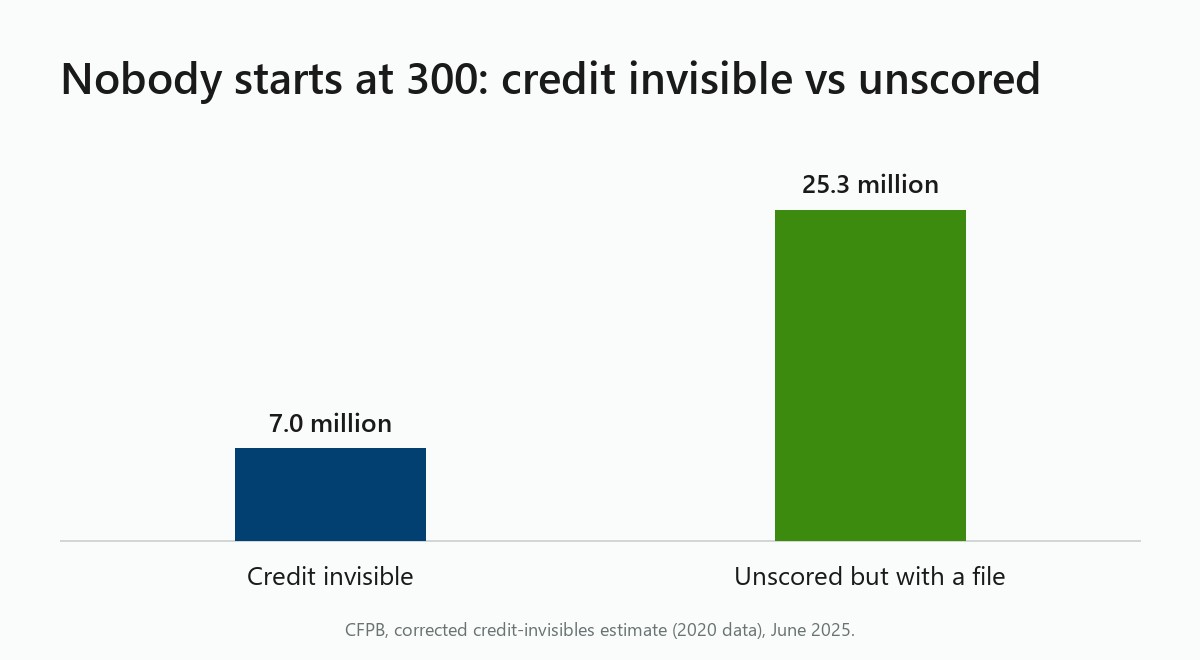
The correction landed in July 2025. The CFPB issued a correction after tracing the original overcount to a methodology error, one that had accidentally excluded records containing only deferred student loans, collections, or closed accounts from the count. Using 2020 data, the corrected estimate puts true credit invisibility at roughly 7 million adults, about 2.7% of the U.S. adult population. A separate group of 25.3 million adults, about 9.8%, falls into a different category the CFPB calls "unscored": people who do have a credit file, just one too thin or too old to generate a score.
That distinction matters more than it sounds like it should. Credit invisible means no file exists yet, anywhere. Unscored means a file exists, but the scoring model can't do anything with it. Either way, you land in the same practical spot as someone who's never applied for anything: no number to show a lender. And almost none of the older articles still ranking for this topic have caught up to the corrected 2025 figures. Most repeat the outdated 26 million estimate as if nothing changed.
Myth 2: You're Stuck With Bad Credit Until You Fix It
This one trips up a lot of first-time borrowers, and it's an easy mix-up to make. Having no credit file gets lumped in with having bad credit, as though they're variations on the same problem. They aren't.
Bad credit means a lender can see your history, and what it sees gives them pause: missed payments, high balances, a collections account. Fixing that takes time, because you have to outweigh a negative record with a better one. No file means there's no history to see at all, negative or otherwise. A lender pulling your report gets back an empty page, not a red flag.
That's actually the easier problem to solve. Nobody has to talk you out of a habit you don't have. You just need enough activity, reported consistently enough, for a scoring model to have something to calculate. This article stays focused on exactly that step, getting your first score to exist. If you're working through an already-low score instead, that's a separate process with its own playbook.
How FICO's Minimum Scoring Criteria Creates Your First Score
So what turns an empty file into an actual number? For FICO, the model this article focuses on, the rule is specific and worth knowing in plain terms. Your file needs at least one account that's been open for six months or more, and at least one account that's been reported to a credit bureau within the past six months, before FICO can generate a score. A single account can satisfy both conditions at the same time.
Read that again, because the six-month wait is often shorter in practice than it sounds. Six months of an account simply existing and reporting is the whole test. Perfect behavior and a savings balance are not part of it. Open a secured card today, use it, pay it on time, and let it report to the bureaus, and you're on track to clear FICO's threshold around the half-year mark.
Not every scoring model runs on the exact same clock. Some scoring models can generate a score sooner than FICO's six-month window under the right conditions, though the specific criteria vary by model and lender. FICO's six-month rule is the stricter requirement, so it's the one worth planning around.
Worth knowing where this rule actually comes from. No law dictates when your first score has to appear. The six-month threshold is FICO's own model design, a data requirement built into how the math works. That distinction matters because the timeline runs on your account activity, and nobody needs to grant you permission or approval to clear it. That's genuinely good news if you've ever worried you were somehow behind or doing something wrong just by not having a file yet. You weren't behind. You just hadn't generated data yet.
The "reported within the past six months" half of the rule deserves its own note, because it trips people up. An account doesn't just need to exist, it needs to be actively sending updates to the bureaus. If a card issuer or lender stops reporting, or if an account goes dormant, that account can stop counting toward your score even though it's technically still open. Using an account regularly, even lightly, keeps that data flowing.
What Your First Score Is Likely to Look Like
Here's where a lot of first-timers brace for the worst, and there's genuinely no fixed number anyone can promise you. No regulator or scoring company publishes a guaranteed starting score, and any article that hands you one exact figure is guessing. That uncertainty can feel unsatisfying if you were hoping for a clean number to write down, but it's the honest answer, and honesty beats a made-up figure you'd only be disappointed by later. What's fair to say is this: your first real score is unlikely to land at the bottom of the range.
Think about what the score is measuring. Two of the biggest factors in FICO's model are whether you've paid on time and how much of your available credit you're using. A brand-new file has zero missed payments, because there's been no time to miss one. If you're keeping your balance low relative to your limit, that also works in your favor from day one. Length of credit history matters too, but it carries far less weight than payment behavior and utilization, so a short history doesn't sink you the way a poor payment record would.
Put those pieces together and a first score commonly lands somewhere in the middle of the range, not at the extreme low end. It won't rival someone with fifteen years of spotless credit, but it also isn't the disaster the 300 myth implies. From there, the same habits that got you a starting score, on-time payments and low utilization, are what push it higher over time.
Two accounts with identical ages can still score differently, which is why a promise of a single starting number would be dishonest even if it were tempting to give one. Someone who opens a secured card and lets the balance climb close to the limit is telling the scoring model something different than someone who opens the same card and keeps the balance low. Both people clear the six-month threshold at the same time. Only one of them is doing it in a way that reflects well on the file. That gap carries a real dollar cost, one Cashzella breaks down in What 100 FICO Points Really Cost on a $15,000 Personal Loan.
The Fastest Legitimate Ways to Get Your First Credit Score
If you don't have a file yet, a few well-worn paths get you there faster than waiting for something to happen on its own. Each of these starts the six-month clock; none of them shortens it.

Secured credit cards
A secured card works like a regular credit card, except you put down a cash deposit that typically sets your credit limit. You use it, pay it off, and the issuer reports your activity to the bureaus just like any unsecured card. Most issuers begin reporting a new account fairly quickly once it's open, and on-time use is what starts building the payment history a scoring model needs. Keep the balance low and pay on time, and this is one of the fastest legitimate routes from no file to first score. It behaves like training wheels for a regular credit card, minus the risk of overspending money you don't actually have.
Credit-builder loans
This one flips the usual borrowing order. Instead of getting the money upfront, you make fixed payments into a locked account, and the lender releases the funds once the loan term ends. Every payment gets reported to the bureaus along the way, which means you're generating on-time payment history from month one, even though you don't have access to the cash yet. Terms vary by lender, so it's worth comparing a few before committing. Credit unions and community banks often make this an approachable first product for someone starting completely from scratch.
Becoming an authorized user
If someone you trust, a parent or a spouse, has a credit card in good standing, they can typically add you as an authorized user without you ever touching the card. Depending on the issuer, that account's history can begin showing up on your credit file relatively quickly once you're added. It's worth having an honest conversation with them first, since their card habits are about to become part of your file too. This only helps if the primary cardholder actually pays on time and keeps balances low. An authorized-user account with a history of late payments or maxed-out balances can drag your file down instead of building it up, so choose carefully who you ask.
What to Avoid While You Build Your File
Having no credit history makes you a target, and it's worth naming that plainly. Ads promising a "CPN," or credit privacy number, marketed as a way to skip the wait and start with a clean slate, are not a legitimate credit-building tool. Treat any offer like this as a red flag rather than a shortcut, and be cautious of anyone charging a fee to "fix" a file that isn't broken, just empty. If a stranger online is selling you a fresh identity number instead of teaching you how credit actually works, that's your clearest sign to walk away.
It's also worth pacing yourself once you start applying. Opening several new accounts in a short window can work against you, since each hard inquiry and each brand-new account resets part of what a scoring model is trying to measure. One or two well-chosen accounts, used consistently, will get you to a first score faster than a stack of applications submitted all at once.
Once your first score exists, the next questions are usually about raising it and getting your file ready before you apply for something bigger, like a personal loan. Cashzella covers both of those separately: Three Proven Moves to Raise Your Credit Score in 60 Days for building on the score you just earned, and A 14-Day Plan to Get Your Credit Loan-Ready for prepping that file before an application. If you're wondering whether comparing loan offers dings the file you just built, Will Shopping for Personal Loan Rates Hurt Your Credit? explains what actually happens.
Frequently Asked Questions
Does everyone start at 300?
No. A score of 300 is the bottom of the FICO range, reserved for files with a troubled payment history, not the default starting point for a new borrower. Before you open any credit accounts, no score exists for you at all, since scoring models need account history to calculate a number.
How long until I have a credit score?
Under FICO's published minimum scoring criteria, your file typically needs at least one account open for six months or more and reporting to a bureau within the past six months. Some other scoring models may generate a score sooner, but the six-month mark is FICO's own threshold for calculating a score at all.
Can I have a credit score with no credit card?
Yes. Any account type that reports to the credit bureaus can build a file, including credit-builder loans, certain installment loans, and authorized-user status on someone else's card. A credit card is one common path, not the only one.
What's a good first score?
There's no single guaranteed starting number, and any source that gives you one exact figure is speculating. What's realistic is that a first score commonly lands in the middle of the range rather than at the very bottom, since a new file has no missed payments working against it and often carries low utilization from the start.