


You already pay your bills on time. Your utilization sits somewhere reasonable, and your score is parked in the 720s, maybe closer to 750 on a good month. Lenders already call that "good" or even "very good." So why does 800 keep showing up in your head anyway? If you're searching for how to get an 800 credit score, you're not fixing something broken. You're chasing a ceiling, and you want to know whether the climb is actually worth it.
It's a fair question, and most articles on this topic never really answer it. They hand you five generic tips (pay on time, keep utilization low, don't close old cards) and call it a plan, as if someone hovering around 740 needs to be told what "on time" means. You don't. What you need is the honest version: exactly what separates a 720-750 file from an 800-plus file, what it actually takes to close that gap, and where the payoff for closing it starts to flatten out.
What Separates a 720 File From an 800-Plus File: The FICO Score Factors Breakdown
FICO publishes the exact weights behind its most widely used score, and they're the clearest map of where an 800 file earns its edge over a 740 file: payment history (35%), amounts owed (30%), length of credit history (15%), new credit (10%), and credit mix (10%). Nothing about income, savings, or net worth factors in. The score only reads your credit file.
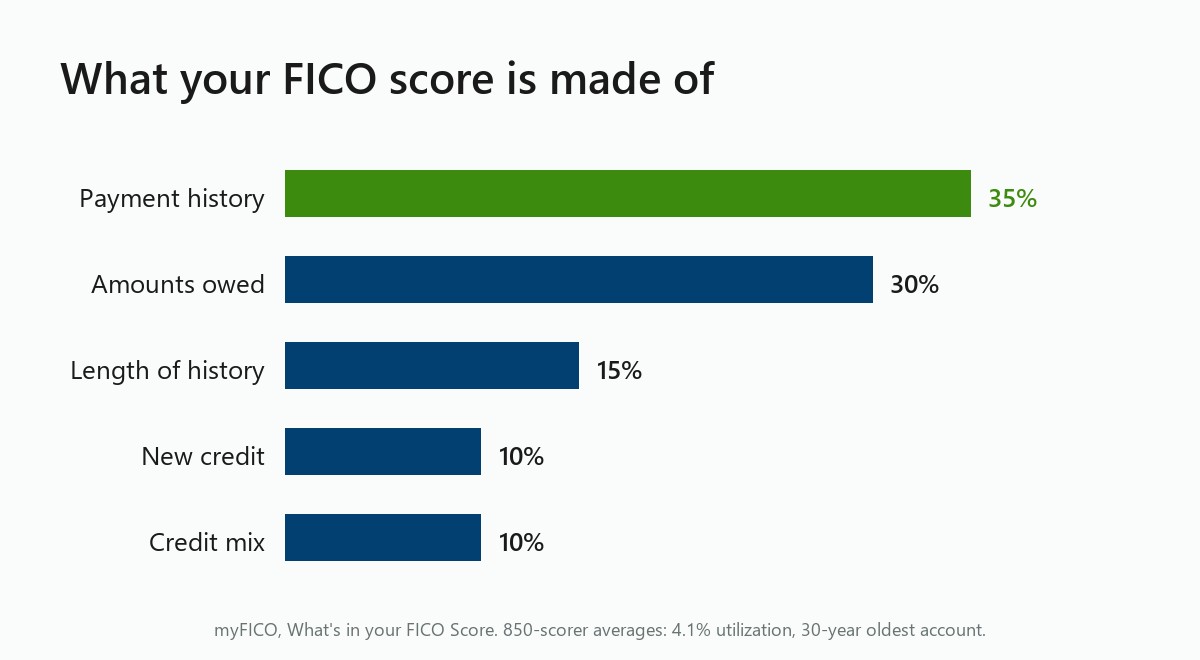
Payment history (35%)
This is where the gap starts. FICO's own study of people holding a perfect 850 score found zero late payments, zero collections, and no other derogatory marks anywhere on file. That's the 850-specific profile, not a blanket rule for every 800-plus scorer, but it points at the same target: an 800-plus file is almost always a file with nothing negative reported, for years at a stretch.
Amounts owed: credit utilization for an 800 score (30%)
The same study found people at 850 carried an average non-mortgage revolving utilization of just 4.1%, with average non-mortgage balances around $13,000. You don't need your utilization at zero. You need it consistently low, ideally under 5%, on every statement that actually gets reported, rather than only the one right before you apply for something.
Length of credit history and average account age (15%)
Here's the part no amount of effort can rush. In that same 850 profile, the average age of the oldest account on file was 30 years. That's the top of the scale rather than a minimum bar for 800. It tells you how much file age compounds. The account you keep open at 22 is quietly working for your score at 45.
New credit and inquiries (10%)
In the 850 profile, about 25% of people had opened a new account in the prior year, and about 10% had a hard inquiry on file in the prior 12 months. A single hard inquiry typically costs fewer than five points on a FICO Score, and its effect on the score fades within a few months even though the inquiry itself sits on your report for two years, since only inquiries from the last 12 months actually count toward the calculation. Rate shopping for one mortgage, auto loan, or student loan gets bundled into a single inquiry as long as you complete the shopping inside a window of 14 to 45 days, depending on the FICO version a lender uses. We've broken down that rate-shopping window in more depth elsewhere, including how soft pulls differ from hard ones, if you want to see exactly how it gets scored before you go loan shopping.
Credit mix (10%)
Credit mix rewards carrying a couple of different account types (a card and an installment loan, say) and managing both well over time. It's tied for the smallest lever of the five, and it's not one you should force by opening accounts you don't need.
One more thing worth knowing before you build a plan around FICO's exact percentages: VantageScore, the other major scoring model, doesn't publish exact weights the way FICO does. It ranks factors by influence instead. Payment history is "extremely influential," age and depth of credit plus credit utilization are both "highly influential," total balances are "moderately influential," and recent inquiries plus available credit are "less influential". The order looks similar to FICO's. The math behind it does not, so don't assume a FICO percentage carries over to a VantageScore-based score a lender might pull instead.
The Multi-Year Habits That Build Those Numbers
None of the factors above move on a 30-day or 60-day schedule. If you need something faster, that's a different article, and this site has two: one walks through tactical moves to raise your score in 60 days, and another covers prepping a file in the 14 days before a specific loan application. Read those if you're applying soon. This piece is about what happens in the years after that work is already done.

The habits that build an 800-plus file over time are less about clever tactics and more about consistency you stop thinking about. Pay every account, every month, without exception, because payment history carries the heaviest weight of any FICO factor and one 30-day-late mark undoes months of good behavior. Keep utilization low across every statement cycle instead of only the week before you apply for something, since balances get reported on a schedule you don't control. Let old accounts stay open, even ones you rarely use, because closing them can shorten your average account age and shrink your total available credit at the same time. Space out new credit applications instead of opening several accounts in a short window. Keep a mix of account types already open rather than adding one purely to check a box.
Does an 800 Credit Score Matter Above 760?
Here's where most "how to get 800" content goes quiet, because the honest answer undercuts the whole premise of the article. FICO's own team has said as much directly, in the same 850-score profile study cited above: creditors typically extend their best terms once a consumer reaches the "upper 700s and higher," and a score of 800, not 850, is usually enough for the best offers a lender has on the table. That's FICO describing its own scoring model's real-world effect, not a guess.
That distinction is worth sitting with, because it's the whole argument. If creditors already extend their best terms once a consumer clears the upper 700s, then most of what an 800-plus score is supposed to unlock has already been unlocked well before you get there. You're not opening a new door. You're double-checking one that was already open.
Compare that to what happens at the bottom of the scoring range. We've broken down separately what the gap between a 580 score and a 680 score costs on a $15,000 personal loan, and the dollar difference there is real money. Up in the high 700s and 800s, that dollar gap mostly disappears. You aren't unlocking a cheaper rate at that point. You're confirming one you likely already had access to.
Consumer finance commentator Clark Howard has made a version of this argument publicly, saying that chasing a score much above 760 is close to pointless because that's roughly where most lenders' best terms are already unlocked. That's one commentator's opinion, not a bureau finding or a data point, though it lines up directionally with what FICO itself says about where best terms kick in. You'll also see similar sentiment floating around on personal finance forums, anecdotally at least, where people already sitting around 760 to 770 ask whether it's worth pushing further, and the recurring reply from other posters, as far as that can be observed, tends to be to redirect that energy toward paying down debt or building savings instead.
There's also a demand-side reason this question keeps coming up more often. FICO's Spring 2026 Credit Insights Report found a record 48.1% of consumers now score 750 or higher, even as the national average score fell to 714, a two-point year-over-year decline that ended an 11-year streak of stable-to-rising averages, driven mainly by resumed student loan delinquency reporting and rising mortgage delinquencies. More people are clustering near the top of the scoring range at the exact moment the broader population is drifting slightly lower, which is likely part of why so many people already sitting comfortably in "good" territory start wondering what 800 would actually get them.
So does it matter? For lending purposes specifically, once you're solidly in the upper 700s, the honest answer is barely. What an 800-plus score still buys you is less about rate and more about cushion. It's a wider margin before a missed payment, a maxed card, or a rough year knocks you back down into a tier that does cost you money. That's worth something. It just isn't worth chasing for the rate alone.
What Can Knock a Very Good Score Back Down
A score in the high 700s or 800s isn't armored. The same factors that build it can unwind it just as fast. A single new derogatory mark, a late payment, a collection, a charge-off, does real damage even at a high starting score, since payment history carries the most weight of any FICO factor. Closing an old account can quietly raise your utilization ratio and shorten your average account age at the same time, both of which work against you. Taking on new debt or opening several accounts in a short window adds inquiries and lowers your average account age further. None of these are exotic mistakes. They're the same five factors working in reverse, so protecting an 800-plus file takes the same discipline as building one.
A Realistic Timeline for an 800 Credit Score From the 720s
There's no single verified number of years this takes, and any article that hands you one specific figure is guessing. What the factors themselves tell you is the shape of the timeline, not its exact length. Utilization can drop in a single billing cycle. A hard inquiry's effect fades within months. Payment history and file age don't work that way. They need a long, unbroken stretch of on-time payments and an account that keeps aging, and neither of those can be rushed no matter how well you manage everything else in the meantime.
That 30-year average oldest-account figure from the 850 profile isn't a target you need to hit. It's a reminder that even the very top of the scoring range reflects decades of an account just sitting there, aging, while its owner paid on time and moved on with their life. Your own timeline depends entirely on your starting file: how old your accounts already are, how clean your payment record already is, and how much room your utilization already has to shrink.
Building the Habit That Makes 800 Feel Inevitable
If you're reading this at 730 or 745, you already have the hard part done. Most of the gap between where you sit now and 800 closes itself if you keep doing what got you here: on-time payments, low utilization, patience with your oldest accounts, restraint with new applications, for long enough. The number stops being the goal somewhere along the way. What replaces it is a file that no longer needs your attention, because the habits behind it run on their own.
That's a better outcome than hitting a specific number anyway. A score you had to sprint toward can slip the moment you stop watching it. One built from years of habit tends to hold, because the behavior behind it never depended on the number in the first place.
Frequently Asked Questions
Is an 800 credit score meaningfully better than a 750 for loan approval?
For most lending decisions, no. FICO's own explainer notes that lenders typically extend their best terms once a borrower reaches the upper 700s, and that a score of 800, not 850, is usually enough for the best offers a lender has to give. Once you're solidly in the upper 700s, you're mostly confirming pricing you likely already qualify for rather than unlocking something new.
Do I need 0% utilization to reach an 800 credit score?
No. FICO's study of people with a perfect 850 score found an average non-mortgage revolving utilization of 4.1%, not zero. Keeping utilization consistently low, ideally under 5% on reported statements, matters more than driving it to nothing.
How long does a hard inquiry affect my credit score?
A single hard inquiry typically costs fewer than five points, and its effect on your score fades within a few months, though the inquiry stays visible on your report for two years and only the last 12 months count toward your score.
Will closing an old credit card hurt my chances of reaching 800?
It can. Closing an account can raise your utilization ratio and eventually shorten your average account age, both of which work against the factors that build a high score. Keeping old, well-managed accounts open generally serves your file better than closing them.
Does an 800 score mean the same thing on VantageScore as it does on FICO?
Not exactly. FICO publishes exact factor weights, while VantageScore ranks factors by influence rather than exact percentages. The two models weigh similar information differently, so a file that scores 800 on one may not land in the same spot on the other.