


The envelope looks official enough to pass a glance test: a seal in the corner, the words "Veteran Benefit Notification" across the top, and a promise that you qualify for a veteran debt consolidation loan that will roll your bills into one lower payment. Veterans and military families have received fraudulent calls and mailers making exactly this kind of claim, according to a consumer fraud alert from VA News, and the pitch usually leans on one word to sound official: government, veteran, or benefits.
Here's the correction that has to come first, and it's the one fact that undercuts most veteran debt consolidation pitches at the source. The Department of Veterans Affairs does not run a personal loan program, and there's no product called a VA debt consolidation loan. VA.gov's own list of home loan types names exactly four: a purchase loan, a Native American Direct Loan, an Interest Rate Reduction Refinance Loan, and a cash-out refinance loan, with nothing resembling a personal loan or debt consolidation product among them.
The VA backs home loans. One feature of that program, the cash-out refinance, is what most of these ads are actually selling once you read past the seal. Below is what the VA does and doesn't offer, the federal protections that genuinely apply to service members and veterans, and the resources worth calling instead of the number on that mailer.
This pattern is not a one-time scandal. The Consumer Financial Protection Bureau took enforcement action over it as recently as August 2024, and the VA and the California Attorney General's office both maintain standing fraud alerts about it today.
VA Debt Consolidation: The Protections and Resources That Actually Exist
There's no VA personal loan or VA debt consolidation loan program
The confusion is easy to understand. The VA does guarantee mortgages for veterans, and one type of VA-guaranteed mortgage, the cash-out refinance, can be used to pay off other debt. Marketers learned that dropping "VA" in front of "debt consolidation" makes a refinance pitch sound like an earned benefit rather than a loan you'd be taking on.

According to the California Attorney General's office, the pattern shows up in specific ways: fraudsters posing as government or VA officials, home loan pitches that ask for money upfront, and marketing that borrows military symbols and seals to build trust the sender hasn't earned. None of that is a VA program. It's a private company using the VA's name to sell something the VA itself doesn't offer.
What a VA cash-out refinance for debt actually does
Follow one of these pitches far enough and what you'll usually find on the other end is a VA cash-out refinance. It replaces your existing mortgage with a new, larger VA-guaranteed loan, and the lender hands you the difference between your old balance and the new loan amount in cash. That cash can pay off credit cards, personal loans, or other unsecured debt.
That sounds like consolidation, and in a narrow sense it is. But it changes what kind of debt you owe. Credit card debt is unsecured: fall behind and your credit score takes the hit, but nobody takes your house. Roll that same balance into a cash-out refinance and it becomes part of a secured, first-lien mortgage. Fall behind on that loan and you're not looking at a lower score anymore. You're looking at foreclosure.
The refinance also resets or extends your mortgage term, which can mean paying more total interest over the life of the loan even when the monthly payment looks smaller on paper. It isn't free, either: closing costs come straight out of the equity you've built.
None of this makes a cash-out refinance a bad tool automatically. It makes it a mortgage decision dressed up as debt relief, and the difference matters.
The Consumer Financial Protection Bureau made that point concretely in August 2024, when it ordered NewDay USA to pay $2.25 million for illegally luring veterans and military families into cash-out refinance loans. The CFPB's order found the company's marketing compared only the principal and interest on the new loan against the old loan's full payment, including taxes and insurance, which made the switch look cheaper than it actually was. The bureau also flagged repeat refinancing, sometimes called churning, as a related concern: pushing veterans to refinance again and again generates fees each time, whether or not it serves the veteran's finances.
Veterans are a specific target for this pitch for a practical reason: a cash-out refinance converts home equity into cash, and fees for the lender along with it. Reading a refinance offer next to your current mortgage statement, line by line, is the only way to know whether the new payment actually beats what you owe now once taxes, insurance, and the reset loan term are counted in. Reading the Truth in Lending disclosure on the new loan matters just as much, since it's the document that spells out the finance charge and total cost over the life of the loan in one place.
SCRA and MLA: the protections that are real
Two federal protections do apply to military borrowers, and they matter more once you understand exactly who they cover. Most marketing that name-drops "military protections" blurs this line on purpose.
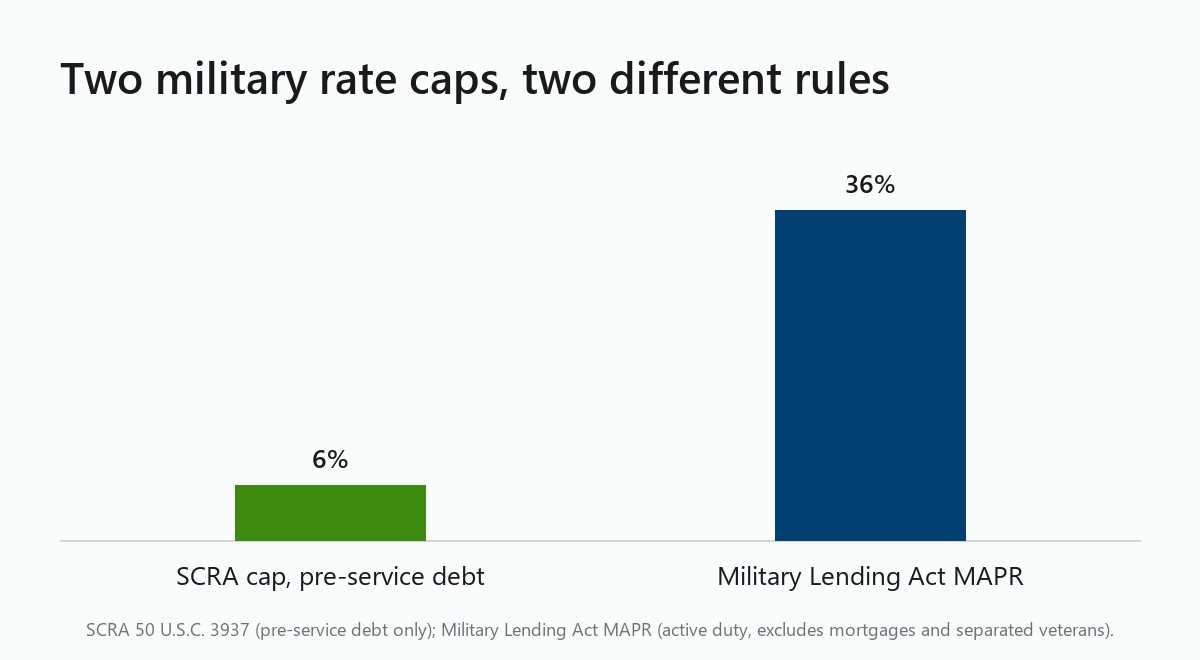
The Servicemembers Civil Relief Act caps interest, including fees and service charges, at 6 percent a year for the period of military service (50 U.S.C. § 3937). That cap comes with a condition that trips up a lot of people searching for veteran debt relief: it applies only to debt taken on before you entered active duty. A credit card balance from before you enlisted qualifies. A personal loan you take out today as a veteran does not, because the SCRA's interest cap is an active-duty protection tied to pre-service debt, not a general veteran benefit.
A separate law, the Military Lending Act, works differently and covers a different group entirely. It caps covered loans at a 36 percent Military Annual Percentage Rate, a figure that folds in most fees and add-on charges rather than just the stated interest rate (CFPB). That same CFPB guidance says the MLA covers active-duty members of every branch, active Reserve members, National Guard members federally mobilized for 30 or more consecutive days, and some spouses and dependents of those service members.
Here's the part most competing content skips: veterans who have separated from service are not covered by the Military Lending Act, per that same CFPB guidance. Once you're out of uniform, the MLA's 36 percent cap no longer applies to you, regardless of how many years you served. That guidance is also explicit that mortgages, home equity loans, and refinances are excluded from MLA coverage entirely, which means the cash-out refinance described above carries no MLA protection for anyone, veteran or active duty. Whatever rate a lender quotes on that refinance, the 36 percent cap simply doesn't reach it.
Legitimate resources: military relief society loans and defense credit unions
If what you actually need is short-term help or a lower-rate way to consolidate, a few resources exist that don't involve a mailer with a fake seal.
Army Emergency Relief, the Navy-Marine Corps Relief Society, and the Air Force Aid Society all offer interest-free loans and grants to active-duty and retired service members and their families facing hardship: overdue utilities, housing costs, food, funeral expenses, car repairs, and medical bills. Coast Guard Mutual Assistance exists as a parallel resource for Coast Guard members.
These aren't general-purpose consolidation lenders; they're built for hardship situations. Still, they're a legitimate first call if you're behind on a specific bill and need to catch up. The CFPB itself directs service members and their families toward relief societies as a source of emergency funding, which says something about how the government's own consumer agency treats them: as a real option, not a marketing gimmick.
For an actual consolidation loan, defense-affiliated credit unions are worth a look before any third-party lender that's cold-calling you. Navy Federal Credit Union offers personal loan products, including a debt consolidation loan category, and membership is open to the armed forces, DoD, veterans, and their families. PenFed Credit Union is another defense-affiliated credit union open to veterans and military families. Rates and terms depend on your credit profile, so check current numbers directly on each institution's own site before applying anywhere. It helps to know how state interest rate caps change what lenders can quote you too, since identical credit profiles can see different offers depending on where you live.
Neither one is automatically cheap, but both are member-owned institutions with a public rate page, not anonymous callers asking for your Social Security number. Consolidating debt without taking out a new personal loan is also worth comparing before you commit to either one.
Worth saying plainly: none of these resources will call you first. A relief society processes an application you initiate. A credit union publishes its own rates on its own site and doesn't need a seal that looks like a federal agency's to prove it's legitimate. If the first contact came from them, that alone is a reason to slow down before you consolidate anything.
Red flags in a veteran debt relief scam
A handful of patterns show up often enough in veteran-targeted debt pitches that they're worth memorizing, and they largely mirror the warning signs of a personal loan scam more broadly.
- Official-looking seals or letterhead designed to resemble a government agency, paired with words like federal, veteran, benefits, or relief.
- Urgency language: a deadline to respond, a claim that your benefits or eligibility status is at risk if you don't act now.
- A promise to erase your debt entirely or fix your credit fast, without any discussion of your actual balances or income.
- A request for your Social Security number, VA.gov login credentials, or bank account information from someone who contacted you first.
- Any claim that a loan or program is government-issued, VA-backed, or federally guaranteed, when it's actually a private lender's product.
Those patterns line up with what regulators have already documented. That same VA fraud alert describes veterans and military families receiving fraudulent calls and mailers claiming government or VA affiliation, and the same California AG page has flagged affinity fraud that uses military symbols specifically to build false trust with veterans. Any one of these on its own is reason enough to stop and verify independently before you respond.
Where to report a suspected scam
If a pitch matches the patterns above, don't sign anything and don't act on the deadline it's pushing you toward. Verify the offer independently: call the VA or the lender using a phone number you look up yourself, never one printed on the mailer. The VA and the Consumer Financial Protection Bureau jointly maintain VSAFE.gov, along with a phone line at 1-833-38V-SAFE, specifically for reporting suspected fraud targeting veterans and military families. You can also follow the reporting guidance in that same VA fraud alert, or file a complaint directly with the CFPB, the agency that has already taken enforcement action against at least one lender for this exact style of veteran-targeted marketing.
Frequently Asked Questions
Does the VA offer a debt consolidation loan?
No. The Department of Veterans Affairs does not run a personal loan program or a debt consolidation loan program. It guarantees home loans, including a cash-out refinance that some marketers repackage and advertise as "VA debt consolidation," but there is no VA-issued consolidation loan product.
What's the difference between a VA debt consolidation loan and a VA cash-out refinance?
A VA debt consolidation loan doesn't exist as a VA product. The real mechanism is a VA cash-out refinance: it replaces your mortgage with a larger one and pays you the difference in cash, which can cover other debt. That converts unsecured debt into a secured mortgage obligation, with foreclosure risk if you fall behind.
Does the Military Lending Act protect veterans after they leave service?
No. The Military Lending Act's 36 percent MAPR cap covers active-duty service members, active Reserve members, National Guard members federally mobilized 30 or more consecutive days, and some dependents (CFPB). Once you separate from service, MLA coverage ends and the cap no longer applies to loans you take out as a veteran.
Who does the SCRA's 6 percent interest rate cap apply to?
The Servicemembers Civil Relief Act caps interest at 6 percent a year, but only on debt incurred before you entered active duty (50 U.S.C. § 3937). Debt taken on during or after your service, including a loan you sign as a veteran, isn't covered by this cap.
Can veterans get low-cost help through military relief societies?
Yes, but eligibility isn't universal. Army Emergency Relief, the Navy-Marine Corps Relief Society, the Air Force Aid Society, and Coast Guard Mutual Assistance offer interest-free loans and grants for hardship, generally to active-duty and retired members and their families. A separated veteran should confirm eligibility with the specific society first. These are emergency-assistance resources, not general consolidation lenders.
How can I tell if a veteran debt consolidation offer is a scam?
Watch for official-looking seals, urgency about a deadline, promises to erase debt entirely, and requests for your Social Security number or VA.gov login from an unsolicited caller. Regulators have documented fraudulent mailers and calls claiming false VA affiliation to sell veterans on debt products (VA News).
Should I use a VA cash-out refinance to pay off credit card debt?
Only after comparing the full cost against what you owe now, including the closing costs that come out of your home equity and the risk that missed mortgage payments can lead to foreclosure. Unsecured debt left unsecured caps your risk at your credit score. Rolling it into a mortgage raises the stakes considerably.