


Texas caps interest at 10% by constitutional default, and yet a Texan with damaged credit can walk into a storefront this afternoon and sign paperwork carrying a 400% annual rate, legally. That contradiction is the whole story behind a bad credit loan in Texas, and almost nobody explains why both things are true at once. The short version: the state's usury cap applies to interest, and a large slice of the small-dollar lending market in Texas isn't structured as interest at all. Once you understand that mechanism, the rest of the market makes sense, including which products you can actually qualify for and which ones are built to keep you paying.
You've probably already noticed the confusion this creates when you compare offers side by side. One lender quotes an APR. Another quotes a flat fee per $100 borrowed. A third calls itself a broker and mentions the actual lender only in the fine print. Each of those reflects a distinct regulatory category, and knowing which one you're looking at changes what the loan will actually cost you over its life.
Texas Usury Law: What the 10% Cap Covers, and What It Doesn't
Start with the baseline. Texas Constitution Article XVI, Section 11 sets the default rule: absent a statute fixing a different maximum, any contract charging more than 10% annual interest is usurious, and a contract that never states a rate at all defaults to 6%. That's the floor the entire consumer lending market in Texas sits on top of. Every rate above 10% you'll encounter exists because the Legislature carved out a specific statutory exception for a specific type of licensed lender.
Two of those exceptions matter most if you have bad credit. Texas Finance Code Chapter 342, Subchapter F governs small installment loans and lets lenders licensed by the Texas Office of Consumer Credit Commissioner (OCCC) charge roughly 80% to 113% APR, capped at a $1,800 loan ceiling that adjusts every July 1 for inflation. Chapter 342, Subchapter E governs larger installment loans and runs 18% to 30% APR by statute, with no maximum loan amount once the rate sits at or below 18%. Both are licensed, both are supervised, and both operate as actual lenders charging actual interest under a statutory carve-out from the constitutional cap.
Then there's the piece most guides skip entirely: the Credit Access Business, or CAB, structure under Texas Finance Code Chapter 393. A CAB is a licensed broker that arranges a payday loan (what the statute calls a deferred presentment transaction) or an auto title loan from an unlicensed third-party lender, not the lender itself, and it charges you a fee for making that arrangement. You deal only with the CAB. The underlying lender stays in the background.
Here's why that distinction is the whole ballgame. The third-party lender's interest is capped at the 10% constitutional baseline, same as everyone else. But the CAB's broker fee is legally a fee, not interest, so it isn't subject to that cap at all. Stack the fee on top of the capped interest and you get the combined APR the OCCC's own 2025 report says can routinely exceed 400%. Nobody broke the usury law. They built a structure that sits legally outside it.
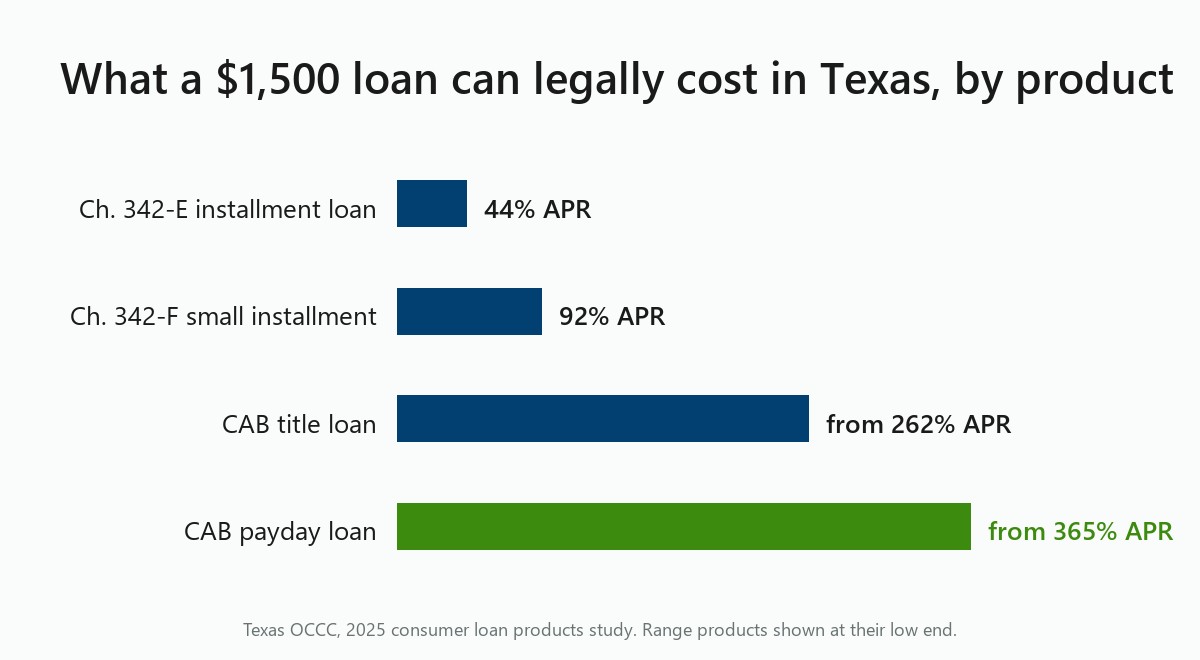
The OCCC's report puts real numbers behind that gap using a single $1,500 loan as its comparison point. A Chapter 342-F small installment loan on that amount comes out to roughly 92% APR. A Chapter 342-E loan on paper carries a note rate of 18% to 30%, but once the report folds in the prepaid administrative fee, the effective APR on that same $1,500 works out to 44%, since a fixed fee eats a bigger share of a smaller loan. A CAB title loan on $1,500 runs 262% to 366% APR. A CAB payday loan on $1,500 runs 365% to 496% APR. Same borrower, same amount, four wildly different outcomes depending on which door you walk through.
What You Can Actually Get Approved For With Bad Credit in Texas
Approval odds and cost move in opposite directions across these products. The lower the rate, the more a lender wants to see steady income and some repayment history. The higher the rate, the less they care, because a CAB or a pawn shop has structured the transaction so the risk of nonpayment is priced into the fee or absorbed by the collateral rather than screened out at the application stage. That trade-off is worth sitting with before you pick a product, because the loan that's easiest to get approved for today is almost always the one that costs the most over the life of the balance. Knowing how to read the fee disclosure before you sign is the fastest way to see that math for yourself, since it lays out the total cost in dollars rather than just a rate.
Small installment loans under Chapter 342, Subchapter F
This is usually the realistic entry point for a subprime borrower with thin or damaged credit and no collateral to offer. These are signature loans, unsecured and underwritten mainly on income and the ability to make the payment, not a credit score threshold. The OCCC caps the rate at roughly 80% to 113% APR, the loan amount at $1,800 (adjusted each July 1), a nonrefundable acquisition charge at 12.5% of the loan capped at $125, and a handling charge of $4 per $100 per month. You're also limited to one outstanding 342-F loan per borrower per company at a time, which caps how deep you can dig with a single lender.
Larger installment loans under Chapter 342, Subchapter E
This tier fits a borrower with more stable income and at least some credit history, even if it's damaged, because these lenders are underwriting bigger sums at a lower statutory rate. The note rate runs 18% to 30% APR with a prepaid administrative fee capped at $125, and there's no statutory ceiling on the loan amount once the rate is at or below 18%, per the same OCCC report cited above. If you can qualify here instead of a 342-F loan, the math favors you. Same lender type, same regulator, meaningfully lower cost.
CAB payday loans in Texas
Approval is fast and forgiving because the underwriting bar is low: a checking account, verifiable income, and an ability to repay within the short term of the loan. That accessibility is exactly what makes the cost structure worth understanding before you sign. Remember, the CAB brokers a deferred presentment loan from an unlicensed third-party lender and charges its own fee on top, rather than lending you the money itself, which is why the OCCC's $1,500 example lands at 365% to 496% APR. Comparing a $1,500 payday loan against the alternatives side by side makes that gap concrete.
CAB title loans in Texas
Same broker structure as a payday loan, but secured by your vehicle's title instead of your next paycheck. Approval tends to be even easier if you own the car outright, since the collateral does most of the underwriting work for the lender. The OCCC's $1,500 example puts the combined APR at 262% to 366%, and the risk runs beyond the rate. Default puts the vehicle itself on the line: Texas law lets the lender repossess the car if you fall behind on payments, on top of every dollar of broker fee you already paid.
Credit-builder loans and secured credit cards
These aren't going to solve an immediate cash shortfall, but they're the lowest-risk starting point if the real goal is qualifying for cheaper credit later. A secured card requires a cash deposit that becomes your credit limit, and a credit-builder loan holds your payments in an account you don't access until the loan term ends, reporting each on-time payment to the credit bureaus the whole way through. Neither is an OCCC-licensed Texas product specifically, so there's no state-specific rate data to cite here, but the mechanics are standard nationally and worth using if you can wait a few months instead of borrowing today. Building your score before you need to borrow again is worth the wait if your timeline allows it.
Pawn loans
Pawn loans sit outside the credit system entirely, which is exactly their appeal if your score is the obstacle. You hand over an item of value, walk out with cash, and if you can't repay, the shop keeps the item. Nothing gets reported to a credit bureau, and you carry no personal liability beyond forfeiting the collateral. Texas Finance Code Chapter 371 tiers pawn rates from 12% to 240% depending on the loan size, with no credit check and no recourse against the borrower on default, per that same OCCC report. For a small, one-time need where you're comfortable losing the item, it's a cleaner risk profile than a CAB loan.
The Texas-Specific Traps to Route Around
Four patterns account for most of the damage in this market, and all four are avoidable once you know to look for them. None of them require a lawyer to spot. They just require asking the lender a direct question before you sign, and paying attention to whether the answer is a straight one.

The broker fee framing
When a CAB quotes you a "fee" instead of a rate, that phrasing is the legal mechanism that keeps the charge outside the 10% constitutional interest cap, since Chapter 393 defines the CAB as a broker arranging a loan from a third-party lender rather than a lender itself, per the OCCC's CAB page cited earlier. Ask for the APR in plain terms before you sign anything. If the lender won't state it clearly, that's your answer. Many of the same warning signs of a predatory loan offer apply here, and it pays to run through them before you sign.
The refinance treadmill
What feels like a two-week bridge loan routinely turns into a year-long fee cycle. The OCCC's 2024 activity data shows 2,130 installment auto title customers refinanced their loan more than 10 times in a single report year, and 7,485 single-payment auto title customers did the same. Each refinance resets the fee clock. Before you renew, run the math on what you've already paid versus what you still owe.
Vehicle repossession exposure
Auto title loan repossessions in Texas have historically run around 9,700 per quarter, roughly 4.2% of active title loans, and have run near 10,000 per quarter in recent periods, per that same OCCC report. If your car is your only way to work, weigh that risk against the alternative of a 342-F installment loan before you put the title on the table.
The CSO-not-CAB gray zone
Some companies that used to hold CAB licenses have restructured to operate purely as Credit Service Organizations (CSOs) under a 2019 Texas Attorney General opinion, a shift the OCCC's 2025 report flags as putting them outside the agency's CAB licensing, examination, and reporting requirements. That means some high-cost small-dollar lending in Texas may not even show up in the state's own CAB data. Ask directly whether the company is OCCC-licensed as a CAB before you sign, and don't assume a storefront that looks identical to a licensed one carries the same oversight.
If Your City Has Stronger Protections Than State Law
Texas hasn't passed a statewide fee cap on payday and title lending, so at least 49 Texas cities, including Austin, Dallas, Houston, San Antonio, and El Paso, have passed their own ordinances layering protections on top of state law. The most common versions cap the total loan amount as a share of your gross monthly income and limit how many times you can refinance or renew. The reform push behind those ordinances is grounded in real damage: 417,286 vehicles were repossessed by Texas auto title lenders between 2012 and 2022, per that same Texas Appleseed data. Whether your specific address falls inside city limits or in the surrounding county can materially change your terms, so check your city's ordinance before you assume state law is the only protection you have.
If you're weighing whether to borrow across state lines, or you're simply curious how Texas's rate structure stacks up against a state with an actual payday lending ban, that comparison lives in a separate breakdown on how personal loan rates differ between New York and Texas, worth a read once you've settled the products above.
Frequently Asked Questions
Is a payday loan legal in Texas?
Yes. Payday loans operate through licensed Credit Access Businesses under Texas Finance Code Chapter 393, per the OCCC's CAB page cited earlier. The CAB arranges the loan from a third-party lender and charges its own fee, which is why a payday loan is legal in Texas despite the state's low constitutional interest cap.
What's the highest interest rate a lender can legally charge in Texas?
The constitutional default is 10% absent a statutory exception. Licensed installment lenders operate under statutory carve-outs up to roughly 113% APR. CAB broker fees sit outside that cap entirely, which is how combined payday and title loan APRs legally reach into the hundreds of percent, per the OCCC report cited earlier.
Can I lose my car over a Texas title loan?
Yes. Default on a CAB title loan and the lender can repossess your vehicle. Repossessions have run near 10,000 per quarter statewide in recent periods, per the same OCCC data cited earlier.
What credit score do I need for an OCCC-licensed installment loan?
A small installment loan under Chapter 342, Subchapter F is typically the product a borrower with minimal or damaged credit history can access, since its rate and fee terms are fixed by statute rather than tied to a credit-score cutoff. Approval leans heavily on verified income and your ability to make the scheduled payment, which is exactly what makes it accessible to borrowers a bank would decline.