


You got a call or filled out a form, and now a rep from Accredited Debt Relief is walking you through a program that promises to knock your credit card balances down for less than you owe. Before you hand over bank account access, you want to know whether Accredited Debt Relief is legit: what this company actually is, whether it follows the rules that govern debt settlement, and whether anyone in a position to know has found problems with it. The public record (court filings, the BBB, and the federal rule that governs debt-settlement fees) gives a clearer answer than a sales script does.
What Accredited Debt Relief Actually Is
Accredited Debt Relief is a doing-business-as name of Beyond Finance, LLC, a debt-resolution company headquartered in Chicago. Accredited Debt Relief operates out of San Diego and was founded in 2011, but it does not exist as a separately incorporated entity apart from Beyond Finance. LendEDU's review states the relationship plainly: "Accredited Debt Relief is a DBA of Beyond Finance, LLC. Beyond Finance, LLC also conducts business as 'Accredited' and 'Beyond.'"
A class action, later removed to federal court, names the defendant as "Beyond Finance, LLC d/b/a Accredited Debt Relief," Case No. 3:26-cv-05780, according to getoutofdebt.org's docket summary. A court caption confirming a DBA structure carries more weight than a review site's summary, because it is the legal name the company itself was served under.
Why does the corporate structure matter to you as a borrower? When one legal entity operates under several brand names, the reviews, complaints, and legal history you find under "Accredited Debt Relief" may not tell the whole story.
A complaint filed against "Beyond Finance" or "Beyond" could involve the same company, same contracts, same settlement teams, under a different marketing name. If you are researching this company, search all three names, since the postcard you received only shows one of them, and a complaint or lawsuit filed under a different name in that trio would not turn up in a search limited to the brand you were pitched. It also helps to know how debt settlement differs from debt consolidation before you sign anything with any provider, since the two programs run on different mechanics and carry different risks to your credit.
How the Fees Work, and What the Law Requires
Accredited Debt Relief advertises no upfront or enrollment fee. According to the company's own marketing, fees are success-based: you pay nothing until a debt is settled, and the fee is built into your program payments rather than charged as a separate lump sum. The company advertises fees of 15% to 25% of enrolled debt, varying by state, according to LendEDU's review of its program. That figure comes from the company's marketing copy as reflected in LendEDU's coverage, not from an independently audited billing document, so treat it as what the company says its model is rather than a confirmed number.
A fee that size still adds up fast on a large balance, which is exactly why the questions checklist below asks you to pin down the total dollar cost in addition to the percentage before you sign anything.
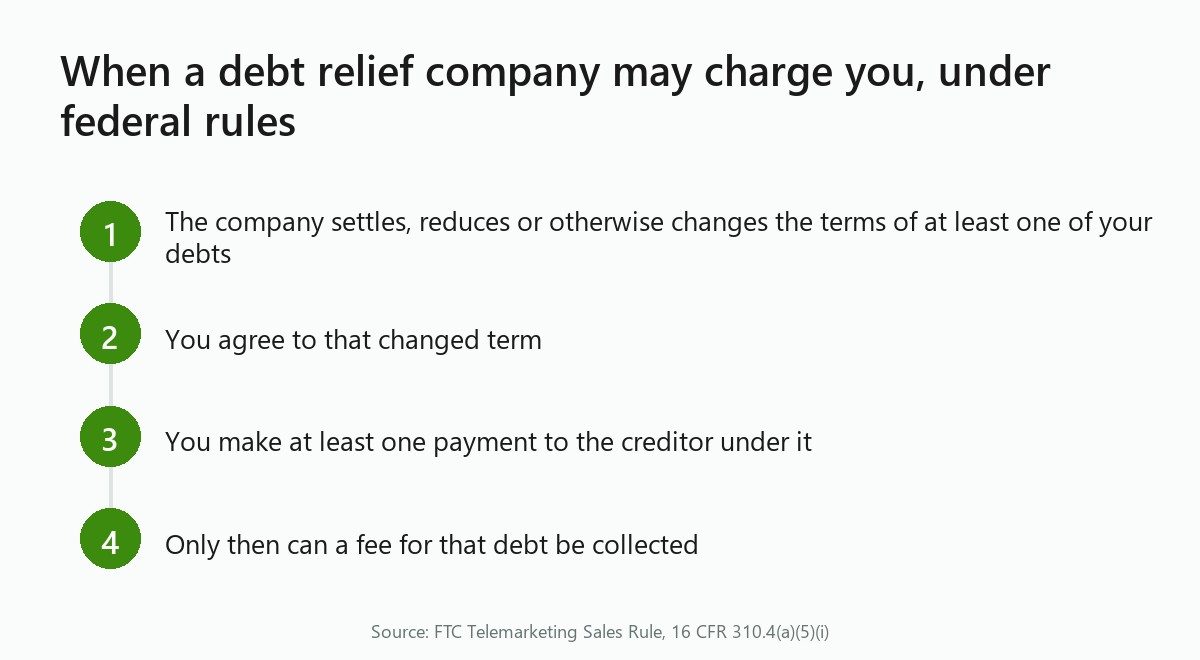
The law that governs this is the FTC's Telemarketing Sales Rule, specifically the advance-fee ban at 16 CFR 310.4(a)(5)(i). The rule prohibits a debt-relief provider from collecting any fee for a telemarketed service until three things have happened: the provider has renegotiated, settled, reduced, or otherwise altered the terms of at least one of your debts; you have agreed to that changed term; and you have made at least one payment under the new agreement.
Measured against that standard, Accredited Debt Relief's described fee structure, no charge until a debt is settled, fee collected through program payments rather than an enrollment charge, tracks the shape of what the rule requires. That is a meaningful distinction from the scam pattern regulators actually chase: providers who collect a fee the moment you enroll, before any debt has been touched. This research did not turn up a regulator finding that Accredited Debt Relief specifically violated 16 CFR 310.4.
The Regulatory and Legal Record
This is usually where the real research starts, and it is also where it is easiest to overstate what you find. No FTC enforcement action, no CFPB enforcement action, and no state Attorney General lawsuit naming "Accredited Debt Relief" or "Beyond Finance, LLC" turned up in this research pass. That statement covers major recent debt-relief enforcement sweeps, including the CFPB and seven state AGs' January 2024 case against Strategic Financial Solutions over allegedly illegal upfront fees, and FTC actions against other debt-relief operators. Neither Accredited Debt Relief nor Beyond Finance appears as a defendant in those actions.
Here is the caveat that matters: no public enforcement action found is a statement about what this search turned up as of publication, not a certification that the company has a clean record. Enforcement dockets update constantly, and an absence of a finding today does not guarantee one won't appear tomorrow. If you are evaluating this company, it is worth a fresh search of the FTC and CFPB press release archives close to whenever you actually enroll.
There is one private lawsuit worth knowing about, and it needs to be described precisely: Jackson v. Beyond Finance, LLC d/b/a Accredited Debt Relief, Case No. 3:26-cv-05780, was removed to federal court in New Jersey around May 20, 2026. The complaint alleges deceptive debt-settlement practices and undisclosed fees.
The defendant filed a motion to compel arbitration on May 27, 2026, and the case shows an order of dismissal dated June 4, 2026, a pattern consistent with the arbitration clause being enforced and the dispute moving out of open court. That timeline comes from getoutofdebt.org's summary of the case docket, not a direct read of the filings themselves.
What that timeline does not tell you is who was right. A dismissal that follows a motion to compel arbitration typically ends the case in court without a judge or jury ruling on the underlying allegations. This is a lawsuit with unproven claims. It should not be read as evidence that Accredited Debt Relief "lost" anything.
A borrower filed these allegations, and the company moved to compel arbitration, which suggests its enrollment contract contains an arbitration clause. Ask whether your own enrollment agreement contains one too, and read it before you sign, because it determines where any future dispute of yours would actually be resolved.
Accredited Debt Relief's BBB Rating and Complaint Patterns
Accredited Debt Relief holds Better Business Bureau accreditation, granted July 25, 2025, with a letter rating of A+. The company's BBB profile, registered under the Chicago BBB, shows 109 complaints closed in the last three years, alongside several thousand customer reviews. Star ratings across review sites for the company cluster around 4.8 to 4.9 out of 5.
One detail is worth flagging on its own: the company's profile appears under both Illinois and California BBB listings, with slightly different review counts depending on which regional page you check. That is a direct product of the dual-branding this article opened with, since Beyond Finance operates out of Chicago while Accredited Debt Relief operates out of San Diego. If you look this company up yourself, check both listings rather than assuming one page tells the complete story.
An A+ rating and a high star average are worth something, but they are a limited picture. An A+ rating says nothing about how fast any given client's debts actually got settled.
Looking at the recurring themes in complaints and reviews about this company gives you a more useful read. Commonly reported issue categories include the company retaining a limited power of attorney over a client's credit accounts even after the client canceled, which blocked card use on accounts that were otherwise current; a settlement account that stalled with slow progress toward actual debt reduction; and follow-up sales calls continuing after a prospective client said they weren't interested.
None of these are unique to this company. They show up across the debt-settlement industry generally, reported as issue patterns rather than proven misconduct in any individual case. That distinction matters, but it doesn't make the underlying questions less worth asking before you sign. A power-of-attorney provision that outlives your enrollment, for instance, is a contract term you can and should ask to see in writing, not something to take on faith from a rep on the phone.
Questions to Ask Before Enrolling
A sales call is not the place to get honest answers under pressure. Get these in writing before you commit:
- Can I see the exact fee schedule in writing, and can you point to the specific clause in the contract that says no fee is charged until a debt is settled and I've made a payment under the new terms?
- Will you hold any power of attorney or account access after I cancel the program, and how do I revoke it in writing if I do?
- What happens to my accounts and credit if a creditor sues me while I'm enrolled?
- Does my enrollment agreement contain an arbitration clause, and what does that mean for how a future dispute between us would be resolved?
- What is the total dollar amount I'll pay in fees over the life of the program, not just the percentage?
- Is this company licensed or registered as a debt-settlement provider in my state, and can you show me that registration?
If a rep can't or won't answer any of these clearly and in writing, that hesitation tells you something the BBB rating can't.
How This Compares to Other Debt Relief Companies
Accredited Debt Relief is one name among several a borrower researching debt settlement is likely to encounter. If you're also weighing an offer from Freedom Debt Relief, the two companies have materially different corporate structures and legal histories, and it's worth reading how Freedom Debt Relief's documented record compares before you decide between them. Don't assume that because one company comes up clean in a records search as of publication, every debt-settlement provider you're considering will.
Bottom Line
Yes, Accredited Debt Relief is a real, legally operating brand of Beyond Finance, LLC, a Chicago-based debt-resolution company, and that structure is confirmed by a federal court filing, not just marketing language. Its advertised fee model, no charge until a debt is settled, tracks the shape the FTC's Telemarketing Sales Rule requires under 16 CFR 310.4(a)(5)(i), though that description comes from the company's own marketing rather than an independent billing audit. This research found no public FTC, CFPB, or state AG enforcement action against the company, and it holds a BBB A+ rating.
The real risks here are ones built into debt settlement itself rather than anything specific to this company: a power of attorney over your accounts that may outlive your enrollment, a settlement account that can stall before it produces results, and an arbitration clause, which the company's motion in the Jackson case suggests its contracts contain. One private lawsuit alleges deceptive fee practices; the defendant moved to compel arbitration, and the case was dismissed from court, a procedural outcome that leaves the underlying allegations untested. Get those terms in writing before you enroll, and take the documented record into the enrollment call.
Frequently Asked Questions
Is Accredited Debt Relief a legitimate company?
Accredited Debt Relief is a DBA of Beyond Finance, LLC. No FTC, CFPB, or state AG enforcement action against the company was found in public records as of publication, and it holds BBB accreditation with an A+ rating. A private class action alleging deceptive fee practices was dismissed from court after a motion to compel arbitration, leaving the allegations untested.
Is Accredited Debt Relief the same company as Beyond Finance?
Yes. Accredited Debt Relief is a trade name Beyond Finance, LLC does business under. This is confirmed both by LendEDU's review coverage and by the caption of a federal lawsuit, Jackson v. Beyond Finance, LLC d/b/a Accredited Debt Relief.
Does Accredited Debt Relief charge upfront fees?
According to the company's own marketing, no. It advertises a success-based model where fees, described as 15% to 25% of enrolled debt, are collected only after a debt is settled and built into program payments. This description has not been independently audited, so confirm the exact fee terms in your own contract before enrolling.
Has Accredited Debt Relief been sued?
A private federal class action, Jackson v. Beyond Finance, LLC d/b/a Accredited Debt Relief, alleged deceptive debt-settlement practices and undisclosed fees. The company moved to compel arbitration, and the case was dismissed from court, consistent with the dispute being routed to arbitration rather than a court ruling on the underlying allegations.
What is Accredited Debt Relief's BBB rating?
Accredited Debt Relief holds BBB accreditation, granted July 25, 2025, with an A+ letter rating. The company's BBB profile shows 109 complaints closed over the prior three years, alongside several thousand customer reviews. Star ratings for the company across review sites cluster around 4.8 to 4.9 out of 5.
What should I ask before enrolling in a debt settlement program?
Ask what specifically triggers a fee, whether the company retains any power of attorney after cancellation, what happens if a creditor sues while you're enrolled, whether your contract includes an arbitration clause, the total dollar cost of the program, and whether the company is licensed or registered in your state.