


You pulled your credit report expecting the usual, and there it is: a collection account you either forgot about or never saw coming. Your stomach drops. The direct answer is yes, debt collection affects your credit score, and it can stay on your report for close to seven and a half years.
What sinks a loan application is often a borrower who didn't understand what they were looking at and made the wrong move out of panic. Let's fix that, one piece at a time.
How badly this one collection hurts you depends on details most people never dig into: how long ago the original delinquency happened, and which scoring model your next lender happens to pull. Get those two answers straight and you know roughly where you stand instead of guessing at a number that changes depending on who's asking. That single line on your report can sit between you and an approval long after the original bill itself is forgotten.
How Long a Collection Stays on Your Report
Most articles on this topic get one thing wrong, and it's the thing that matters most. They say "seven years" and stop there, as if the clock starts on the day the collection agency picked up the debt. It doesn't.
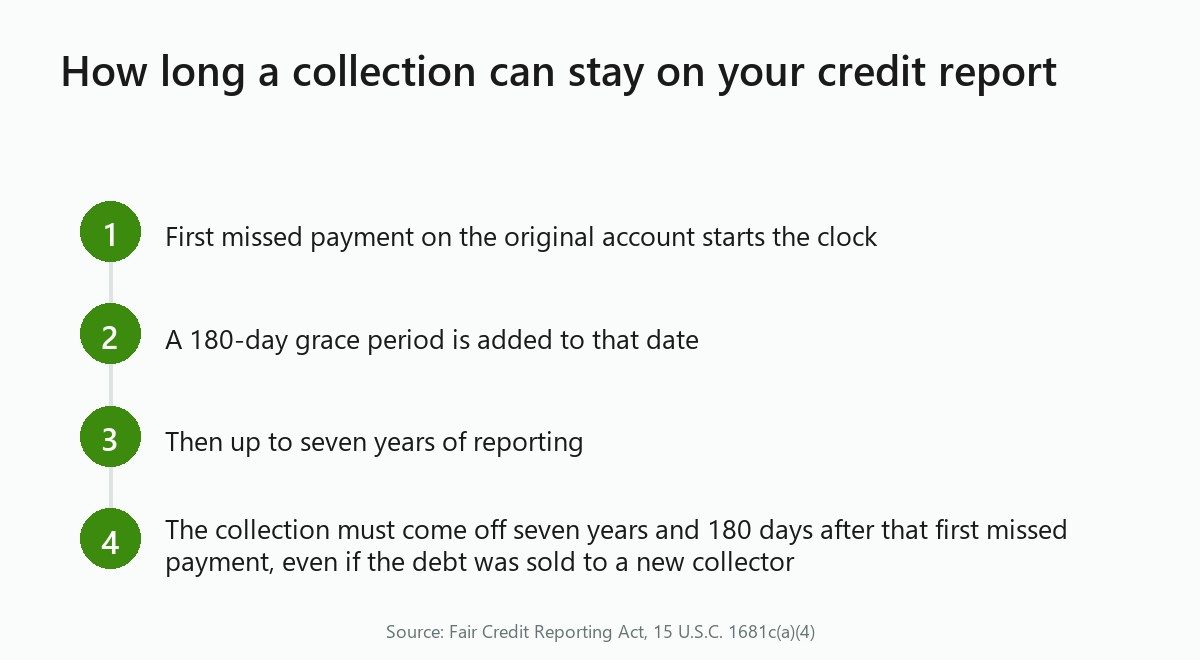
The seven-year window runs from the date of first delinquency on the original account, known in the industry as the DOFD. That's the date you first fell behind and never caught back up, on the original credit card, medical bill, or loan. It is not the date a collection agency bought or was assigned the debt.
Under 15 U.S.C. § 1681c(a)(4), a collection or charge-off generally cannot be reported more than seven years plus a 180-day grace period measured from that original delinquency date. Add it up and you get roughly seven and a half years total from the day you first missed the payment that started the slide. Lenders looking at your file during that window will see it, full stop, no matter how many times the account has changed hands since.
What trips people up is a specific scenario. Say you fell behind on a credit card in March 2021. The original lender charged it off, sold it to a collection agency in 2022, and that agency sold it again to a different collector in 2024. The reporting clock still runs from March 2021, not from either sale.
A debt does not get a fresh seven years every time it changes hands. I've had applicants argue with me across the desk that a debt "couldn't still be on there" because it was three different collectors ago. It doesn't matter how many companies touched the account. The calendar only cares about that first missed payment, and the 180-day grace period tacked onto that seven-year window is measured from that same original delinquency, not from whatever date shows up on the newest collector's paperwork.
If a collector reports a later delinquency date to make the account look newer than it actually is, that's called re-aging, and it's a separate FCRA violation on top of everything else. If you think a collector is trying to pull that on you, or you're not even sure the debt is yours, that's exactly the moment to make the collector prove the debt is yours before you pay anything. Our Debt Validation Letter Template walks you through that process step by step.
Does Paying Off a Collection Help Your Score?
This is where I watched people lose money for no reason. A borrower would pay off a collection expecting a score bump, then come back confused because the score hadn't moved. They weren't wrong to try. They were just working off bad information about how scoring actually works, because most explanations stop at "seven years" and never say which score is being pulled or how it treats a paid account.
Whether paying a collection helps your score depends entirely on which scoring model the lender pulls when they check your file. Paid collections are scored differently depending on the model:
- FICO Score 8, still the version most lenders use for everyday credit decisions, scores a collection whether it's paid or unpaid, as long as the original balance was $100 or more. Paying it off does not remove the scoring impact under FICO 8, myFICO says.
- FICO Score 9 and the FICO Score 10 suite, myFICO says, ignore paid third-party collections entirely. A collection marked paid or zero-balance stops factoring into your score, though the late payments that led to it are still scored.
- VantageScore 3.0 and 4.0 also ignore paid collections, and VantageScore's newer models go further by excluding medical collection debt from scoring entirely, paid or not, a change the company rolled out in January 2023, according to VantageScore.
The catch nobody hands you at the counter is this: you don't get to pick which score your lender pulls, and lenders usually don't tell you which one they're using. Mortgage underwriting in particular still leans on older FICO models, while many everyday consumer lenders have already moved to FICO 9, FICO 10, or VantageScore 4.0. The same paid collection can be invisible to one lender and fully scored by the next, depending on which product you're applying for.
Paying off a collection is still the right move for your own peace of mind and for any lender running a newer model. Just don't walk into a loan application assuming a paid collection is invisible to the lender sitting across from you. Assume it's still visible unless you know otherwise.
Medical Collections Are Different, but Not the Way You've Heard
If you've read anything online about medical debt getting wiped off credit reports, you've probably read something that's already out of date. This is where I want to slow down, because getting this wrong could cost you a real decision down the road.
In January 2025, the Consumer Financial Protection Bureau finalized a rule that would have barred medical debt from appearing on credit reports and from being used in most lending decisions nationwide. It sounded like the end of medical collections dragging down scores for good.
Then, on July 11, 2025, a federal court in the Eastern District of Texas vacated that rule, in a case called Cornerstone Credit Union League v. CFPB. The request to vacate came jointly, from the CFPB itself under new leadership and from the trade groups that had sued to stop the rule in the first place. The court found the rule exceeded the Bureau's statutory authority, according to the CFPB's own record of the final rule.
That rule is not in effect. There is currently no federal regulation barring medical debt from your credit report, whatever you may have read or heard secondhand.
So what's actually protecting you right now comes from the credit bureaus themselves. Equifax, Experian, and TransUnion voluntarily agreed to stop reporting paid medical collections starting July 1, 2022, and to stop reporting medical collections with an original balance under $500, effective April 11, 2023. They also extended the waiting period before an unpaid medical bill can appear on a report, from six months to a full year.
The CFPB estimated this policy removed medical collections from roughly half of the credit files that previously carried them. That protection is voluntary bureau policy, not a law.
The bureaus adopted it, and they could narrow it or walk it back without asking Congress or a judge for permission. It may never happen, but don't build your financial plan on a policy a company chose to follow.
What "Pay for Delete" Actually Gets You
I heard this phrase across the desk more times than I can count: "If I pay it, will they delete it?" Collectors will sometimes float this deal themselves, offering to remove a collection from your report in exchange for payment. It sounds like a clean trade. It usually isn't.
A debt collector has no legal obligation to remove an account from your credit report just because you paid it. The CFPB says so directly: a consumer generally cannot get accurate negative information removed from a credit report simply by paying it off. The FCRA summary of rights that every credit bureau must give you makes the same point: a reporting agency isn't required to remove information that's accurate, except in narrow situations like identity theft, duplicate reporting, or a genuine error.
The FTC backs this up in its own consumer guidance, noting that paying off a debt doesn't automatically erase it from your history. The FTC has also pursued "debt parking" cases, where collectors reported debts consumers never actually agreed to in the first place. Where those debts came off reports, it was through an FTC enforcement order, not a phone call to the collector. A collector was always free to ignore a handshake pay-for-delete deal, because nothing on paper obligated them to honor it.
That doesn't mean pay for delete never works. Some collectors will agree to it in writing, and if you get that agreement on paper before you send a dime, you might get lucky. Just don't count on it as your strategy. If a collector promises deletion over the phone with nothing in writing, you have nothing to hold them to later.
What to Do Next
Before you pay a collector anything, confirm the debt is actually yours, for the right amount, and reported with the correct date. Whichever collection you're staring at, the fix starts with knowing exactly which clock and which score you're dealing with, not guessing. If the collection showed up because someone opened an account in your name, that's a different problem entirely, and you'll want to look at a credit freeze versus a fraud alert to lock things down.
Once a collection is verified, paid, or has aged off your report, the real work starts: rebuilding what it cost you. That process looks different depending on where your score sits today and which accounts are still open, and we've laid out the order that works in three proven moves to raise your credit score in 60 days.
Keep two separate clocks straight in your head while you sort this out. How long a debt can sit on your credit report is a federal reporting question, governed by the federal FCRA. How long a collector can sue you over it is a completely different matter, governed by your state's own statute of limitations, and that clock can run shorter or longer than the reporting window depending on where you live (readers in California can see how that plays out in our California credit card debt statute of limitations guide). Confusing those two clocks is how people either pay a debt they didn't need to worry about, or ignore one they should have handled years ago.
Frequently Asked Questions
Does debt collection affect your credit score even if the amount is small?
According to myFICO, under FICO 8, 9, and 10, a collection with an original balance under $100 is disregarded and shouldn't affect your score. Above that threshold, FICO 8 scores it regardless of size, while FICO 9, FICO 10, and VantageScore models ignore the collection once it's marked paid.
How long does a collection stay on your credit report?
Up to seven years plus a 180-day grace period from the date of first delinquency on the original account, not from when it was sold to a collector, under 15 U.S.C. § 1681c(a)(4). That's roughly seven and a half years total from the original missed payment.
Can a collector restart the seven-year clock by selling my debt?
No. The reporting period is tied to the original delinquency date and does not reset when a debt is resold or reassigned to a new collector. A collector reporting a false, later date to make the debt look newer is engaging in re-aging, which is a separate violation of the FCRA.
Is medical debt removed from credit reports in 2026?
Not by federal law. The CFPB rule that would have barred most medical debt from credit reports was vacated in July 2025 and is not currently in effect. The credit bureaus still voluntarily exclude paid medical collections and ones under $500, but that's company policy, not a legal requirement.
Will paying off a collection raise my credit score?
It might, depending on which scoring model your lender uses. FICO 9, FICO 10, and VantageScore 3.0 and 4.0 all ignore paid collections. FICO 8, still widely used by lenders today, continues to score a collection whether it's paid or not.
Does "pay for delete" guarantee a collector will remove the account?
No. Collectors are not legally required to delete accurate information just because you paid, and both the CFPB and FTC confirm there's no automatic right to have a paid, accurate collection removed. Get any deletion promise in writing before you pay a cent.