


The letter usually shows up with a company name you don't recognize attached to a debt you barely remember. Maybe it's a summons instead, delivered by a process server at your door, listing an account balance from a card you closed years ago. Before you panic, or before you send a payment just to make it go away, there's a number worth knowing: California's credit card debt statute of limitations is four years. After that window closes, a lawsuit to collect on that debt should not succeed, provided you know how to raise the defense.
That four-year rule isn't the whole story, though. California also restricts what can restart that clock, and debt buyers face an added layer of restrictions under a state law built specifically to keep them from suing on old debt. None of this applies if your card balance is current and collectible: a reader who paid off $24,000 in credit card debt in 28 months solved a different problem entirely, and a repayment plan was the right tool for that job.
California's 4-Year Statute of Limitations on Credit Card Debt
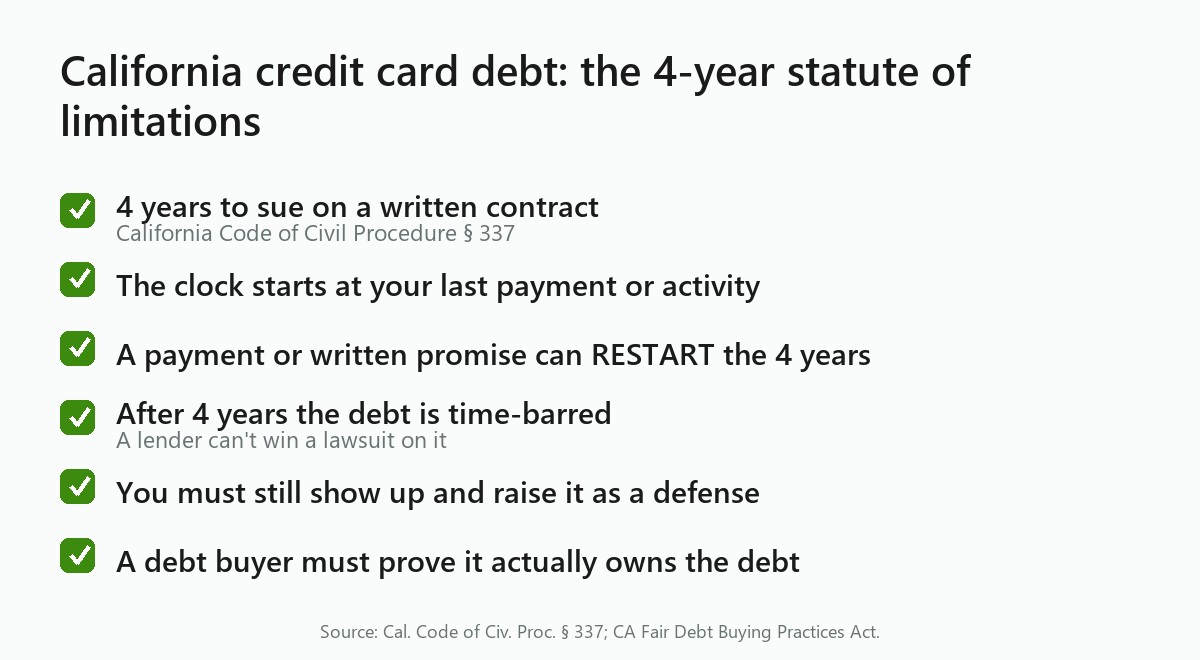
A statute of limitations is a legal deadline. It's the window a creditor or debt collector has to file a lawsuit and win a court judgment against you. Once that window closes, the debt becomes what lawyers call "time-barred": you may still owe it in a moral or accounting sense, but a court can no longer force you to pay it through a lawsuit, as long as you tell the judge the deadline passed.
For a credit card agreement, California treats that deadline as four years. California Code of Civil Procedure section 337(a) sets the limit for "an action upon any contract, obligation or liability founded upon an instrument in writing". A credit card agreement counts as a written contract, so the four-year clock applies.
Being time-barred doesn't erase the debt or force a collector to stop contacting you. It means a court can't enter a judgment against you if you show up and point out the deadline. Miss that step, and a judge who never hears about the statute of limitations can rule against you anyway. It's the part that trips up a lot of people who assume an old debt just disappears on its own.
Credit card lawsuits get filed under a few different legal theories, including breach of a written contract, an "account stated" (a running balance both sides agreed to), and an "open book account." California Courts' own consumer guidance confirms all three carry the same four-year period. The label on the complaint can change, but the underlying deadline for a credit card debt generally doesn't.
When Does the Clock Actually Start Running?
The four-year period starts when the cause of action accrues, which in practice usually means the date you first missed a payment that led to the account going into default. It's a general starting point, and confirming it for your own account still means checking your own paperwork. Some accounts have unusual payment histories, partial cures, or disputed charge dates that make the exact starting point less obvious.
This matters because people often confuse the wrong date with the right one. The date you opened the card, the date of your last purchase, and the date you stopped paying are three different dates, and only one of them typically starts the clock. Getting that date right matters most at the point you respond to a lawsuit, since the statute of limitations only protects you if you plead it as an affirmative defense in your Answer; leave it out, and you generally can't raise it later in the case. If you're trying to figure out whether your own debt is time-barred, the safest move is to pull your account records (old statements, a credit report entry, or documents attached to a collection letter) and compare the default date against today. Better yet, have a California consumer-law attorney or legal aid clinic confirm it for you before you rely on your own math in court.
Debt buyers and collection agencies often print a "date of last activity" on their own letters, and it's tempting to treat that number as the final word. It shouldn't be. The collector's own internal records produce that figure, not a court judgment. Cross-check any date a collector gives you against your own statements or credit report history rather than accepting it at face value, particularly if the account has changed hands between collectors more than once.
The Re-Aging Trap: What Restarts a Time-Barred Debt in California (and What Doesn't)
Collectors have a strong financial incentive to find a way around an expired deadline, and the most common tactic is getting you to do something that legally revives the debt. California Code of Civil Procedure section 360 governs what actually counts. It requires that any acknowledgment or promise to pay be "contained in some writing, signed by the party to be charged" before it can create a new or continuing contract.
Payment gets treated differently under the same statute, and the distinction matters. Section 360 is specific about what a payment cannot do on its own: "no such payment of itself shall revive a cause of action once barred." A bare payment isn't the signed writing the statute requires to create a new or continuing contract. In plain terms, sending money on an already-expired debt does not, by itself, hand the collector a fresh four years.
A California Court of Appeal decision in 2026 sharpened that rule further, rejecting an attempt to revive a time-barred debt through an informal act (a memo line on a check) rather than a signed written acknowledgment, according to case commentary from Horst Counsel.
Understanding why collectors push so hard for revival helps explain the pattern. Once a debt is time-barred, a lawsuit is off the table, and a court judgment (with its wage garnishment and bank levy powers) is no longer an option, so a collector has little left to gain by leaving it alone. A signed acknowledgment or a fresh written promise changes that math, handing the collector a live, enforceable claim again. That incentive is exactly why the law sets the bar at a signed writing rather than a phone call or a partial payment.
California's Extra Layer of Protection: The Fair Debt Buying Practices Act
Most of what's covered so far applies to any creditor. California adds a separate, stronger set of rules that apply specifically to debt buyers: companies that purchase charged-off consumer debt and then attempt to collect it themselves. Civil Code section 1788.50 is the provision that defines who counts as a debt buyer under this law, which matters because the stronger protections below hinge on which category your collector falls into. That's a distinct category from your original card issuer, who is still collecting a debt it never sold, and the extra protections below don't automatically extend to that original issuer.
Telling the two apart usually isn't hard once you know what to look for. If the name on your collection letter or summons doesn't match the bank or card company that originally issued the card, and the letter references the account being "assigned" or "purchased," you're most likely dealing with a debt buyer. That distinction is worth pinning down early, since it decides whether the stronger protections below apply.
For debt buyers, California's Fair Debt Buying Practices Act goes further than simply letting the statute of limitations work as a defense. Civil Code section 1788.56 bars a debt buyer from filing suit in the first place: "A debt buyer shall not bring suit or initiate an arbitration or other legal proceeding to collect a consumer debt if the applicable statute of limitations on the debt buyer's claim has expired". California bars the suit outright, rather than leaving the deadline as a defense you have to raise yourself.
When a debt buyer does try to collect on a time-barred debt outside of court, the law requires it to say so in writing. Civil Code section 1788.52(d)(2) requires the written demand to include specific language: "The law limits how long you can be sued on a debt. Because of the age of your debt, we will not sue you for it". If a debt buyer sends a collection letter on old debt without that disclosure, that's worth flagging to a consumer-law attorney.
What To Do If You're Sued Over Old Credit Card Debt In California
If you've actually been served with a summons and complaint, here's the sequence that matters most.
- Don't ignore it. A summons carries far more weight than a collection letter, and skipping it lets the plaintiff request a default judgment against you without a fight.
- Confirm the default date on the account, using your own records or, ideally, an attorney's help, so you know whether the four-year window under CCP 337 has actually closed.
- Note the deadline. You generally have 30 days from the date you were served to file a response, using the Answer, Contract form (PLD-C-010) if the case is a straightforward debt claim (California Courts self-help guidance).
- Plead the statute of limitations as an affirmative defense in the Answer itself. California Courts' list of debt defenses guidance lists this among the recognized defenses, describing it as showing "that the other side waited too long to sue you." Defenses left out of the Answer generally can't be raised later in the case.
- Look into the filing fee waiver if cost is a barrier. Filing fees for these forms typically run $225 to $450, and fee waivers are available for people who qualify, per the same self-help guidance.
None of this is a substitute for individualized legal advice, especially once real money and a court deadline are involved. A California consumer-law attorney or a local legal aid clinic can review your specific dates, your specific account, and your specific summons before you file anything or sign anything. Once your situation is resolved, if new borrowing comes up later, it's worth weighing a personal loan against a payday loan or cash advance before signing anything new.
Mistakes That Can Restart an Expired Clock
The most damaging mistakes tend to happen quietly, long before a lawsuit ever gets filed. A partial payment on an old account, made to "show good faith" or to stop the phone calls, can complicate your position even though a bare payment alone doesn't revive an already-barred debt under section 360. Signing any document that acknowledges the debt, agrees to a new payment plan, or promises future payment is riskier still, since a signed writing is exactly what section 360 requires to create a new obligation. If the debt is still valid and worth paying down, options like consolidating debt without taking on a new loan are worth a look once the legal question is settled.
Collectors sometimes frame a settlement offer or a "payment plan agreement" in ways that function like that signed acknowledgment. Read anything you're asked to sign carefully, and don't assume a friendly tone on the phone means the paperwork behind it is harmless. If a collector is pushing you toward a payment or a signature on a debt you believe is old, get a consumer-law attorney or legal aid clinic to look at it first. That single step costs far less than a debt getting a fresh four years attached to it.
Frequently Asked Questions
Does a time-barred debt still show up on my credit report?
Yes, a time-barred debt can still appear on your credit report. The statute of limitations governs whether a creditor can sue you and win, not how long an account can be reported. Credit reporting time limits are a separate rule from the litigation deadline discussed here.
Can a debt collector still call me after the statute of limitations expires?
Yes, in general a collector can still contact you about a time-barred debt. What California's Fair Debt Buying Practices Act restricts is a debt buyer's ability to sue you over it, and it requires specific written disclosures when a debt buyer collects on debt that's already too old to sue on.
What's the difference between time-barred debt and discharged debt?
Time-barred debt still legally exists, but a court generally can't force payment once the statute of limitations has run and you raise it as a defense. Discharged debt (through bankruptcy, for example) has been legally eliminated. The two outcomes come from very different legal processes.
Does making a small payment always restart California's four-year clock?
Not by itself. Under California Code of Civil Procedure section 360, a payment made after a debt is already time-barred doesn't revive it on its own. Reviving an already-barred debt generally requires a signed written acknowledgment, so consult an attorney before making any payment on an old account.
Does the Fair Debt Buying Practices Act protect me against my original card issuer?
Not automatically. The Act's stronger protections, including the bar on suing over time-barred debt, apply specifically to debt buyers who purchased the charged-off account. An original card issuer that never sold the debt is a separate situation, though the four-year statute of limitations under CCP 337 still applies to it.
What happens if I miss the 30-day deadline to answer a debt lawsuit?
Missing the deadline lets the party suing you request a default judgment, which the court can grant without hearing your side, including any statute of limitations defense. File the Answer, Contract form (PLD-C-010) on time, or seek help from a legal aid clinic immediately if you're at risk of missing it.