


The call comes at 4:40 on a Tuesday. The voice reads back the last four digits of your Social Security number, names a creditor you've never dealt with, and offers to "resolve it today" for $340 if you give up a card number. You don't have to give them anything. A debt validation letter template costs a stamp and ten minutes, and a written dispute mailed inside the right window forces that collector, by statute, to stop collecting until it mails you proof.
Here's the part almost every free template page gets wrong. Those pages say the collector has 30 days to respond to your letter. That is not what the law says, and the error runs in the direction that hurts you: the 30 days is your deadline to dispute, not theirs to answer. Federal debt collection rules set no response deadline for the collector at all. What they set is a freeze that lasts as long as the collector stays silent.
People file federal complaints on that misunderstanding. Complaint 8694853, filed with the Consumer Financial Protection Bureau (CFPB) in April 2024, states flatly that "under the Fair Credit Reporting Act it states that collectors have 30 days to validate." Wrong statute, invented deadline. It sits in the Bureau's public complaint database. The rule that applies is the Fair Debt Collection Practices Act (FDCPA).
What a Debt Validation Letter Actually Does
A debt validation letter is a written dispute you send to a third-party collector or debt buyer, asking it to prove the debt before collecting another dollar. Not a loophole. A right written into 15 U.S.C. 1692g.
The collection freeze under 15 U.S.C. 1692g(b)
The operative sentence is short. Dispute in writing within the validation period and the collector "shall cease collection of the debt, or any disputed portion thereof, until the debt collector obtains verification of the debt" and mails you a copy. Text at Cornell's Legal Information Institute.
Two things follow. Collection stops, not slows. And the freeze carries no expiration date, lifting only when verification reaches your mailbox, so a collector holding nothing stays stuck.
Regulation F, the CFPB's debt collection rule, extends the same stop to a written request for the original creditor's name and address inside that window, at 12 CFR 1006.38.
One boundary: the FDCPA reaches third-party collectors and debt buyers, not an original creditor collecting its own account.
The 30-Day Validation Period Runs Against You, Not the Collector
Within five days of first contacting you, a collector has to send written notice covering the amount of the debt, the creditor's name, your right to dispute within 30 days, and its obligation to mail verification if you do. Miss that 30-day window and the debt is "assumed valid" for purposes of the statute, though failing to dispute is expressly not an admission that you owe anything. That protection is in 1692g(c).
How Regulation F counts the days
Regulation F, effective November 30, 2021, defines the validation period as starting when the collector provides the validation information and ending 30 days after you receive it or are assumed to receive it. The assumption is generous: five days after the notice goes out, excluding Saturdays, Sundays, and legal public holidays. The definition lives at 12 CFR 1006.34(b)(5), published by the CFPB.
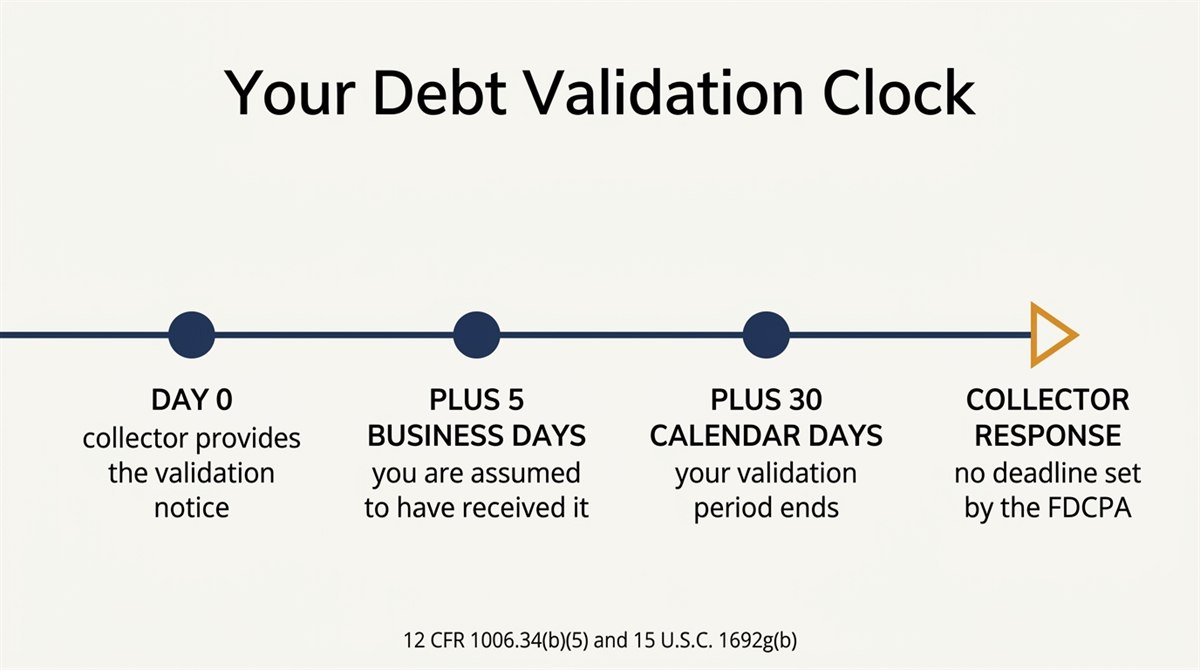
Run the math on a real calendar. Say the collector mails your notice on Monday, March 2, 2026. Counting five business days gets you to Monday, March 9, the date you're assumed to have received it. Thirty calendar days from there lands on Wednesday, April 8, 2026. The template sites doing "30 days from the postmark" would tell you April 1. You have a week more than they think.
If you already missed the window
Missing it isn't fatal. CFPB guidance: "In certain situations, you only have 30 days after you're contacted to ask for certain information, but even if more than 30 days pass, it's still a good idea to ask for what you need."
What changes after day 30 is leverage, not your right to ask. The automatic freeze no longer attaches, so calls continue while the collector hunts for your file. Send the letter anyway, certified.
What the Collector Must Send You First
Read their validation notice against this list
Before you write anything, check whatever they mailed you against 12 CFR 1006.34(c). A compliant validation notice includes:
- The collector's name and the mailing address for disputes
- Your name and address
- The name of the creditor the debt is owed to
- The account number, or a truncated version of it
- An itemization date, which must be one of five specific dates: the last statement date, the charge-off date, the last payment date, the transaction date, or the judgment date
- The amount owed on that itemization date
- An itemization of interest, fees, payments, and credits applied since then
- The current amount claimed
- The date the validation period ends
- A reference to the CFPB's debt collection website
Anything missing is a gap you name in your letter. A lump sum with no itemization date, no creditor name, and no end date isn't doing what the rule requires.
The checkbox most people never notice
The CFPB publishes a Model Validation Notice, Form B-1, with a tear-off dispute section at the bottom. If the collector used it, dispute by checking a box, signing, and mailing the strip back. Then send the fuller letter below. The checkbox preserves the deadline; the letter builds the record.
The Debt Validation Letter Template
Copy this, fill in the brackets, keep it plain. No threats, no statutes you haven't read, nothing resembling an offer to settle.
[Your full name], [Street address], [City, State ZIP], [Date]
To: [Collector's company name], [Dispute mailing address exactly as printed on their notice]
Re: Account number [reference number shown on your notice]. Amount claimed: [$ amount].
This letter is a written dispute and a request for verification under 15 U.S.C. 1692g(b) and 12 CFR 1006.38. I dispute this debt in full. Nothing in this letter is an acknowledgment that I owe any amount, and I waive no right or defense.
Please cease collection of this debt until you obtain verification and mail it to me at the address above.
So that I can identify what you are collecting, please provide:
- The name and address of the original creditor.
- The account number used by the original creditor.
- The itemization date you are using and the amount owed on that date.
- An itemization of all interest, fees, payments, and credits applied since the itemization date.
- A copy of the contract or agreement that created this account and authorizes the interest and fees you claim.
- The date of my last payment to the original creditor and the date the account went into default.
- The date you acquired or were assigned this account, and the name of the party you acquired it from.
- Whether you contend the statute of limitations on this debt has expired, and the date you contend it began to run.
- Proof that you are licensed or bonded to collect debts in [your state], if licensing is required there.
If any portion of this debt has been paid, settled, discharged in bankruptcy, or belongs to another person, state that in writing.
Please direct all further communication to me in writing at the address above.
Sincerely, [Signature], [Printed name]
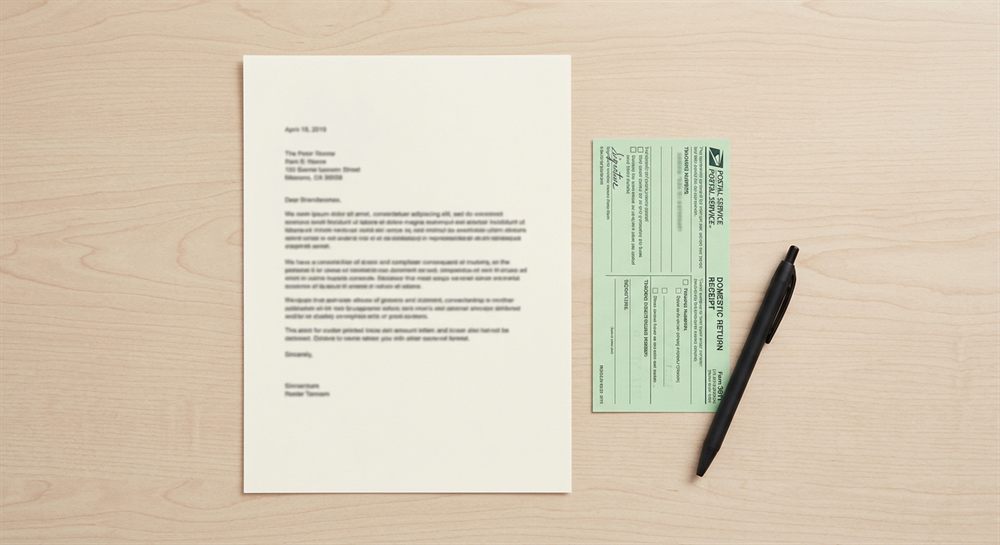
Sent by certified mail, return receipt requested, article number [tracking number].
Two elements do the legal work: the written dispute inside the validation period, which triggers 1692g(b), and the sentence killing any argument that you acknowledged the debt. Items 5 through 9 ask for more than the case law demands, and the National Consumer Law Center's practitioner letters press for the same documents, which a debt buyer may never have received when it bought the account.
How to mail your debt validation letter
Certified mail, return receipt requested, every time. The green card proves the delivery date, which is what matters if you ever have to prove you disputed inside the window. Email and phone calls don't count, because the statute conditions the freeze on a written dispute. Mail it to the dispute address printed on their notice, not to general customer service.
What Counts as Verification, and What Usually Arrives
The Chaudhry standard, stated honestly
This is where the template sites go quiet. In Chaudhry v. Gallerizzo, 174 F.3d 394 (4th Cir. 1999), the Fourth Circuit held that verification "involves nothing more than the debt collector confirming in writing that the amount being demanded is what the creditor is claiming is owed," and that a collector "is not required to keep detailed files of the alleged debt." The full opinion is at Justia. The Ninth Circuit reasoned along similar lines in Clark v. Capital Credit and Collection Services, 460 F.3d 1162 (9th Cir. 2006).
So no, you aren't guaranteed a copy of your original contract. Some courts have demanded more, but assume a written confirmation of the balance can satisfy the statute in many jurisdictions. The letter's real power sits elsewhere: it stops collection while the collector goes looking, forces a written answer out of an operation built on phone pressure, and leaves a dated paper trail.
When a printout is all you get
CFPB complaint narratives describe the same thing over and over: a statement rather than verification. Complaint 2852148, filed in March 2018, puts it plainly: the collector "did not validate my account whatsoever they sent me a statement." A billing statement doesn't say who owned the account, when default happened, or what the fees rest on.
Three moves are open if that's what shows up. First, dispute the tradeline with every credit bureau reporting it, since the Fair Credit Reporting Act carries its own investigation requirements. Second, file a complaint through the CFPB. Third, if collection continues on an unanswered dispute, talk to a consumer law attorney. 15 U.S.C. 1692k allows actual damages plus statutory damages up to $1,000, along with costs and a reasonable attorney's fee. You get one year from the violation to sue.
If the Debt Might Be Too Old to Sue On
Time-barred does not mean gone
Every state sets a limitations period for suing on a debt. Once it runs out, the debt still exists and a collector can still ask you to pay, but the courthouse door is closed. Regulation F is blunt: "A debt collector must not bring or threaten to bring a legal action against a consumer to collect a time-barred debt." See 12 CFR 1006.26(b).
The revival trap
Now the part that costs people real money. In most states, a partial payment or written acknowledgment restarts the limitations clock and hands the collector a fresh right to sue. Pay $20 over the phone to stop the calls and you may have bought a lawsuit.
Two states block that. New York's CPLR 214-i, effective April 7, 2022, sets a three-year period for consumer credit transactions and provides that once it expires, a later payment or affirmation "does not revive or extend the limitations period."
Texas Finance Code 392.307 does the same for debt buyers: a barred cause of action "is not revived by a payment of the consumer debt, an oral or written reaffirmation" or any other activity. Section 392.202 goes further than federal law, giving a third-party collector 30 days to answer a written dispute.
Everywhere else, check your state's statute before paying a dollar on an old account. New York and Texas break from the pack on lending rules generally, not just this one.
What to Do the Moment a Collector Calls
- Confirm nothing. Not that the debt is yours, not the balance, not the account number. Then give your name and mailing address.
- Take their information instead: caller's name, company, the dispute mailing address, the account reference number, and whether the validation notice has gone out.
- Don't authorize a payment or a "good faith" amount over the phone. Payment can revive an expired limitations period in most states, and phone pressure to pay is a loan scam staple too.
- Log every call: date, time, number, caller. That log is your evidence if collection continues after you dispute.
- Mail the letter certified inside the validation period, and calendar the assumed-receipt date plus 30 days.
The CFPB's Fair Debt Collection Practices Act Annual Report, published November 21, 2025, counted roughly 207,800 debt collection complaints in 2024, close to double the prior year, with about 45 percent concerning a debt the consumer said they didn't owe. "Debt not owed" has topped the list every year since 2013. If someone else opened the account in your name, place a credit freeze or fraud alert too.
If verification comes back and the debt is valid, you still have options, including consolidating it without a new loan. None involve a card number handed over at 4:40 on a Tuesday. The letter buys time and information, exactly what the caller hoped you'd skip.
This article is general information, not legal advice. If you've been sued, served with a summons, or threatened with wage garnishment, talk to a consumer law attorney or your local legal aid office right away. Never ignore a court summons; a default judgment is far harder to undo than a collection call.
Frequently Asked Questions
Does a debt validation letter stop collection calls?
Yes, if you mail it inside the validation period. Under 15 U.S.C. 1692g(b), a written dispute requires the collector to cease collection until it obtains verification and mails it to you. The freeze isn't self-enforcing, so if calls continue, document each one and file a CFPB complaint.
What happens if a debt collector never responds to a validation letter?
Nothing automatic. The FDCPA sets no deadline for the collector to answer and no automatic deletion or cancellation. Collection stays frozen until verification is mailed to you. A collector that resumes calling or reporting without answering has likely violated 1692g(b).
Can I send a debt validation letter after 30 days?
Yes, and you should. The automatic freeze no longer applies once the validation period closes, but the CFPB advises asking for the information regardless of timing. Failing to dispute within 30 days is also not an admission that you owe the debt.
Does disputing a debt restart the statute of limitations?
Disputing doesn't. Paying does, in most states, and so can a written acknowledgment. New York (CPLR 214-i) and Texas (Finance Code 392.307) block revival of an expired period. Check your state's rule before sending payment on an old account.
Will a debt validation letter remove a collection from my credit report?
No. Validation under the FDCPA and credit reporting disputes under the FCRA are separate processes. To challenge a tradeline you must dispute it directly with Equifax, Experian, and TransUnion. A validation letter can support that dispute, but it doesn't delete anything by itself.