


You open your banking app the night before you plan to apply for a personal loan. Your score says 690, and you feel good about it. Then the lender pulls your file and quotes you a number in the 650s instead, and suddenly you're wondering if something is wrong with your credit, or wrong with the app, or wrong with you.
Usually, nothing is wrong. You just ran into one of the most common, least explained mismatches in personal finance.
The number in your free app is usually a Vantage credit score, not the score your lender actually pulls. The two come from two different companies, using two different formulas, on two different rulebooks. Neither number is fake; both are just answering the question "how risky is this borrower?" in two different ways.
Once you know who's behind each number and how their models actually differ, the gap becomes exactly what it is: two measuring sticks reading the same information a little differently. That distinction matters most in the days right before you submit a loan application, when the number in front of you is about to shape the rate you're offered.
Who Actually Builds the Vantage Credit Score
The score most people see in a free app comes from a specific company called VantageScore Solutions, LLC, formed in 2006 as an independently managed joint venture owned jointly by the three nationwide credit reporting agencies: Equifax, Experian, and TransUnion. Each bureau markets and sells VantageScore products under license from VantageScore Solutions.
FICO, by contrast, is a separate company (Fair Isaac Corporation) with its own scoring models, sold separately to lenders. The two companies compete for the same job: turning your credit report into a three-digit number a lender can trust. They just don't agree on exactly how to do it.
Which App Shows Which Score
Here's where a lot of the confusion actually starts. Credit Karma displays a VantageScore 3.0 built from your Equifax and TransUnion files. It is not a FICO score, and it's worth being precise about the version too: it's VantageScore 3.0, not the newer VantageScore 4.0.
Meanwhile, most lenders pull a specific FICO Score version tailored to the product they're underwriting. A credit card issuer might pull FICO Score 8. A mortgage or auto lender has historically pulled an older FICO version (per Credit Karma).
So when you compare your app score to your lender's quote, you're often comparing VantageScore 3.0 against a FICO version from a different generation entirely, built for a different purpose. That gap is the actual reason the numbers rarely line up, and it has nothing to do with a mistake on your part.
If you're just starting to build credit and wondering what a "normal" starting number even looks like, or where the floor and ceiling of the score range sit, that's worth understanding before you get hung up on a gap between two different models. It helps to know what counts as a genuinely low score before you assume a gap like that means trouble.
Three Real Differences Between VantageScore and FICO
The gap between your app score and your lender's score traces back to specific, documented differences in how each model reads your credit file. Three matter most for a first-time borrower.
1. Scoring thin credit files
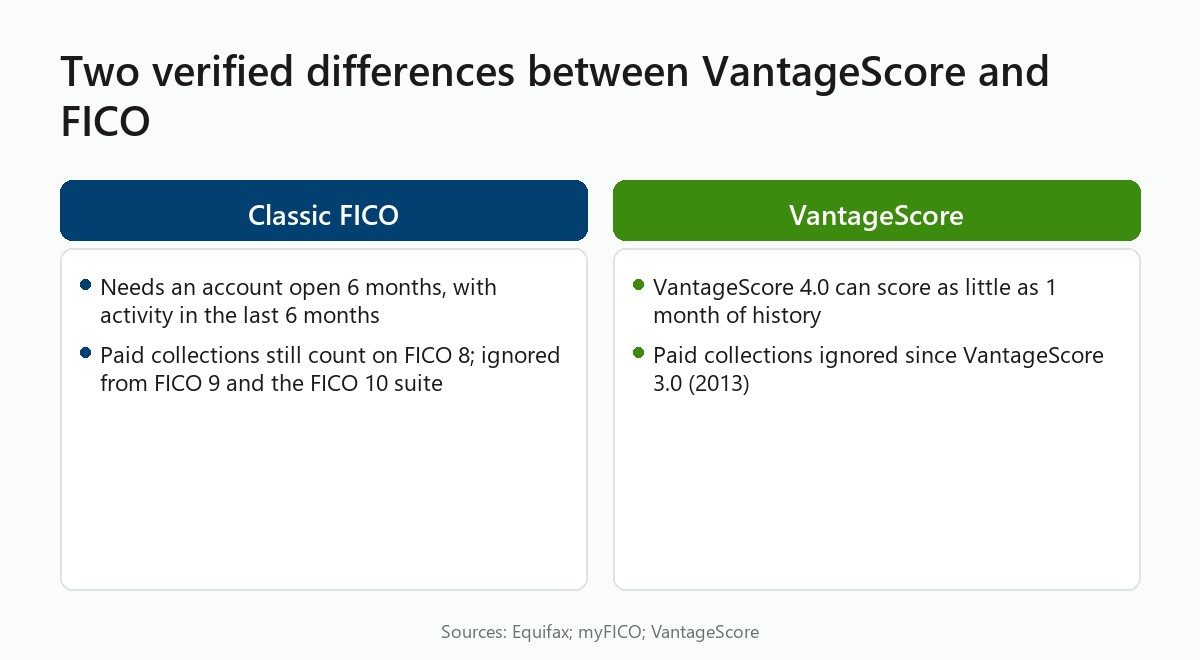
If you're new to credit, or you've only had one or two accounts for a short time, Equifax's comparison of VantageScore 4.0 and classic FICO scores shows VantageScore 4.0 can generate a score with as little as one month of credit history on file. It can also pull in trended and alternative data, like rent, utility, and telecom payment history, to score people who don't have enough traditional history for a FICO score. VantageScore's own materials state that its 4.0 model can score roughly 33 million more consumers than other commercially available models (that figure comes from VantageScore itself, so treat it as a company claim rather than an independently audited number). Classic FICO models require at least one account that's been open for six months with activity reported in the last six months.
In plain terms: if your credit file is thin, VantageScore's newer model is built to find something to work with, while classic FICO may simply have nothing to score yet. If you've ever wondered what credit score you start with the moment you open your first account, this is exactly why that starting number can look so different depending on which model is doing the counting.
2. Trended data
VantageScore 4.0 also looks at trended credit data, meaning how your balances and utilization moved over roughly the past two years, rather than judging you on a single snapshot in time (Equifax's comparison, cited above). This matters because it means the model can reward you for a genuine pattern of paying down debt, instead of judging you only on where your balance happens to sit the day it's checked.
FICO has a newer model, FICO 10T, that also uses trended data. But the FICO scores most commonly pulled today for credit cards, auto loans, and, until recently, mortgages don't use it. So "trended data" is a feature of the newest models on both sides, not a clean VantageScore-versus-FICO split, and whether you benefit from it depends entirely on which specific version your lender happens to pull.
3. Paid collections and medical debt
This is where version numbers matter most, and where it's easiest to accidentally overstate what a model actually does.
VantageScore says it stopped counting paid collection accounts starting with VantageScore 3.0 in 2013, and that carries forward into VantageScore 4.0. On the FICO side, myFICO's guidance on how collections affect your score confirms paid-in-full collections are disregarded starting with FICO Score 9 and the FICO Score 10 suite, but not FICO Score 8, which still counts them. Since FICO 8 remains one of the most widely pulled FICO versions for credit cards, a paid collection sitting on your report could still be dragging down the score a card issuer sees, even after VantageScore has stopped counting it entirely.
Medical debt gets excluded too, at least on VantageScore's side. VantageScore's own explanation of its medical-debt policy confirms its newest models, 3.0 and 4.0, don't use medical collection debt in the score calculation at all, regardless of the amount or how old it is. VantageScore estimates that consumers with medical collections could see their score rise by as much as 20 points once scored under 3.0 or 4.0.
If you've been chipping away at old collection accounts and wondering why your app score jumped but your lender's number barely moved, this is very likely why. The app and the lender are running that information through rulebooks written years apart.
The FHFA Decision That's Reshaping Mortgage Scoring
This part of the story is still unfolding, and it's worth knowing even if you're applying for a personal loan rather than a mortgage, because it shows where credit scoring is headed industry-wide.
According to the Federal Housing Finance Agency's policy page on credit scores, the FHFA, the regulator that oversees Fannie Mae and Freddie Mac, announced on October 24, 2022 the validation and approval of two new credit score models for use in the conventional mortgage market: FICO 10T and VantageScore 4.0. Both models had to clear required accuracy and reliability thresholds before FHFA would approve them.
Implementation has been phased over several years since that validation. A limited lender pilot began in 2026, and in September 2026, FHFA directed Fannie Mae and Freddie Mac to accept VantageScore 4.0 scores from all approved originating lenders. The 2022 validation date is the firm, confirmed anchor here; the pace and exact scope of the 2026 rollout are still developing, so treat that piece as directionally accurate rather than fully settled.
Why does a mortgage-market decision matter to you if you're applying for a personal loan? Because it signals that the model built to score thin files and use trended and alternative data, VantageScore 4.0, is gaining ground in exactly the corner of lending that's historically leaned hardest on the oldest FICO models. Scoring standards shift slowly, but they do shift, and this is one of the clearest signs of where they're heading.
What to Do When Your Two Scores Disagree, Before You Apply
You don't need to solve the industry's scoring disagreement. You just need a plan for your own application. Here's the sequence that actually helps.
- Ask the lender directly which score they pull. Before you apply, ask what scoring model and version the lender uses for a personal loan decision. A specific, honest answer here saves you from anchoring on the wrong number.
- Treat your free-app score as a trend line, not a decision number. Your VantageScore 3.0 from Credit Karma is genuinely useful for tracking whether your habits are moving your credit in the right direction over months. It's a poor tool for predicting the exact number a lender will quote you tomorrow.
- Don't panic over a gap between the two numbers. A gap between models is normal, given how differently VantageScore and FICO are built. But if the gap is unusually large or you can't otherwise account for it, that's a good reason to check your full report at each bureau.
- Check how lenders will actually pull your score before you formally apply. Many lenders let you see a preliminary rate (prequalification) through a soft pull, which doesn't affect your credit, before you commit to a full application. That's the moment to compare real numbers instead of guessing.
- Understand what the FICO number actually costs you in dollars. The gap between score tiers isn't cosmetic. It shows up directly in the interest rate you're offered, which is worth understanding in real terms before you sign anything.
- Keep building, regardless of which number you're staring at. The habits that move a FICO score, like paying on time and keeping balances low relative to your limits, tend to move a VantageScore in the same direction too. Someone who's climbed from the low 700s toward the 800s got there by building a track record that credit scoring models generally reward, not by chasing one specific model.
None of this requires you to become a credit-scoring expert. It just means walking into your application knowing which measuring stick is being used, instead of assuming the number in your pocket is the only one that counts.
The Bottom Line
The vantage credit score you see in a free app and the FICO score your lender pulls simply come from different sources, built to answer the same question in different ways. VantageScore 4.0 scores thinner files and uses trended balance data; both 3.0 and 4.0 ignore paid collections and medical collections. FICO's treatment of paid collections depends heavily on which version a lender pulls, with FICO 8 still counting them while FICO 9 and the FICO 10 suite no longer do.
Both numbers are legitimate answers to slightly different questions, and once you know that, a mismatch between your app and your lender stops being a mystery. Before you apply, ask your lender directly which scoring model and version they pull. That's the single most useful thing you can do with this information.
Frequently Asked Questions
Is a vantage credit score the same as a FICO score?
No. VantageScore and FICO are built by two separate companies using two separate models. VantageScore Solutions, LLC is a joint venture owned by Equifax, Experian, and TransUnion, while FICO scores come from Fair Isaac Corporation. The two systems weigh factors like thin files and collections differently depending on the specific version used.
Why does Credit Karma show a different score than my lender?
Credit Karma displays a VantageScore 3.0 built from your Equifax and TransUnion files, while most lenders pull a specific FICO Score version chosen for their product, such as FICO Score 8 for credit cards. Comparing the two is comparing different models built for different purposes, which is why the numbers rarely match exactly.
Does VantageScore count paid collections against you?
No. VantageScore has excluded paid collection accounts from its scoring since VantageScore 3.0, launched in 2013, and that continues in VantageScore 4.0. On the FICO side, paid collections are disregarded starting with FICO Score 9 and the FICO Score 10 suite, but FICO Score 8, still one of the most commonly pulled versions, does count them.
Will VantageScore 4.0 be used for mortgages?
The Federal Housing Finance Agency (FHFA) validated and approved VantageScore 4.0, alongside FICO 10T, for Fannie Mae and Freddie Mac use on October 24, 2022. Per news coverage, implementation has since included a 2026 lender pilot and a September 2026 directive for approved lenders to accept VantageScore 4.0, though the exact pace and scope are still settling.
Which score should I trust before applying for a personal loan?
Neither score is inherently more trustworthy: they're built for different purposes. Use your free-app VantageScore to track your overall trend over time, then ask your specific lender which scoring model and version they use before you apply, so you know what number will actually be part of the decision.