


You pulled your score and saw 620. Now you want a straight answer. So here it is. A 620 credit score gets you approved at some personal loan lenders, flatly rejected at others, and it gets you an APR that will not be pretty.
I spent 28 years underwriting loans at a community bank and a credit union, and the number one thing I watched happen to Fair-tier borrowers was this: they applied at the wrong lender first, got declined, and assumed the door was shut everywhere. Usually just that particular door was shut, and nobody had told them which one to try instead.
Where 620 Sits in the Fair Credit Tier
According to myFICO's official credit score tiers, FICO breaks its scoring range into five tiers: Poor below 580, Fair from 580 to 669, Good from 670 to 739, Very Good from 740 to 799, and Exceptional from 800 to 850. A 620 sits 40 points above the Fair tier floor and 50 points below the Good tier threshold of 670.
Put another way, you're 49 points from the top of your own tier and 50 from the next one up. You're in the lower half of Fair, and that distinction matters more than most people realize when they're comparing loan offers.
About 17 percent of all consumers land somewhere in the Fair range, 580 to 669, per myFICO. That's a big group, and lenders know it. Lenders may classify borrowers in this band as subprime, a word that sounds harsher than it needs to.
It just means the lender is pricing in more risk before they approve your file. It does not mean you're unbankable, and it does not mean every lender treats a 620 the same way. Some barely blink at it. Others won't touch it.
Think of it the way an underwriter does: risk gets priced. A lender that approves a 620 file is charging a rate that covers what its own default data tells it about borrowers at that score. That's a business decision. It's worth remembering the next time a rejection letter makes it feel personal.
If you're not sure how you ended up at 620 in the first place, whether it's late payments, high card balances, or a thin file with barely any credit history behind it, our guide to what credit score you start with is worth a look before you start applying anywhere.
The Lenders a 620 Score Clears
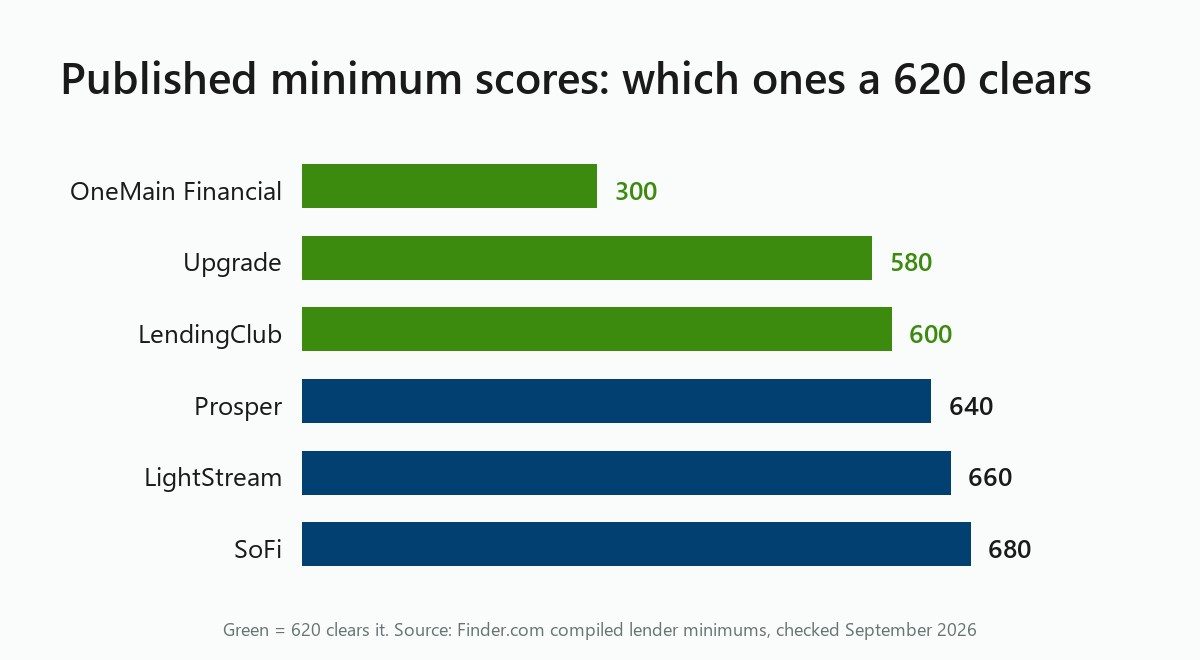
Here's where the generic "improve your credit" articles stop being useful and specifics start mattering. According to Finder.com's compiled table of published lender minimums, updated June 9, 2026, a 620 borrower clears several well-known personal loan lenders:
- Upstart: no stated minimum in most states. Upstart underwrites with alternative data as well as your score, so there's no published floor for 620 to miss, though approval is still not guaranteed.
- OneMain Financial: 300 minimum. OneMain will look at a 620 file, though it frequently pushes lower-score borrowers toward a secured loan structure that requires collateral.
- Upgrade: 580 minimum. A 620 score clears with room to spare.
- LendingClub: 600 minimum. A 620 score clears, but only by 20 points, so don't expect the best terms this lender offers to a stronger file.
None of that is a guarantee. These are published floors, and published floors move without warning. A minimum listed three months ago can be outdated by the time you hit submit.
Upstart and OneMain in particular lean on alternative-data underwriting, meaning your score is one input among several, not the single gate that decides your application. That's worth knowing before you assume a decline anywhere is final. Confirm current requirements directly with each lender before you apply.
In my underwriting days, the file that got approved was rarely the highest score in the stack. It was the file where the income documentation was clean, the debt-to-income ratio left room to breathe, and nothing on the application contradicted anything on the credit report. A 620 score with a tidy file beats a 650 with sloppy paperwork more often than people expect.
That's how it worked at the bank and the credit union where I sat across the desk from applicants. It may work differently at a purely online lender, where more of the file gets decided by algorithm before anyone looks at it.
If a bank or online lender still turns you down, a credit union is worth a serious look before you give up on the process entirely. Credit unions weigh your full relationship with them alongside your score, and our guide to bad credit personal loans at a credit union walks through how that process differs from a standard online application.
Lenders that still say no at 620
Now the other side of the ledger. These lenders' published minimums sit above 620, so a 620 score misses them outright, per that same Finder.com comparison:
- Prosper: 640 minimum, a 20-point miss.
- Best Egg: 640 minimum, a 20-point miss.
- Rocket Loans: 640 minimum, a 20-point miss.
- Achieve: 640 minimum, a 20-point miss.
- LightStream: 660 minimum, a 40-point miss.
- SoFi: 680 minimum, a 60-point miss.
Notice the pattern. Twenty points separates you from four different lenders on that list. Twenty points is a gap the moves below can work on, and we'll get to exactly how further down.
For now, apply where the door is already open. Wasting a hard inquiry on SoFi when you're sitting at 620 does nothing but ding your score for a decline you could have predicted before you ever hit submit.
If a lender offers a soft-pull rate check, the kind that doesn't touch your score at all, use it first. I watched too many borrowers apply cold, take a hard inquiry, and get an offer they would have walked away from if they'd seen the number before it hit their credit file.
What APR to Actually Expect at 620
I'm not going to hand you a single average APR number for a 620 score. Several sites will show you a tidy figure and act like it's settled fact, but I could not trace any of those numbers to a primary source. So I'm not printing a figure I can't stand behind, and you should be skeptical of any article that does hand you one without saying where it came from.
What we can do instead is look at the real published ranges from lenders a 620 score actually clears, and tell you honestly where in that range you'll likely land. Upgrade's own published rate page shows a range from 7.74 percent to 35.99 percent APR, on terms of 24 to 84 months.
Other lenders on the clears list publish their own wide ranges too. In every case, that low end is reserved for the borrowers with the strongest files, the ones sitting well up in Good or Very Good territory.
At 620, expect your offer to land in the upper third to upper half of whatever range a lender publishes. Don't expect the advertised floor rate at Fair credit. That rate is reserved for top-tier borrowers, and 620 isn't that.
If you want to see what that spread costs in real dollars over the life of a loan, our comparison of a 580 versus a 680 score on a $15,000 loan breaks down the payment difference in plain terms.
The Moves That Push 620 Toward 670
Fifty points stands between you and the Good tier. That's closer than it feels once you know exactly what moves the needle. Three actions actually work, and here's what each one does and does not promise.
Pay down your revolving balances. Utilization, how much of your available credit you're using, makes up roughly 30 percent of your FICO score, the second-biggest factor after payment history, according to Experian's credit-improvement guidance. Card issuers typically report your balance once a month, around your statement closing date.
Timing is the trick most people miss: knock the balance down before that statement date, and the impact shows up within a few months as new, lower balances get reported to the bureaus. This move sits entirely in your own control. You don't need a family member, an issuer's reporting policy, or anyone else's cooperation to make it happen.
Become an authorized user on someone else's account. If a family member with a long, clean payment history adds you as an authorized user, that account's full history can land on your report and produce an immediate positive impact, once the issuer reports it.
That reporting typically happens within a month or two, per Experian. The catch: not every card issuer reports authorized users to the bureaus. Ask before you count on this one, because if the issuer doesn't report it, the move does nothing for your score at all.
Build a streak of on-time payments. Payment history is 35 percent of your score, the single largest factor of all, per Experian. Experian is careful not to attach a specific number of days or months to how fast this shows up, and so am I.
Anyone who tells you "you'll gain X points after 90 days" is making that number up. What's true is that the improvement builds gradually over consecutive on-time cycles. There's no shortcut here, just no more missed due dates, starting today.
For a tighter, dated plan built around a specific window, our breakdown of three credit score moves you can make in 60 days lays out the sequence in more detail than we have room for here.
When 620 Isn't Enough Yet
Sometimes the honest answer is to wait a bit, or take a different door. If every lender on that first list still declines you, or the APR that comes back would strangle your monthly budget, a personal loan built for damaged credit, not just Fair credit, might be the better fit right now.
Our guide to getting a personal loan with horrible credit covers lenders and loan structures built specifically for scores well below 620, where a personal loan through a prime lender simply isn't going to happen yet no matter how well you present your application.
Sometimes the math says wait. Sometimes it says the rate gap isn't worth losing three more months to a problem you needed solved last week. Only you can weigh that trade-off, and the real numbers above are what you weigh it with.
What to Do This Week if You're at 620
Start with Upstart, Upgrade, or LendingClub, the lenders whose published minimums you already clear. Pay down your card balances before your next statement closes.
If a trusted family member has an old account in great standing, ask whether their card issuer reports authorized users to the bureaus before you rely on that move. Then set every bill on autopay so a missed due date never chips away at the one factor that carries the most weight.
None of that fixes 620 overnight. All of it moves you toward 670 faster than doing nothing, and every lender that clears your score today is still sitting there waiting while you work on the rest.
I sat across the desk from thousands of applicants, and the ones who came back later with a cleaner file almost always got a better offer the second time around. The score moved because they stopped guessing and started working the three levers that actually count. There's no reason a 620 file can't do the same thing.
Frequently Asked Questions
Can I get approved for a personal loan with a 620 credit score?
Yes. Lenders including Upstart, Upgrade, LendingClub, and OneMain Financial publish minimum score requirements a 620 score clears, though expect an APR well above each lender's advertised floor rate, since that floor is reserved for stronger files, per Finder.com and Upgrade's own rate page.
What personal loan options exist with a credit score of 600?
A 600 score meets LendingClub's 600 minimum exactly, and it clears Upgrade's 580 floor and OneMain's 300 floor. Upstart publishes no stated minimum in most states, so there's no published floor to miss there either, though approval is never guaranteed. A 600 misses any lender with a 640-plus minimum, a gap of 40 points or more, per Finder.com.
Is 620 a good or bad credit score for a loan?
620 sits in FICO's Fair tier, 580 to 669, 40 points above the tier floor and 50 points below the Good tier that starts at 670, per myFICO. It's workable for a personal loan at several named lenders, just not at the rates a Good-tier score commands.
How much can I borrow with a 620 credit score?
Loan amounts vary by lender and get set during underwriting, once you clear a lender's published minimum. Prequalifying where a lender offers it is the way to find your specific approved amount and available terms.
How fast can I raise a 620 score to 670?
There's no fixed timeline. Paying down revolving balances can show results within a few months as issuers report updated balances, and a clean payment streak builds gradually over consecutive on-time cycles, but Experian gives no fixed day count for either move.