


A refinance personal loan calculator will tell you that swapping a 21.5% loan for one at 14.9% saves $42.13 a month. What it usually will not tell you, at least not without digging, is whether that saving actually clears the fee you just paid to get it. That is the whole question behind a refinance decision, and it is answerable with one formula and a calculator you already own.
This piece opens the hood. It walks through the standard amortization formula that every refinance personal loan calculator runs behind the scenes, then works three full numeric examples so you can check any online tool's output against your own arithmetic before you sign anything. Each example uses real inputs, every intermediate figure, and the final decision that number produces, so nothing is left for you to take on faith.
A personal loan refinance calculator is only a convenience. The formula underneath it is fixed and public, which means any calculator that hides its assumptions, whether about your remaining balance, the fee, or the term, can be checked against the same arithmetic a credit analyst would run by hand.
What a Refinance Calculator Is Actually Computing
Every personal loan refinance calculator needs exactly four inputs: your remaining balance on the existing loan (not the original amount you borrowed), the remaining term in months, the new APR you have been quoted, and the new loan's origination fee, if any. From those four numbers, it derives everything else: the new monthly payment, the total interest over the remaining term, and the break-even point where accumulated savings finally cover the fee.
The engine underneath is the standard amortization payment formula. For a principal P, a monthly interest rate r (APR divided by 12), and a term of n months, the monthly payment M is:
M = P x r(1+r)^n / [(1+r)^n minus 1]
Remaining balance after k payments follows a related formula: P(1+r)^k minus M[(1+r)^k minus 1]/r. That second formula matters because it is how you find your true current balance instead of assuming it is close to what you originally borrowed. A calculator that skips straight to "new payment" without showing this step is asking you to trust a black box. You do not have to.
Example 1: The Break-Even Test, Fee Paid Up Front
Start with a borrower who took out an $18,000 personal loan at 21.5% APR over a 48-month term. Plugging those numbers into the formula above gives an original payment of $562.23 a month. After 18 monthly payments, the remaining balance has dropped to $12,960.37, with 30 months left on the original schedule.
A new lender offers to refinance that $12,960.37 at 14.9% APR, keeping the same 30-month remaining term, with a 6% origination fee of $777.62 paid up front rather than rolled into the balance. Bankrate puts typical personal loan origination fees at roughly 1% to 8%, occasionally higher, so 6% sits mid-range. Running the formula again on the new numbers produces a payment of $520.10 a month, a monthly saving of $42.13 compared to the old loan.
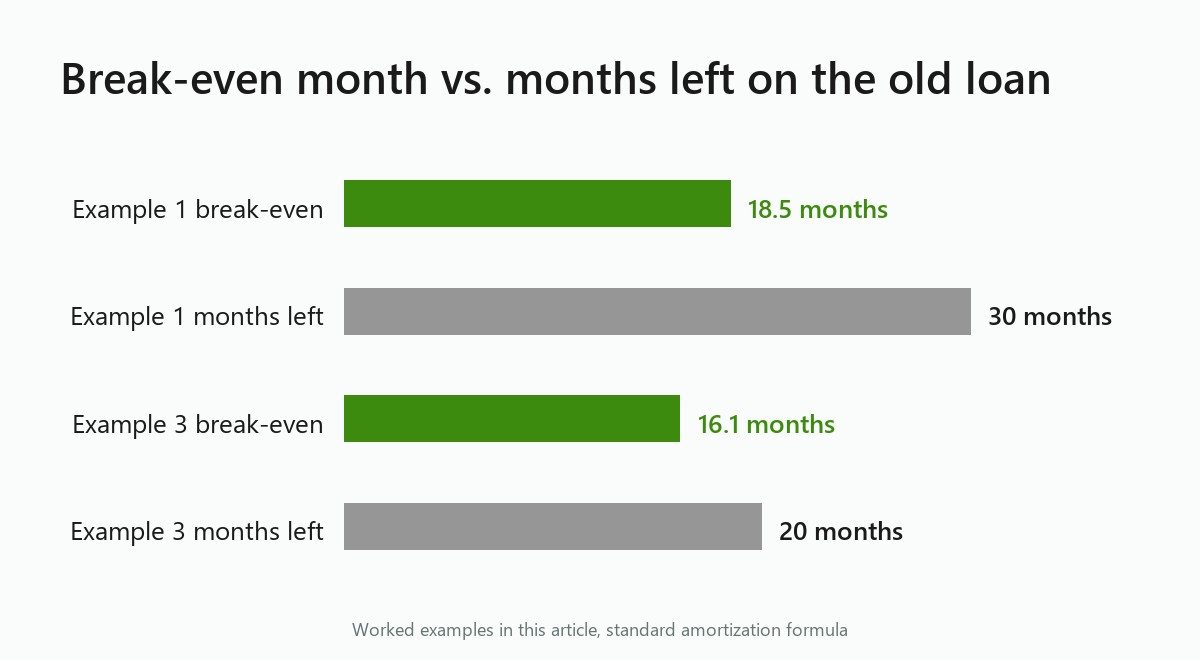
Divide the fee by the monthly saving to find the break-even month: $777.62 divided by $42.13 equals 18.5 months. That is comfortably inside the 30 months remaining, which means the borrower recoups the fee with more than 11 months of pure savings left on the clock. Total interest tells the same story from a different angle: the old loan would cost $3,906.67 in interest over the remaining term, versus $2,642.76 on the new one, a $1,263.91 interest saving (figures are computed from unrounded monthly payments, so totals may be a cent off simple subtraction), or $486.28 once the $777.62 fee is netted out.
Notice what this example does and does not prove. It confirms the refinance is worth it here, on this timeline, at this fee. It says nothing about whether a lower rate always beats a higher one once a fee enters the picture; that is a separate question, and Cash Zella's piece how an origination fee can make a lower rate cost more works through exactly that question on a single new loan. This article is about a different comparison: an existing loan already in repayment against a replacement.
Example 2: The Term-Extension Trade-Off
Take the same refinanced balance from Example 1, $12,960.37 at 14.9% APR, and change only the term. At 30 months, the payment is $520.10 and total interest is $2,642.76, as already shown. Stretch that same balance and rate to 48 months instead, and the payment drops to $360.04 a month, a full $160.06 lower every month.
That is the number a payment-only calculator leads with, because a lower monthly figure looks like an unambiguous win. It is not the whole picture. Total interest on the 48-month version rises to $4,321.56, which is $1,678.79 more than the 30-month version's $2,642.76 (again, unrounded from the exact payment figures). The borrower trades a smaller bill today for a materially larger one over the life of the loan.
Neither choice is wrong on its own. A borrower who needs breathing room in the monthly budget may reasonably accept the extra interest. A borrower who can absorb $520.10 a month is paying roughly $1,679 for the convenience of a lower payment by choosing the longer term instead.
The point is that a calculator showing only "your new payment" hides this trade-off entirely. Run both term lengths through the formula before deciding, because the same principal and the same rate can still produce two very different total costs depending on how many months you stretch the schedule.
Example 3: When a Prepayment Penalty Enters the Math
Prepayment penalties complicate the arithmetic without necessarily killing the deal. They add a second upfront cost on top of the new loan's origination fee, and that second cost sits on the old loan, not the new one, which is easy to overlook if you only compare the two loans' rate sheets. Consider a borrower with $10,000 remaining on an existing loan at 24.99% APR, 20 months left on the term, and a current payment of $616.45 a month. The old lender charges a 2% prepayment penalty on the payoff balance, which comes to $200.
A new lender offers the same $10,000 principal at 15.99% APR, matching the 20-month remaining term, with a 5% origination fee of $500. Add the penalty and the fee together and the combined upfront cost is $700. The new payment works out to $572.89 a month, a monthly saving of $43.56.
Break-even here is $700 divided by $43.56, or 16.1 months, still inside the 20-month remaining term, but with a noticeably thinner margin than Example 1's 18.5-month break-even against a 30-month runway. Total interest confirms the refinance still wins: $2,328.94 on the old loan versus $1,457.70 on the new one, an $871.24 interest saving, or $171.24 once the combined $700 in upfront costs is subtracted.
That margin is thin enough to matter. A shorter remaining term, a larger penalty, or a smaller rate gap could flip this same scenario negative. If your own loan agreement includes a payoff or prepayment clause, run this exact test with your own numbers before assuming a lower rate automatically pays for itself.
The Consumer Financial Protection Bureau's explainer on prepayment penalties addresses the concept mostly in the context of mortgages, where a penalty is typically limited to the first three to five years of the loan, and it does not confirm or rule on prepayment penalty practices for personal loans specifically. No federal rule comparable to the mortgage-focused Ability-to-Repay/Qualified Mortgage rule applies to personal loan prepayment terms. Prepayment terms on a personal loan are set by the individual loan contract, and state law may add restrictions in some cases, so your own agreement remains the only reliable source for whether a penalty applies to you and how it is structured.
Remaining Balance and Amortization: Why Refinancing Resets the Clock
Every amortized loan front-loads interest. Early payments are weighted heavily toward interest and lightly toward principal, and that ratio shifts toward principal as the loan matures. Refinancing replaces the remaining balance with a brand-new amortization schedule, which means the new loan starts that front-loaded pattern over again, even though the balance itself may be smaller than the original.
This is the detail Example 1's borrower needs to internalize. Refinancing after 18 payments on a 48-month loan restarts the interest-versus-principal split on a $12,960.37 balance instead of the original $18,000, over whatever new term is chosen, rather than picking up the old schedule where it left off. That is precisely why the remaining balance, not the original loan amount, has to be the P in every calculation here.
A calculator that uses your original principal instead of your current payoff amount will overstate both your new payment and your potential savings. The gap between the two figures grows with every payment you have already made, which is why an 18-month-old loan produces a bigger discrepancy than a 3-month-old one. For a fuller walkthrough of how amortization works on a personal loan, Cash Zella's application-to-payoff guide covers the mechanics in more depth.
The Hard-Inquiry Cost of Applying
Comparing offers has its own price. Applying for a new loan generates a hard inquiry, which typically costs under about 5 to 10 points on a FICO score and affects FICO scoring for roughly 12 months, though it stays visible on the credit report for up to two years, and VantageScore can weigh it for up to 24 months.
Here is where refinance shopping differs from something like mortgage or auto rate shopping. FICO's model groups multiple hard inquiries for the same loan type within a set window, typically somewhere between 14 and 45 days depending on the scoring version, and counts them as a single inquiry for scoring purposes. That deduplication window applies reliably to mortgage, auto, and student loans.
Personal loans sit outside that reliable coverage. A borrower comparing four refinance offers in the same week may end up with four separate hard inquiries on the report rather than one grouped event, each carrying its own scoring impact under Experian's figures cited above. Cash Zella's guide to how rate shopping affects your credit goes deeper into which inquiries do and do not get grouped.
Comparing offers still makes sense despite that cost. Do it efficiently: work through the math in Examples 1 through 3 first, narrow the field to two or three lenders whose advertised rates could plausibly clear your break-even point, and apply to those instead of a dozen speculative ones. The inquiry cost is small and temporary; applying to lenders whose numbers were never going to work is not a cost worth paying at all.
A Short Checklist Before You Refinance
- Pull your exact payoff quote from your current lender, not your original loan balance. That figure is your P in the formula, and it is usually different from what you remember borrowing.
- Read your existing loan's prepayment or payoff clause directly. Terms vary by lender and by state, and the only reliable source for whether a penalty applies to you is your own agreement.
- Compare APR, not the headline rate. The APR bakes in the origination fee's effect on true cost, which the bare interest rate does not.
- Decide up front whether you are paying the origination fee out of pocket or financing it into the new balance. Financing it changes both the break-even math and the principal you are amortizing.
For a broader framework on evaluating any loan offer, whether a refinance or a first-time application, Cash Zella's rundown of the five numbers worth comparing on any loan offer lays them out before you sign.
Why This Math Matters
Borrowers running this math often find the same surprise twice: the rate dropped, but the payment barely moved once the fee and remaining term were accounted for, or the interest they thought they would save had already been paid off on the old loan before they got around to refinancing. Both outcomes are visible in the amortization formula before you apply, not after. Any refinance calculator is only as good as the numbers you feed it, and now you know exactly what those inputs are and what the tool does with them. Running the numbers yourself, even as a rough check against a calculator's output, turns refinancing from a trust exercise into a verified decision.
Frequently Asked Questions
What inputs does a refinance personal loan calculator actually need?
Four numbers: your current remaining balance (from an exact payoff quote, not your original loan amount), the remaining term in months, the new loan's APR, and its origination fee. Those four feed the standard amortization formula that produces the new payment, total interest, and break-even point.
How do I calculate the break-even month by hand?
Divide the total upfront cost of refinancing (origination fee, plus any prepayment penalty on the old loan) by the monthly savings between the old and new payments. In Example 1 above, $777.62 divided by $42.13 equals an 18.5-month break-even.
Does a longer term always mean a worse refinance?
A longer term usually raises total interest. Example 2 showed a 48-month term lowering the monthly payment by $160.06 while raising total interest by $1,678.79 compared to keeping the 30-month remaining term. Whether that trade is worth it depends on how much monthly breathing room you need.
Will refinancing hurt my credit score?
Applying generates a hard inquiry. Experian says a hard inquiry typically costs under 5 to 10 FICO points and affects the score for about 12 months. Because personal loans are not reliably covered by FICO's rate-shopping deduplication window, comparing several offers in the same week can mean several separate inquiries rather than one.
Do personal loans commonly have prepayment penalties?
Bankrate notes reputable online personal-loan lenders typically skip this fee altogether. No federal rule limits them for personal loans the way the Ability-to-Repay/Qualified Mortgage rule limits them on most mortgages, and state rules vary. Check your own loan agreement's payoff clause directly.