


You pulled an old envelope out of the mailbox, or worse, someone handed you a summons at your front door. Either way, you're now asking a question I heard plenty over the years: can they still come after me for this? In Florida, the honest answer is "it depends on your paperwork," and I mean that literally. The statute of limitations on Florida credit card debt runs either four years or five years, and which one applies to your account comes down to a document fight most collectors would rather you never think about.
Here's what does and doesn't reset that clock, what a debt collector is legally barred from doing to you once it's expired, and why your credit report timeline has nothing to do with any of this. (If you're dealing with an old balance you're trying to work through rather than fight in court, our debt validation letter template walks through how to make a collector prove what it's owed before you pay anything.)
What Florida Statute 95.11 Actually Says
Florida splits contract debt into two buckets, and the split determines your deadline.
Under Fla. Stat. § 95.11(2)(b), a lawsuit on "a contract, obligation, or liability founded on a written instrument" has to be filed within 5 years of when the claim accrued. Source: Florida Statutes, official Legislature site.
By contrast, Fla. Stat. § 95.11(3)(j) gives a claim "not founded on a written instrument," including "store accounts," just 4 years. Same source as above.
Courts decide that classification case by case, based on what paperwork the creditor can actually produce, and one reason it's contested so often is that many cardholder agreements were never signed, since the customer accepted terms by using the card.
Think about how you opened your last card. You applied online, maybe over the phone, and you started using it. You never signed a loan document the way you would for a mortgage or an auto loan. That distinction matters more than the interest rate ever will if you end up in court.
That gap between how card debt actually gets opened and what the law expects for a "written instrument" is exactly why the classification fight matters so much in practice. It's not a technicality lawyers invented to bill more hours. It's the difference between a creditor easily clearing the 5-year bar and a creditor stuck defending a 4-year claim that may already be time-barred by the time the lawsuit gets filed.
Why Credit Card Debt Gets Fought Over in Court
This is where the fight actually happens. A debt buyer that sues you on an old credit card balance usually doesn't have a signed contract in its file. What it has is a stack of monthly statements and a generic cardmember agreement pulled from a template. Whether that file proves a "written instrument" under the 5-year rule or only supports an "open account" theory under the 4-year rule is the actual fight in Florida county courts.
No single Florida appellate ruling settles this cleanly across the whole state, and I won't pretend one exists. Florida's district courts of appeal haven't spoken with one voice on exactly what documentation proves a written-instrument claim. What actually gets examined is straightforward enough: does the paperwork include a signed application or agreement, or only statements and a terms sheet the debt buyer picked up secondhand?
Courts look at what the creditor can actually produce, and that's a different question than what the headline "5-year rule" implies. If you're holding a complaint right now, look at what's attached as exhibits. A generic terms-and-conditions printout is not a signed agreement, and that gap is exactly what your defense should be built around.
What Restarts (and Doesn't Restart) the Clock in Florida
This is the part that gets misrepresented constantly, in forum comments and in some competitor content too. A lot of people believe that making any payment on an old debt, even five dollars, wipes the slate clean and starts the clock over. In Florida, that's not how it works.
Fla. Stat. § 95.04 requires more than a payment. It says: "An acknowledgment of, or promise to pay, a debt barred by a statute of limitations must be in writing and signed by the person sought to be charged." Source: official Florida Statutes.
The Florida Supreme Court applied this rule in Woodham v. Hill, 78 Fla. 517, 83 So. 717 (1919), and that ruling is still controlling law.
The court held that a bare payment on a debt already barred by the statute of limitations, made without a written acknowledgment that the balance exists and will be paid, does not pull the debt back out of the statute. Source: CourtListener, hosting the official opinion.
I want to flag something important here, because I've seen this misread before. Woodham addresses reviving a debt that's already expired. It doesn't resolve what happens when you make a payment while the clock is still running, before the deadline hits.
That's a separate, more fact-specific question, and courts generally look at the last payment or default date to figure out when the clock started in the first place, not a "the payment restarted everything" theory. Keep those two situations separate in your own head, because a collector's script won't separate them for you.
So if a collector calls about a debt from years back and offers to "work with you" for a small token payment, understand what that call actually is. It's an attempt to get you to say something, in writing if possible, that looks like an acknowledgment.
A payment alone, or a spoken promise to pay, on an already-expired Florida debt doesn't revive it under § 95.04. That doesn't mean you should ignore the call. It means you should know exactly what you're signing or agreeing to before you do it.
One more note on timing. Attorneys who handle these cases regularly explain that a charge-off date or a "date of last activity" on your account is an accounting and reporting convention, not a legal trigger for the statute of limitations. I'm passing that along as practitioner consensus rather than a cited statute, because no single Florida law ties the clock to the charge-off entry itself.
What a Debt Collector Legally Cannot Do
Once a debt is past its Florida deadline, federal law puts real teeth behind that expiration. Under 12 CFR § 1006.26(b), part of the CFPB's Regulation F, "a debt collector must not bring or threaten to bring a legal action against a consumer to collect a time-barred debt." Source: eCFR current text.
This prohibition was part of Regulation F's original 2020 debt collection rule. In a May 2023 advisory opinion, the CFPB confirmed the ban applies even if the collector doesn't know or have reason to know the debt is time-barred, meaning a collector can't sue on stale debt and later claim it simply didn't realize the clock had run. Source: Federal Register, advisory opinion 2023-09171, "Fair Debt Collection Practices Act (Regulation F); Time-Barred Debt."
Florida's own consumer collection law, the Florida Consumer Collection Practices Act, also bars debt collectors from misrepresenting a debt's legal status.
The Other Clock: Your Credit Report's Seven-Year Rule
Here's the confusion I ran into more than almost any other, sitting across the desk from borrowers. They'd tell me a debt "fell off" their credit report, so they figured they were in the clear. That's mixing up two completely unrelated clocks.
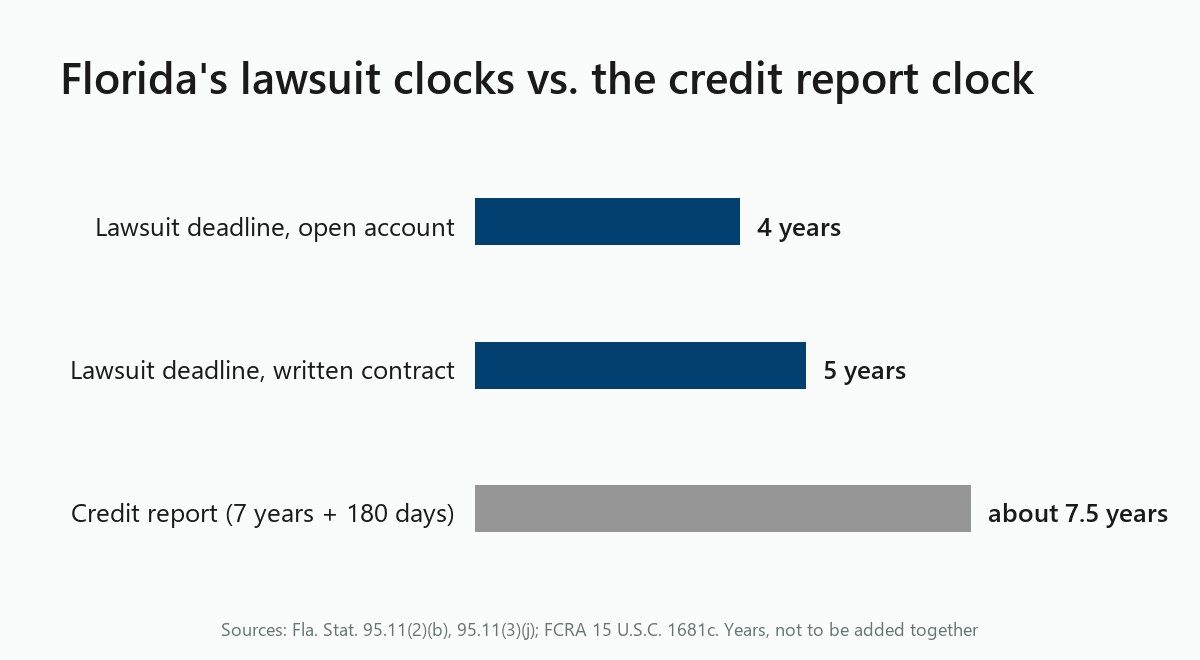
The seven-year rule comes from the Fair Credit Reporting Act, not from Florida's statute of limitations. Under 15 U.S.C. § 1681c(a)(4), consumer reporting agencies generally cannot include "accounts placed for collection or charged to profit and loss which antedate the report by more than seven years." Source: Cornell Law School Legal Information Institute.
The start date for that seven-year clock isn't the charge-off date, and it isn't your last payment date either. Under 15 U.S.C. § 1681c(c)(1), it begins 180 days after the date of the delinquency that led to the charge-off or collection activity. Same Cornell source.
These two clocks, the state limitations period and the federal credit-reporting window, run completely independently of each other. The common mismatch is a debt that's already past your Florida deadline but still sitting on your credit report, since the FCRA's roughly seven-and-a-half-year window (seven years plus the 180-day start delay) usually outlasts the state's four- or five-year clock.
The reverse, a debt dropping off your report while Florida's clock is still running, is unusual. It only happens if the legal clock started later than the delinquency, for example a later signed § 95.04 acknowledgment that resets the limitations period without changing when the account first went delinquent for reporting purposes. Neither clock controls the other. If you're trying to figure out where you stand, check both dates separately, because a collector or a forum post that treats them as the same thing is giving you bad information.
If You've Been Served Papers
Getting served doesn't mean the debt is automatically collectible, but it also doesn't mean it goes away if you throw the papers in a drawer. In general, a defendant served with a summons and complaint in a Florida civil debt case has around 20 days to file a written Answer, under Florida's civil procedure rules. This is consistent guidance echoed across Florida consumer-law practitioners, but check the deadline stated on your own summons, since it controls your case.
This is the part that trips people up the most. Florida consumer-law attorneys consistently advise that a court will not raise the statute of limitations defense on its own. You have to raise it yourself, in your Answer or in a motion to dismiss if the complaint's own dates show the debt is time-barred.
If you miss that deadline and never raise the defense, a court can enter judgment against you even on a debt that was, in fact, too old to sue on. I've seen good defenses go unused because the person assumed the case would just fall apart on its own.
It won't. You have to show up and say it.
Showing up doesn't necessarily mean hiring a lawyer for every case, though that's worth exploring if the amount is significant. At minimum, it means filing a written Answer by the deadline on your summons, checking the dates on the complaint against Florida's four- and five-year clocks, and raising the statute of limitations defense yourself if the math is on your side. If you'd rather work out a payoff than fight it in court, see our debt relief vs. debt consolidation guide for how those two routes actually compare.
Quick Reference: Written Contract vs. Open Account
- Written instrument claim, Fla. Stat. § 95.11(2)(b): 5-year limitation period. Turns on whether the file contains a signed agreement or application, not just monthly statements.
- Open account / not founded on a written instrument, Fla. Stat. § 95.11(3)(j): 4-year limitation period.
- What revives an expired debt: a signed written acknowledgment or promise to pay under Fla. Stat. § 95.04, not a bare payment, per Woodham v. Hill.
- What Regulation F bars: suing or threatening suit on a time-barred debt, under 12 CFR § 1006.26(b).
- What the FCRA seven-year rule covers: how long a collection account can appear on your credit report, starting 180 days after the delinquency began, under 15 U.S.C. § 1681c. This has no bearing on whether you can still be sued.
Florida isn't the only state with its own written-contract-versus-open-account wrinkle. If you or someone you know is dealing with old card debt out west, our California credit card debt statute of limitations guide covers that state's different deadlines and revival rules.
Frequently Asked Questions
Does a credit card debt disappear once the Florida statute of limitations runs out?
No. The debt doesn't vanish and you still technically owe it. What changes is that a creditor can no longer win a lawsuit on it, provided you raise the statute of limitations as a defense. Collectors can still call or write, subject to limits in the federal Fair Debt Collection Practices Act (FDCPA), Florida's Consumer Collection Practices Act (FCCPA), and Regulation F.
Can a debt collector still call or send letters about time-barred debt in Florida?
Yes, in most circumstances collection contact can continue, but Regulation F bars a collector from suing or threatening to sue on a time-barred debt. Florida's own consumer collection law also prohibits misrepresenting a debt's legal status.
If a debt fell off my credit report, does that mean I can't be sued anymore?
No, and this is one of the most common mix-ups I've seen. The seven-year credit-reporting clock under the federal Fair Credit Reporting Act (FCRA) and Florida's four- or five-year statute of limitations are separate rules with separate start dates. The more common mismatch is a debt that's past Florida's deadline but still showing on your report.
Does making a small payment on an old Florida credit card debt restart the clock?
It doesn't, at least not on its own. Under Florida Statute § 95.04 and Woodham v. Hill, a bare payment alone doesn't revive an already-expired Florida debt; reviving it takes a written, signed acknowledgment or promise to pay. A payment made before the deadline hits is separate and fact-specific, since courts look at the last payment or default date to set when the clock started.
How do I know if my Florida credit card debt falls under the 4-year or 5-year rule?
Whether your account falls under the 4-year or 5-year rule depends on whether the creditor's file contains a signed written instrument, such as a signed application or agreement, or only unsigned statements and a generic terms document. Courts look at what the creditor can actually produce as evidence, so review the exhibits attached to any complaint or the documentation referenced in any collection letter closely.