


You filled out the application on your phone. Thirty seconds later, the screen told you no. No loan officer read your file. No human being weighed anything. An algorithm looked at your score, ran it against a formula, and spit out a decline before you'd even finished your coffee. If that's been your experience with online lenders, I don't blame you for thinking bad credit personal loans are a dead end. They're not, but you've been shopping in the wrong aisle.
Credit unions run on a different model. I watched two borrowers with nearly identical credit files get opposite answers depending on where they walked in. One got a form letter. The other got a phone call. That difference comes down to structure, and once you understand it, you'll know exactly where to take your application next.
Why a Credit Union Can Say Yes When a Bank's Algorithm Said No
A bank answers to shareholders. Every loan on its books has to justify itself to people who own stock and expect a return. That pressure pushes banks toward automated decisioning: feed the application into a model, let the model score it against thousands of other files, approve or decline based on where the numbers land. It's fast and cheap to run at scale, and it treats every file the same way. It also means the model rarely bends for a borrower whose story doesn't fit the pattern, even when that story is a good one.
A credit union answers to its members. There are no outside shareholders demanding a quarterly return, because the members are the owners. Credit unions operate as not-for-profit, member-owned cooperatives, which shifts the loan decision toward serving the membership rather than generating a return for outside owners. That structural difference changes what "acceptable risk" looks like on paper, and it's a big part of why a credit union can approve an application a bank's system flagged and dropped.
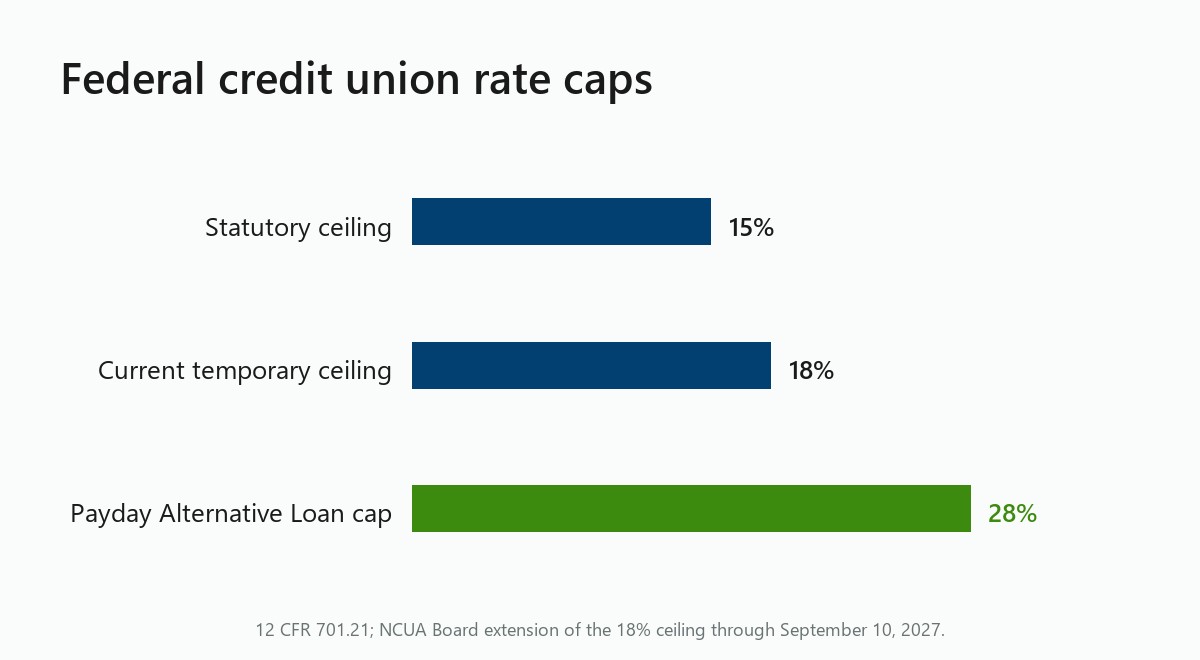
There's also a built-in guardrail worth knowing about. Federal credit unions are statutorily capped at 15% APR on member loans, though the National Credit Union Administration (NCUA) Board has authority to raise that ceiling temporarily when market rates justify it. The current temporary ceiling sits at 18%, extended through September 10, 2027, under 12 CFR 701.21, as laid out in NCUA's own supplemental information page on the loan interest rate ceiling and confirmed by NCUA's February 2026 press release.
That cap applies specifically to federal credit unions, the ones chartered and supervised by the NCUA. State-chartered credit unions answer to their state regulator instead and follow that state's usury law, which can land above or below the federal number. Ask which charter type you're dealing with before you assume the 18% ceiling applies.
Here's why that cap matters for your approval odds. A lender that can't charge past 18% has no way to price its way around a risky borrower the way a subprime online lender can, stacking fees and double-digit rates onto anyone who scares the algorithm. A federal credit union has to build its risk tolerance into the underwriting itself, not into the interest rate. That pushes the decision toward a human being looking at your whole file instead of a rate table doing the work for them.
Credit Union Underwriting for Bad Credit, Explained Without the Jargon
An automated decision engine works off a handful of inputs: credit score, debt-to-income ratio, maybe a few flags from your credit report. Feed it a 580 score and a high utilization ratio, and it declines you before a human ever sees the file. It doesn't know you paid off a collection account last spring or that you've had the same job for six years. It doesn't care.
A loan officer at a credit union looks at the same numbers, plus everything the score can't capture. Do you bank there already? Has your account stayed in good standing? Do you have a member relationship the credit union can point to as evidence you handle money responsibly, even if a rough patch dented your score? This is what people mean by relationship or character-based underwriting. It's a loan officer weighing the whole picture, the way lending worked before every decision got automated.
I sat across from plenty of applicants with scores in the 500s who walked out approved. Not because I ignored the risk. Because I could see context an algorithm throws away: a medical collection from three years back that had nothing to do with how they managed money today, a divorce that wrecked a joint account they'd since closed and rebuilt from, a steady paycheck and a track record on the accounts they still held. A bank's model sees a low score and stops reading. A credit union loan officer keeps reading.
Don't mistake this for a rubber stamp. Character-based underwriting still means you have to show up with a real ability to repay. What changes is how the decision gets made and who's making it. A person, not a formula, decides whether your file tells a story worth backing.
The Starter Toolkit: Share-Secured Loans and Payday Alternative Loans
If your credit is rough enough that even a relationship-minded loan officer needs more to work with, credit unions built two products specifically for that gap.
Share-secured loans (some call them savings-secured loans) let you borrow against money you already have on deposit at the credit union. You pledge your savings balance as collateral, and the credit union lends against it, typically up to most or all of the pledged amount, at a rate set just a few points above what your savings itself earns. The mechanic is simple: since your own money backs the loan, the credit union's risk is close to zero, which is exactly why it doesn't need your credit score to carry the decision. This structure shows up consistently across credit union product pages, including how 1st United Credit Union describes it.
You make on-time payments, those payments get reported to the credit bureaus, and you build payment history while your savings sit locked up earning dividends in the background. When the loan is paid off, the money is yours again, plus whatever it earned along the way.
Payday Alternative Loans, known as PALs, are a federal credit union exclusive built to undercut payday lenders on price. The rate on a PAL is capped at 1,000 basis points above the Board's ceiling. Run the math on the current 18% ceiling and that puts the PAL cap at 28%.
Under 12 CFR 701.21, PAL I loans run from $200 to $1,000, with terms of one to six months, and require you to have been a member for at least one month before you can apply. You're limited to three PALs in any rolling six-month window, and the application fee is capped at $20, which by rule has to reflect what it actually costs the credit union to process the loan, not padded on as extra profit. PAL II raises the ceiling to $2,000 with terms up to twelve months, at the same rate cap. Ask your credit union whether PAL II is open to you as a brand-new member before you count on one closing in a hurry.
Both products exist for the same reason: to give a credit union something to say yes to when your credit history alone isn't enough collateral for a lending decision.
Federal credit unions averaged roughly 10.7% APR on a three-year unsecured personal loan, compared to roughly 12.1% at commercial banks, according to Bankrate's average personal loan rates report. That gap is real, and it tends to travel together with the more forgiving approval path described above, not against it.
How to Join a Credit Union: Membership 101
Most people assume "credit union" means "I have to work for a specific company or belong to a specific union," and for a lot of credit unions, that used to be true. It still can be. But the eligibility rules, called field-of-membership rules, are broader than most borrowers realize.

Every federal credit union operates under a defined field of membership: a charter that spells out who's allowed to join. That charter usually falls into one of a few buckets: employer-based charters tied to a specific company or industry, geographic charters open to anyone who lives, works, worships, or attends school in a defined city, county, or region, and charters built around a particular community group or association. If you fall into any of those categories for a given credit union, you're already eligible to join, whether you knew it or not.
Here's the part almost nobody explains clearly. NCUA's associational common bond rule lets a federal credit union add an unrelated nonprofit or membership association to its field of membership, as long as that group wasn't created for the primary purpose of making people eligible for the credit union. In practice, this means many credit unions partner with outside associations, and joining that association can be your path to credit union membership even if you don't live in the right zip code or work for the right employer. NCUA built this pathway into the rule on purpose, as a defined route into membership that any qualifying association can use.
What that costs and which associations a given credit union partners with varies from one institution to the next, and those terms change over time. Don't take a number you saw somewhere else as gospel. Pull up the specific credit union's own membership page and confirm current fees and partner associations before you commit to anything. A ten-minute check now saves you a surprise later.
Family membership is the third common door in. If a parent, sibling, spouse, or child already belongs to a credit union, that relationship alone often qualifies you too. Before you assume a credit union is off limits, check all three paths: your employer or location, an associational partnership, and family.
Applying With Sub-600 Credit: What Actually Happens
Here's the walkthrough, stripped of the polish you'll find on a marketing page.
Step one: confirm eligibility and join. Figure out which field-of-membership path applies to you, then open a membership account, usually with a small deposit into a savings account. That savings deposit is your "share," and it's what makes you a member-owner rather than just a customer.
Step two: expect a possible waiting period, and confirm it before you assume anything. Some credit unions require a membership period, often 60 to 90 days, before you're eligible to apply for an unsecured loan. This isn't a universal rule across every credit union, and it doesn't apply the same way to every product, so check with your specific credit union rather than assuming a number. If a share-secured loan or a PAL is available to you sooner, that's often the faster route in while you build the relationship.
Step three: gather your documents. Expect to provide proof of identity, proof of income (pay stubs, a tax return, or bank statements if you're self-employed), proof of address, and authorization to pull your credit report. Nothing exotic here. It's the same paperwork any lender asks for, just reviewed by a person instead of feeding straight into a black-box model.
Step four: talk to a loan officer, in person or by phone if the credit union offers it. This is where the character-based part of underwriting actually shows up. Be ready to explain any rough spots on your credit report in plain language, covering what happened and what's different about your situation now. A collection from a medical bill three years ago tells a different story than a pattern of missed payments last month, and a loan officer who's allowed to weigh context will want to hear the difference.
Step five: know your realistic outcomes. A sub-600 score at a credit union doesn't guarantee approval for an unsecured personal loan, and nobody honest will tell you it does. What it often does get you is a real conversation and a real look at your file, plus a fallback option, a share-secured loan or a PAL, that doesn't hinge on your score carrying the whole decision. Walking in with a specific plan for what you can qualify for today, even if it's the secured route first, puts you in a stronger position than walking in hoping the algorithm feels generous.
Before you apply anywhere, it's worth spending time on your side of the equation too. Raising your score before you apply, even modestly, widens which products you qualify for. And getting your documents and credit loan-ready before you sit down with a loan officer speeds up every step above. If a bank has already turned you down, understanding the denial letter it sent you can also tell you exactly what to fix before your next application, at a credit union or anywhere else. Whatever offer you land on, weigh it against the five numbers that decide if a loan is worth taking before you sign anything.
Frequently Asked Questions
Can I get a personal loan from a credit union with bad credit?
Yes. Credit unions use character-based underwriting that weighs your whole financial picture instead of leaning on your credit score alone, and they offer starter products like share-secured loans and Payday Alternative Loans that don't rely on your score to carry the approval decision.
Do I have to work for a specific company to join a credit union?
Not necessarily. Field-of-membership rules can be based on your employer, but many credit unions also accept members based on where you live, work, worship, or attend school, through family membership, or through a partner association under NCUA's associational common bond rule.
What is a Payday Alternative Loan?
A PAL is a small-dollar loan exclusive to federal credit unions, capped at 1,000 basis points above the NCUA Board's interest rate ceiling, currently 28%. PAL I ranges from $200 to $1,000 with a one- to six-month term and requires at least one month of prior membership. PAL II goes up to $2,000 with terms up to twelve months at the same rate cap.
How is a share-secured loan different from a regular personal loan?
A share-secured loan is backed by money you already have on deposit at the credit union, so approval depends on your savings balance rather than your credit score. You make payments that get reported to the credit bureaus, building payment history, and your savings stay intact (earning dividends) until the loan is repaid.
Is there a waiting period before I can get a loan after joining a credit union?
It depends on the credit union and the product. Some require a membership period, often 60 to 90 days, before you can apply for an unsecured loan, while secured options like share-secured loans or PALs may be available sooner. Confirm the specific timeline with the credit union you're joining.
Do all credit unions cap interest rates at 18%?
Only federal credit unions are bound by the 18% temporary ceiling set by the NCUA Board (extended through September 10, 2027) under a 15% statutory cap. State-chartered credit unions follow their own state's usury law instead, which can be higher or lower than the federal figure.