


The letter usually shows up in a plain envelope, no warning, no phone call first. It says the Department of Veterans Affairs paid you too much, whether that's disability compensation, pension, or education benefits, and now the VA Debt Management Center wants it back. A separate but related letter can arrive over an unpaid VA health care copay. For a lot of veterans, this is the first they've heard that anything was wrong with their payments.
VA debt management runs on the dates printed near the top of that letter. They control which options stay open to you and which ones close over the next thirty days, so reading the notice closely matters more than almost anything else you do this month.
What the VA Debt Management Center Actually Does
The DMC is the VA office that handles benefit overpayments and collects on them. It's a government office, not a private collections agency and not a scam letter, despite how alarming it can look on first read.
You can reach the DMC at 800-827-0648, and correspondence, including VA Form 5655, gets mailed to Debt Management Center, PO Box 11930, St. Paul, MN 55111. You can also respond through the VA's Ask VA portal or online, according to the VA's own debt management page.
The office exists because overpayments happen more often than most veterans assume. The VA's Office of Inspector General told the House Veterans' Affairs Committee in May 2025 that the VA issued at least $5.1 billion in compensation and pension overpayments between fiscal years 2021 and 2024. About $1.4 billion of that came in FY2024 alone, and the VA tried to collect roughly $1 billion in overpayment debt that year, according to the American Legion's coverage of the May 2025 House testimony, reporting VA OIG congressional testimony.
Much of it traces back to claims processing errors tied to the PACT Act, and it's a documented, ongoing pattern rather than an isolated clerical mistake. Roughly 25% of PACT Act-related claims reviewed between August 2022 and August 2023 were improperly calculated, according to the same OIG testimony.
Overpayment debt can come from disability compensation, VA pension, or GI Bill and other education benefits. Each of these runs through the same DMC process once a debt is established, and the 30-day and one-year deadlines described below apply to that process. Knowing which benefit the debt traces back to matters mostly for your own budgeting.
The Clock Starts the Day You Open the Letter
Two deadlines determine what happens next, and they are not the same deadline, even though people confuse them constantly. Missing the 30-day window doesn't end your case, but it does let collection activity, including offset, move forward while you pursue other options. Missing the one-year mark closes off the waiver route entirely, since the statute sets a hard cutoff for that specific request.
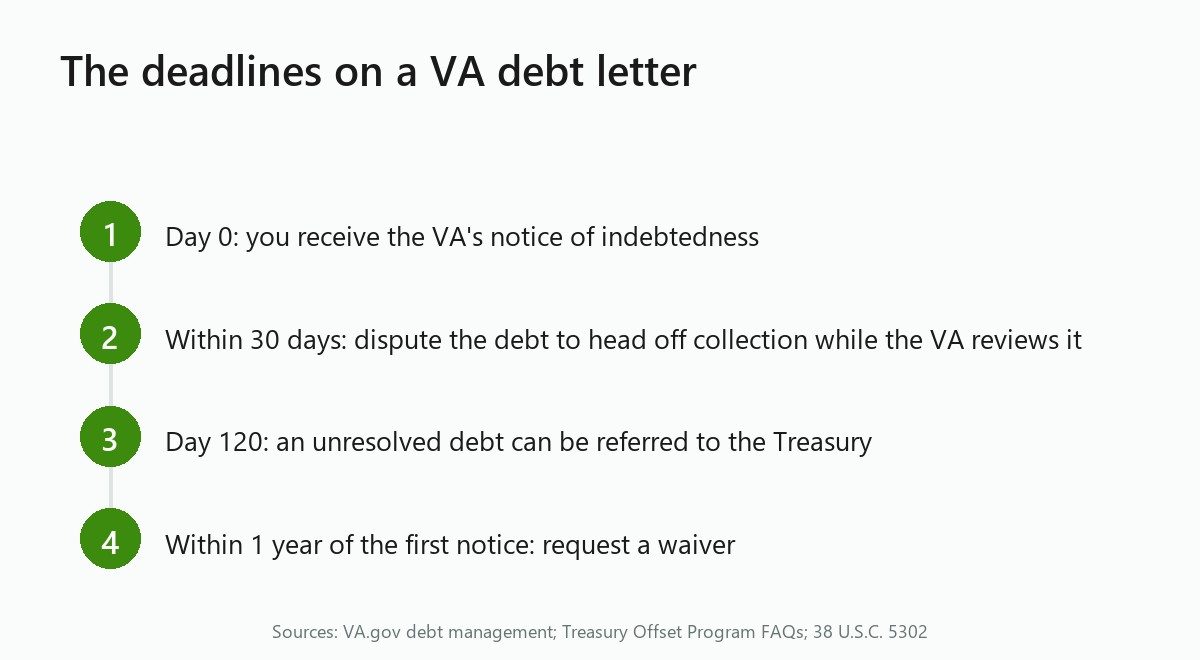
30 days: dispute the debt. If you believe the debt is wrong, either the VA made an error or the amount is off, you have 30 days from receiving the notice to dispute it and head off collection action while the VA reviews your case. That figure comes directly from the VA's own guidance on requesting help with a debt.
One year: request a waiver. A waiver accepts the debt and argues that repaying it would be unfair given your finances.
As of a legislative change effective December 29, 2024, you now have one year from the date of the VA's first notice of indebtedness to file that request. The statute is explicit: 38 U.S.C. § 5302(a)(1) reads, "application for relief is made within one year from the date of notification of the indebtedness by the Secretary to the payee."
Here's the part worth pausing on. That one-year window used to be 180 days. Older articles, forum posts, and legal-aid fact sheets written before the amendment may still cite that outdated figure, and at least one Military.com explainer still does.
If you're inside the old 180-day mark but haven't hit a full year yet, you likely still have time to file. Confirm your exact notification date against the current one-year rule before assuming you missed it.
If You Do Nothing: Offset and the 120-Day Referral
Ignoring the letter does not make the debt disappear. According to the VA's debt management page, the agency can withhold all or part of your monthly benefit payment, up to your full check, until the debt is repaid, after sending you the required notice that satisfies due process before offset begins (va.gov, "VA Debt Management").
Veterans who don't respond can lose their entire monthly VA payment to the debt; it's not just a partial deduction. Legal-aid groups such as Nolo and Iowa Legal Aid note that many veterans don't realize the VA can take the whole check.
A debt left unpaid or unresolved for 120 days gets referred by the VA to the U.S. Department of the Treasury for collection through the Treasury Offset Program (va.gov, "VA Debt Management"). Some third-party sites cite 180 days for this referral point, but that figure appears to conflate the old waiver deadline with the separate offset-referral timeline. Both va.gov and the Treasury's own program documentation independently state 120 days for nontax debt referral, so that's the number to plan around.
What the Treasury Offset Program Can Take
The Treasury Offset Program matches your name against a database of delinquent federal debtors and intercepts qualifying federal payments to cover what you owe. That can include federal tax refunds, certain federal salary payments, and in some cases other federal benefit payments, according to the Treasury's Bureau of the Fiscal Service. Treasury also charges the referring agency an offset fee per transaction. The program operates under Treasury's broader federal debt collection authority, which is separate from the VA's own overpayment rules and applies to referred debts across many federal agencies, not VA debt alone.
Acting before the 120-day referral is the practical argument for responding early, since Treasury can then intercept your tax refund and other federal payments on top of whatever the VA is already withholding.
Your Three Real Responses
Most paths back to the VA run through VA Form 5655, the Financial Status Report. It's used for a waiver, a compromise offer, and any repayment plan longer than five years; a dispute can also go through Ask VA without the form. Mail it to the DMC address above, or submit it through Ask VA or online, per the VA's official form page.
Which path fits depends on one question: do you think the VA got the number wrong, or do you agree with the number but can't manage paying it? A dispute answers the first question. A waiver or repayment plan answers the second, and the two are not interchangeable.
1. Dispute the debt
Write "DISPUTE VALIDITY OF DEBT" or "DISPUTE AMOUNT OF DEBT" directly on Form 5655, or submit your dispute through Ask VA, if you think the debt shouldn't exist or the amount is wrong. This has to happen within 30 days of the notice to pause collection while the VA reviews it. Put your objection on the record, in writing, before the deadline passes.
2. Request a waiver
File for a waiver using Form 5655 plus a personal statement, within one year of your first notice, when the debt is accurate but repaying it would be unfair given your financial circumstances. The VA evaluates waiver requests against an "equity and good conscience" standard set out in 38 U.S.C. § 5302. The implementing regulation, 38 CFR § 1.911, confirms you have the right to a hearing on your request.
3. Propose a compromise or repayment plan
Offer to settle for less than the full amount, called a compromise offer, or set up a structured repayment plan when you don't dispute the debt and don't qualify for a full waiver. Extended plans running longer than five years require Form 5655; shorter repayment arrangements generally don't. A veteran who disputes a debt they actually owe, instead of requesting a waiver, may end up back at square one once the dispute is denied, closer to the Treasury referral clock with less runway left.
Whichever path fits your situation, timing decides how many of the three stay open. Dispute inside 30 days, request a waiver inside one year, and propose a compromise or repayment plan at any point before the debt is resolved. Waiting past the 120-day Treasury referral doesn't close off any of these paths, but it adds tax-refund and other federal-payment offsets on top of whatever the VA is already withholding.
Why This Keeps Happening
Committee staff who visited the DMC in person, according to the same American Legion coverage, met veterans who were "confused, angry and even suicidal because they incurred a debt they didn't know about." This comes directly from congressional testimony about a system that keeps generating large overpayment totals and then asks veterans, often on fixed incomes, to pay it back on short notice.
That same testimony pressed the VA on why it regularly overpays veterans in the first place before demanding the money back later. Much of the pattern traces to claims processing: when a PACT Act claim is calculated incorrectly on the front end, the correction often shows up months later as a debt letter instead of a smaller monthly check from the start.
Legal-aid organizations including Nolo, Iowa Legal Aid, and Swords to Plowshares publish their own walkthroughs of the same three-path process, aimed at veterans navigating it without a lawyer. Cross-referencing more than one source is reasonable, but confirm any deadline you read elsewhere against the current one-year and 30-day figures above, since not every guide has been updated for the 2024 amendment.
None of that changes your deadlines, but it's worth knowing you're one of a large, documented group of veterans caught in the same overpayment surge.
If Your Debt Problem Is Bigger Than Just the VA
Sometimes a VA overpayment notice lands on top of credit card balances, medical bills, or other debt that has nothing to do with your benefits. Resolving the VA piece through the DMC process above is still the right first move in that situation.
You may also want to look at consolidating other debt alongside a VA repayment plan, which is a separate question with its own tradeoffs and sales pitches to watch for. Weighing settlement versus consolidation is worth doing carefully before you commit to either path, since the right answer depends on how much non-VA debt you're carrying and what it's costing you in interest. A VA compromise offer or repayment plan is negotiated directly with the DMC and does not require a debt-settlement company; anyone who tells you otherwise is selling something you can do directly with the DMC.
Frequently Asked Questions
Does a VA debt affect my credit?
A debt unresolved for 120 days moves to Treasury, which can offset your tax refund and other federal payments. Ask the DMC whether your debt is reported to credit bureaus. It helps to understand the basics of protecting your credit report before any collection activity escalates.
Can I still receive new VA benefits while I owe a debt?
Generally, yes. You can keep receiving VA benefits while an overpayment debt is being resolved, though the VA may offset part or all of ongoing payments toward the balance once the notice period has passed, unless you disputed within 30 days. Contact the DMC to confirm how your benefit type is affected.
What if I already missed the 30-day dispute window?
You can still request a waiver as long as you're within one year of your first notice of indebtedness, even if the 30-day dispute window has closed. Disputing and waiving are different requests with different deadlines, so missing one does not automatically close off the other.
What's the difference between a dispute and a waiver?
A dispute argues the debt is wrong, either it shouldn't exist or the amount is off. A waiver accepts the debt is accurate but asks the VA not to collect it because doing so would be inequitable given your finances. They share a form but represent opposite arguments about the same debt.
Does the VA charge interest on this debt?
VA says it may add interest to certain debts; ask the DMC what applies to yours. Don't assume a percentage you saw elsewhere applies to your account. Ask the DMC directly what interest policy, if any, applies before you plan a repayment budget around it.
Where do I send VA Form 5655?
Mail it to Debt Management Center, PO Box 11930, St. Paul, MN 55111, or submit it electronically through the VA's Ask VA portal or online, per the VA's official form guidance. The same form and address work for a waiver, a compromise offer, or an extended repayment plan; a waiver request also needs a personal statement attached.