


Does debt consolidation hurt your credit? Yes, for a few weeks. Then, for most people, it turns around and pays them back. I spent 28 years reading credit files for a living, and the folks who called me panicked after consolidating almost always had the same story: they saw a small dip, assumed they'd wrecked their credit, and hung up before the recovery kicked in.
It doesn't work that way. Consolidation moves your score down a little, then up a lot, and the path it takes depends on which of the three routes you pick: a debt consolidation loan, a balance transfer card, or a nonprofit debt management plan. Here's what actually happens, month by month, on each one.
The Three Paths, at a Glance
A debt consolidation loan pays off your credit cards with a fixed-rate installment loan. You close out several revolving balances and replace them with one loan payment. A balance transfer card moves your card balances onto a new card, usually one with a 0% introductory rate. You still owe revolving debt, just on one card instead of several.
A debt management plan, or DMP, is different from both. A nonprofit credit counseling agency negotiates lower rates with your existing creditors and you pay the agency one monthly amount, which it distributes. No new account opens, and no loan gets underwritten. The mechanics diverge from there, and so does the credit score timeline.
Month 0 to 1: The Hard Inquiry
Applying for a debt consolidation loan or a balance transfer card triggers a hard inquiry on your credit report. A hard inquiry typically costs fewer than 5 points, according to myFICO, and only inquiries from the past 12 months count against your FICO score at all (they stay on the report for up to two years but stop affecting your score after one).
If you're shopping multiple lenders to compare rates before you commit, you don't need to submit a full application to every one of them. Many offer prequalification with a soft pull that doesn't affect your score. This site has the full mechanics on how soft pulls and hard pulls differ, worth reading before you apply anywhere.
A DMP skips this step entirely. Enrolling with a nonprofit counseling agency doesn't involve a credit application, so there's no hard inquiry and no Month 0 dip from this cause.
Month 1 to 2: A New Account Shakes Up Your Average Age and Mix
New credit is worth 10% of your FICO score, and credit mix is worth another 10%, according to myFICO's published factor weights.
Open a consolidation loan or a new balance transfer card and you've added a fresh account to your file. A brand-new account pulls down your average age of accounts, which matters because length of credit history carries 15% of your score. If your oldest card is twelve years old and your newest is two months old, the average drops, and that shows up as a modest, temporary drag.
Credit mix usually helps rather than hurts here. Adding an installment loan to a file that was all revolving cards diversifies it, which can help. A balance transfer card doesn't get that same mix benefit since it's still revolving debt, just consolidated onto one card.
A DMP causes none of this. No new account means no hit to average age and no shift in credit mix from a fresh tradeline. This is one of the two structural reasons the DMP timeline looks different from the other two paths.
Month 1 to 3: Utilization Drops, But Not Overnight
This is where the real recovery starts, and it's also where people get impatient. Amounts owed, mostly your credit utilization ratio, makes up 30% of your FICO score, the single largest factor after payment history. Pay off your cards with a consolidation loan and the debt actually leaves the card system: utilization on those cards falls toward zero.
A balance transfer works differently. Your debt doesn't shrink, it just moves to a new card, so your total utilization only improves by whatever credit limit that new card adds to the pool. If the new card carries a small limit, you've barely moved the needle, and if it's already sitting near its own limit before you transfer a dime onto it, the move can work against you instead of for you. Either way, your score doesn't move the day you pay the balance or complete the transfer.
Card issuers report your balance to the credit bureaus once per statement cycle, typically at statement close, not the moment you pay. That means a balance drop from consolidation often isn't reflected in your score for one to two full billing cycles after the payoff, roughly 30 to 60 days, according to Experian's guidance on how long it takes your score to reflect a payoff.
Picture a borrower carrying balances on three cards who consolidates into one loan on the first of the month. Card one closes its statement two weeks later and still shows the old balance, because the payoff hadn't posted yet when the statement cut. Card two and card three close on different dates, so their zero balances land on the credit report in staggered fashion over the following month. The score reflects the full picture only once every card has reported at least one clean statement.
That lag is the entire reason so many people think consolidation "isn't working." It is working. Your score just hasn't caught up to your bank statement yet. This is the real debt consolidation effect on your credit score that most articles skip: the dip you can see immediately (the inquiry, the new account) shows up fast, and the gain you're waiting for shows up slow. Patience matters more than any single move you make here.
The DMP Path: No Inquiry, No New Account, But Watch the Closed Cards
A DMP's timeline is genuinely different from a loan or a balance transfer, and it's worth being clear about why before you enroll. There's no scoring factor that penalizes you for being on a debt management plan, according to credit.org's breakdown of how a DMP affects your credit score.
But most creditors participating in a DMP require you to close the cards being repaid, and that has two effects. First, if those cards carried unused credit limits, closing them removes that available credit from your total, which can push your utilization ratio up even while your actual debt goes down. Second, closing accounts can shrink your average account age over time and narrow your credit mix to fewer open revolving lines.
Some creditors also add a notation to the tradeline flagging that it's being repaid through a debt management plan, which future lenders can see.
One thing worth clearing up before you go further: a DMP is not debt settlement, even though people mix the two up constantly. A DMP repays what you owe in full, just at a better rate and on a structured schedule. Settlement means negotiating to pay less than you owe, and it carries a very different and generally more severe credit impact. If you're weighing a DMP against settlement, that comparison and the specific score damage settlement can cause deserve their own look, and this site has a full breakdown of debt relief versus debt consolidation that walks through exactly that distinction.
Should You Close the Paid-Off Cards?
Once a consolidation loan or balance transfer zeroes out your old cards, you'll face a decision nobody warns you about ahead of time: close them or keep them open. The tradeoff comes straight from two FICO factors doing the fighting: amounts owed is 30% of your score and length of history is 15%, per myFICO's weighting.
Keep a paid-off card open with a zero balance and you preserve its credit limit, which keeps your overall utilization low, and you preserve its age, which protects your average account age. Close it, and you lose both.
Say you had $9,000 in total credit limits across three cards before consolidating, and one of them, a $3,000 limit card, gets paid off and closed. Your total available credit drops to $6,000. If you're still carrying any balance elsewhere, that same dollar amount now represents a bigger share of a smaller pie, and your utilization ratio rises even though your actual debt didn't change.
For most borrowers, keeping the old card open with no balance, maybe using it for one small recurring charge you pay off monthly, is the stronger move for your score. Close it only if the annual fee doesn't justify keeping it, or if you know yourself well enough to know an open card with room on it is a temptation you can't manage. That decision comes down to self-control more than credit math, and only you can judge it honestly.
When Does the Net Effect Turn Positive?
This is the number that should actually change how you think about this. TransUnion's 2019 study tracked consumers who consolidated credit card debt into an unsecured personal loan and found that 68% of them saw their credit score improve by more than 20 points within one quarter, about three months, according to TransUnion's 2019 study on debt consolidation and credit performance.
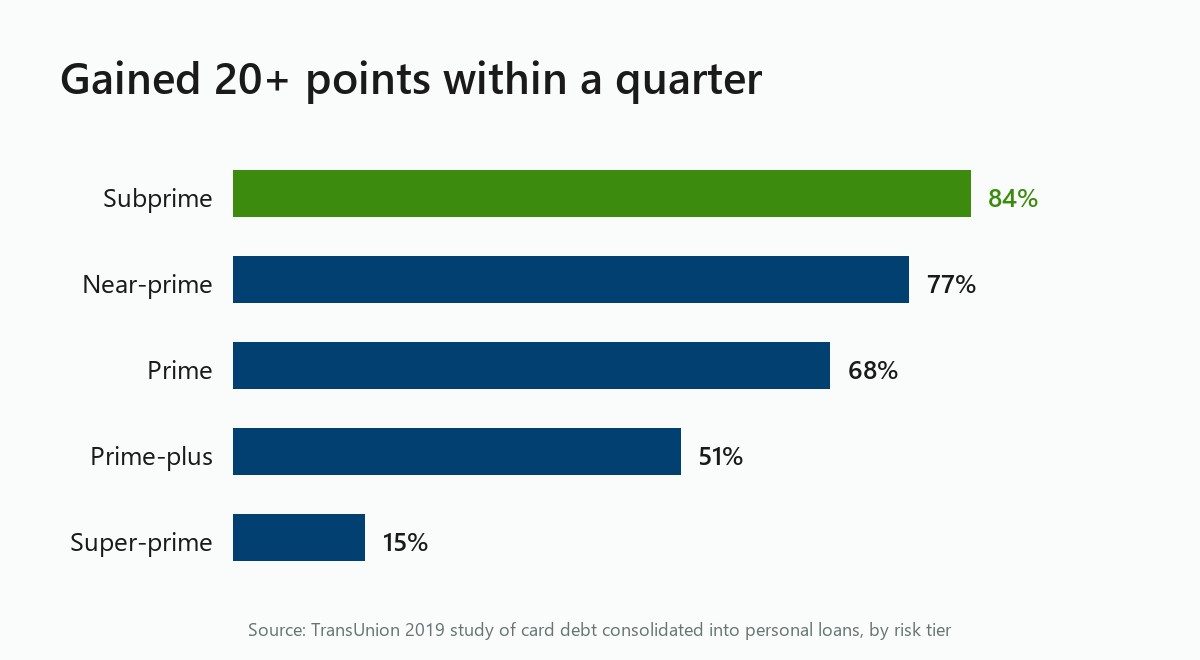
The gains weren't spread evenly. A larger share of riskier borrowers crossed that 20-point mark: 84% of subprime consumers and 77% of near-prime consumers gained 20 or more points, compared to 68% of prime, 51% of prime-plus, and 15% of super-prime borrowers, who had less room to climb since their scores started higher.
TransUnion tied the improvement to an average 58% reduction in card balances, from $14,015 down to $5,855 (run the math yourself: that's an $8,160 drop, which is 58% of the original balance, so the figure checks out). Lower balances meant lower utilization, and utilization is the lever doing most of the work. The improvements showed up after one quarter and held, at a somewhat reduced level, a full year later.
Translate that into a calendar. Month 0, you take the inquiry hit and open the new account. Month 1 to 2, the average-age drag settles in while your first post-consolidation statements start reporting the lower balances. Month 3, for most loan borrowers, the utilization improvement outweighs everything else and the score turns net positive.
Does the Credit Score Effect Differ Between a Loan, a Balance Transfer, and a DMP?
Does debt consolidation affect your credit score the same way on every path? No. Each route trades different factors for different reasons.
- A consolidation loan: hard inquiry, new account (helps mix, hurts average age briefly), utilization drop reported over 30 to 60 days, net positive for most by month three.
- A balance transfer card: hard inquiry, new account (no mix benefit since it's still revolving), utilization improves only by the new card's added limit and can worsen if that new card sits near its own limit, plus a transfer fee typically 3 to 5% of the amount moved and an introductory 0% window that commonly runs 12 to 21 months. That promotional rate has to last at least six months unless you fall 60 or more days behind, according to the CFPB's explainer on balance transfers.
- A DMP: no inquiry, no new account, but often closed cards that can raise utilization and shrink average age over time, plus a possible tradeline notation.
None of the three is automatically the "safest" choice for your score. The right one depends on your credit tier, how much available credit you'd lose by closing cards, and whether you can realistically pay off a balance transfer before the promotional rate expires.
The Bottom Line
Consolidating credit card debt will likely knock a few points off your score in the first month, then hand most of them back and more within a quarter, as long as you keep paying on time and don't run the old cards back up. The dip is real but small. The recovery is bigger, and for consolidation loan borrowers specifically, TransUnion's data says it's the more likely outcome.
If you're still deciding between a loan and a balance transfer specifically, this site has a full comparison of debt consolidation loans versus personal loans that walks through the underwriting side of that choice. Once your consolidation is in motion, a handful of deliberate moves over the following two months, covered in this site's guide to three credit score moves you can make in 60 days, can speed the recovery along even further.
Frequently Asked Questions
Will my credit score drop right after I consolidate my debt?
If you take out a loan or open a balance transfer card, expect a small drop from the hard inquiry (typically fewer than 5 points, per myFICO) and a temporary dip from the new account lowering your average account age. A DMP causes neither of these, so it usually doesn't produce this initial dip.
How long until my score goes back up after consolidating?
Balances typically report to the bureaus 30 to 60 days after you pay them off, since issuers update once per statement cycle. The lower balances start showing up within that window, and TransUnion found 68% of borrowers who consolidated into a personal loan saw a 20-plus point gain within a full quarter.
Should I close my credit cards after I pay them off through consolidation?
Usually not, if you can trust yourself with them. Keeping a paid-off card open preserves its credit limit (which helps utilization) and its age (which helps your average account history). Close it only if the fee outweighs the benefit or you can't resist running the balance back up.
Does a debt management plan hurt my credit score?
Enrolling itself doesn't. There's no scoring penalty for being on a DMP. The impact comes indirectly, from creditors requiring you to close the cards being repaid, which can raise your utilization ratio and shorten your average account age.
Is debt consolidation the same as debt settlement?
No. Consolidation repays what you owe in full, just restructured into one payment at a better rate. Settlement means negotiating to pay less than the full balance, and it carries a more severe credit impact than any of the three consolidation paths covered here.