


If you searched "debt consolidation vs personal loan" hoping to find out which one wins, stop right there. You're comparing a car to that same car with a specific bumper sticker on it. A debt consolidation loan is a personal loan.
Same application, same credit pull, same fixed monthly payment for the life of the loan. The only real difference is that the lender restricts what you do with the money: it has to go toward paying off existing debts, not a vacation or a kitchen remodel.
That confusion is exactly why the search exists. People read one term in one place and the other term somewhere else, and nobody stops to say plainly that the two describe the same instrument. Borrowers commonly assume a debt consolidation loan is a different animal from a personal loan, purely because the name sounds specialized. It's just a marketing label, nothing more, applied to the exact same loan.
The Consumer Financial Protection Bureau lays out three real ways to consolidate credit card debt: a balance transfer, a consolidation loan (which it describes as an installment loan from a bank or credit union), and a home equity loan. Notice what's missing from that list: "debt consolidation loan" sitting apart from personal loans as its own category. Experian backs this up directly, describing a debt consolidation loan and a personal loan as, structurally, the same fixed-rate installment product, with the only real difference being how the lender labels the use of funds.
What you're actually weighing isn't which term sounds more official. It's which method of consolidating your debt fits your situation, and when you compare the two, that's the question worth your time.
Debt Consolidation Loan vs Personal Loan: The Four Real Options, Compared
Set aside the fake choice and four real ones remain: a personal loan, a balance transfer credit card, a HELOC or home equity loan, and a debt management plan run through a nonprofit credit counseling agency. Each one moves your debt somewhere else. None of them make it disappear.
What changes is the rate you pay, how long you're on the hook, what you risk losing if the plan falls apart, and what it does to your credit report along the way. None of the four comes free of trade-offs, and the trade-off that matters most to you might not be the one that matters most to your neighbor.
One more thing worth knowing before you weigh the four side by side: that same CFPB guidance cautions that promotional and introductory rates are temporary by design, and stretching any payoff over a longer term can raise your total cost even when the monthly payment looks smaller. A lower payment isn't automatically a better deal. Check the total cost, not just what hits your bank account each month.
Personal loan (debt consolidation loan)
- Rate: Averaged around 12% on a 24-month term at commercial banks, per the Federal Reserve's May 2026 G.19 consumer credit figures. That figure reflects how the Fed rate environment has moved personal loan pricing over the past two years.
- Term: Typically 2 to 7 years, fixed rate, fixed payment. What you owe on day one and what you owe on the final day are entirely predictable.
- Collateral: None. It's unsecured. A lender can wreck your credit and send you to collections if you stop paying, but they can't take your house.
- Credit impact: One hard inquiry to shop for a rate. Multiple personal loan inquiries made within a 14 to 45 day window count as a single inquiry for scoring purposes under both FICO and VantageScore, so rate shopping across lenders doesn't multiply the damage. See the fuller picture on how rate shopping with multiple lenders affects your credit.
- Who qualifies: Your score is where the rate you're offered actually gets decided.
Balance transfer credit card
- Rate: Often 0% intro APR for 15 to 21 months, plus a transfer fee of 3% to 5% of the balance moved. Once the intro period ends, whatever balance remains reverts to the card's standard purchase APR, which commonly runs 20% or higher. The Federal Reserve's G.19 data puts the average rate across existing card accounts at about 21% as of May 2026, while Forbes Advisor's rate database shows new-offer APRs closer to 24% to 25%, so that reversion rate isn't a rounding error.
- Term: The 0% window is your entire runway. Miss it and the math turns against you fast.
- Collateral: None. Same unsecured exposure as a personal loan.
- Credit impact: Opening a new card is a hard inquiry and adds a new account to your file, which can briefly dent your average account age.
- Who qualifies: Good to excellent credit generally gets you the longest 0% windows. Weaker credit gets a shorter promo, or a decline.
HELOC or home equity loan
- Rate: Around 7% on average as of mid-2026, per Bankrate's HELOC rate survey, the lowest of the four options by a wide margin. That's roughly half a personal loan's rate and a third of a credit card's.
- Term: Varies by lender and structure, often stretching well beyond a personal loan's five to seven years.
- Collateral: Your home. This is the sharpest difference among all four methods. That same CFPB guidance warns plainly that failing to repay a home equity loan used for debt consolidation can end in foreclosure. You're trading credit card risk for house risk, and that swap isn't automatically a good one just because the rate looks better on paper.
- Credit impact: A hard inquiry to apply, plus closing costs that can run into the hundreds or thousands of dollars.
- Who qualifies: Homeowners with enough equity built up. No equity, no HELOC. It's that simple.
Debt management plan (DMP)
- Rate: Not a loan at all, this one works differently. It runs through a nonprofit credit counseling agency, where your creditors agree to a reduced interest rate and you make one monthly payment to the agency, which distributes it out. Money Management International, an NFCC (National Foundation for Credit Counseling) member agency, reports enrolled accounts see rates negotiated down to an average of 7.66%, compared with an average original rate of 27.91% on those same accounts.
- Term: Designed to be paid off in under five years. MMI's own data shows a median plan length of around 50 months, against a projected 362 months, roughly 30 years, making minimum payments without one.
- Collateral: None. No new debt gets created.
- Credit impact: Typically no new hard inquiry to enroll, but creditors often require you to close the enrolled cards as a condition of the reduced rate, which affects your utilization and average account age. According to Money Management International, consumers who complete a plan see an average credit score increase of about 82 points, though that figure comes from one agency's own outcome data, not a guarantee every plan delivers.
- Who qualifies: Borrowers who don't qualify for competitive loan or balance transfer rates, or who want a third party negotiating and structuring the payoff instead of managing it themselves. Modest fees apply: MMI caps its setup fee at $75 and its monthly fee at $69.
The Worked Example: $20,000 in Credit Card Debt
Numbers settle arguments that opinions can't. Say you're carrying $20,000 in credit card debt at an assumed 24% APR, toward the high end of current averages between the Fed's all-accounts average and the higher new-offer rates being advertised in 2026. Here's what two of the four paths actually cost you. If you would rather see this play out for an actual borrower first, one borrower's real 28-month payoff timeline shows the same fixed-payment math at work in real life.
Option A: personal loan at 12% APR, 60 months
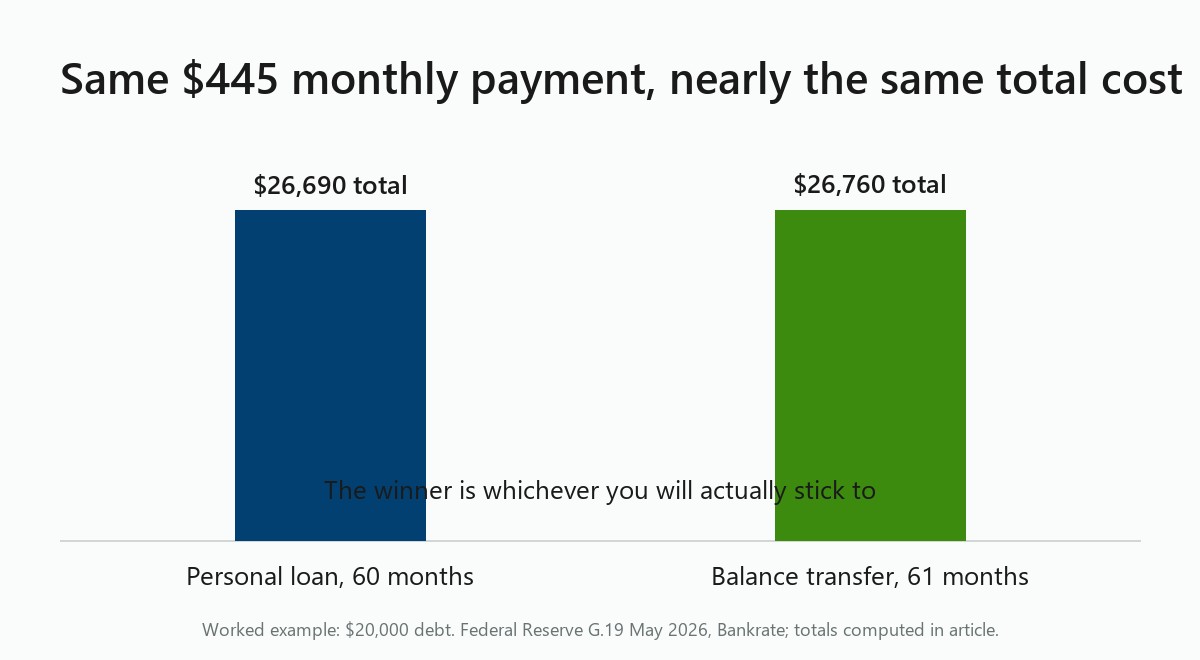
Take out a $20,000 personal loan at 12% APR over five years and your payment lands around $445 a month. Over the life of the loan you pay about $26,690 total, meaning roughly $6,690 in interest. That number doesn't move. It's fixed the day you sign, and it stays fixed whether your income goes up, down, or sideways.
Option B: balance transfer card, two ways
Move that same $20,000 onto a card offering 0% APR for 18 months with a 3% transfer fee. That fee adds $600 to your balance right away, so you start at $20,600. What happens next depends entirely on how aggressively you pay.
Pay it down hard, about $1,144 a month, and you clear the whole balance before the 0% window closes. Total cost: just the $600 fee. No interest at all. That's the best possible outcome, and it beats the personal loan outright, but it demands a payment more than double what the personal loan asks for.
Drop to the same $445 a month you'd pay on the personal loan instead, and the picture changes. After 18 months at 0%, you've knocked the balance down to about $12,590. Then the promo rate expires and the remaining balance reverts to roughly 24% APR. Finishing the payoff at that same $445 payment takes about 42 more months, landing you around the five-year mark, the same as the personal loan. Total paid over that stretch comes to roughly $26,760, which is about $70 more than the personal loan cost you over the identical timeframe.
That's the part most comparison pages skip. A balance transfer card only wins if you can genuinely clear it before the intro rate expires. Match the personal loan's payment instead, and you land within about $70 of it over five years, because the card's reversion rate runs close to double the personal loan's fixed rate for however long you're paying it down. The 0% window isn't a discount. It's a deadline, and blowing past it costs you.
Keep in mind these numbers use current average rates as of August 2026, not a specific lender's quote. Your actual offer depends on your credit profile, your income, and which lender you apply with. The relationship between the two options holds regardless: a fixed-rate loan gives you certainty, a promotional card gives you a discount with a deadline attached, and that deadline is the entire game.
Which Debt Consolidation Option Fits Your Situation
None of these four decisions happens in a vacuum. Your credit score, whether you own a home, and how disciplined you are about deadlines all narrow the field before you even glance at a rate sheet. Match your actual situation against the profiles below. Whichever path fits, the five numbers to compare on any loan offer apply no matter which of the four you choose.

If your credit is good to excellent and you can realistically pay off the balance within 12 to 18 months, a balance transfer card is hard to beat. The 0% window covers your entire payoff runway, and if you stick to the plan, you avoid interest almost entirely. The catch is discipline. This option punishes anyone who treats the deadline as flexible.
Homeowners who have equity built up carry an advantage here: a HELOC or home equity loan offers the lowest rate of the four by a wide margin. That's real money saved over years of payments. It also puts your house on the line, and that's not a detail to gloss over. Only take this route if you're confident, not hopeful, that you can keep the payments current.
Don't trust yourself to juggle multiple creditors and want someone else managing the structure? A debt management plan through an NFCC-affiliated nonprofit agency is worth a call. You'll likely have to close your existing cards, and there are modest monthly fees, but the negotiated rates are competitive with a HELOC and you're not taking on new debt to get there.
Maybe none of those fit. You want a fixed payment, don't want to touch home equity, can't hit a strict payoff deadline, and don't want to close your existing cards. A personal loan is the default in that case. It's the option that works when the other three each ask you to give up something you're not willing to give.
Already applied and turned down across the board? You're not out of options. Cashzella covers those routes separately in Four Ways to Consolidate Debt Without a Personal Loan.
Frequently Asked Questions
Is a debt consolidation loan the same thing as a personal loan?
Yes. The CFPB and Experian both describe them as the same fixed-rate installment product. A lender marketing one as a "debt consolidation loan" simply restricts what the funds can be used for, directing them toward paying off existing debts instead of leaving the use open ended.
Does applying for a debt consolidation loan hurt your credit score?
A single hard inquiry typically costs fewer than five points, and the effect fades within several months to a year, according to Experian. Shopping multiple lenders within a 14 to 45 day window counts as a single inquiry for scoring purposes, so comparing offers doesn't multiply the hit.
Is a balance transfer or a personal loan better for paying off credit card debt?
It depends on whether you can pay off the balance before the promotional rate expires. Clear it within the intro window and a balance transfer usually costs less. Make the same payment you'd make on a personal loan instead, and the two options land within a small amount of each other over five years.
Is a HELOC a good way to consolidate credit card debt?
It can offer the lowest rate of any consolidation method, currently around 7%, but it secures the debt against your home. Miss payments and you risk foreclosure, a risk that doesn't exist with an unsecured personal loan or balance transfer card. Consider it only if you're confident you can maintain the payments long term.
What's the difference between a debt management plan and a debt consolidation loan?
A debt management plan runs through a nonprofit credit counseling agency, where creditors agree to lower your interest rate and you make one payment to the agency each month. A debt consolidation loan works differently: it's a new loan that pays off your old debts directly, and you make payments straight to the new lender instead.