

Two offer emails land in your inbox the same week. One says "personal loan, fixed rate, $10,000." The other says "personal line of credit, apply now." Same dollar amount, same general lender category, completely different words, and nobody explains what that actually means for your monthly bill. If you're stuck comparing a line of credit vs. a loan before you sign anything, you're not missing some obvious answer sitting in the fine print. The two products run on different mechanics, and that mechanic is exactly what decides what you'll owe and when.
What a Personal Loan Gives You
A personal loan is the simpler of the two to explain, and how one works is covered separately, so here's the short version. You borrow one lump sum, the lender sets a fixed rate and a fixed term, and you make the same payment every month until the balance hits zero. Bankrate puts the average personal loan rate at 12.41% APR for a borrower with a 700 FICO score on a $5,000 loan with a three-year term, as of July 15, 2026, with rates across the market ranging roughly from 8% to 36% APR depending on credit (Bankrate).
State rate caps can move your quote before a lender even pulls your credit, so the number you see nationally isn't always the number you'll get. The rate is locked the day you sign, and what you owe in month one is what the math predicted for month thirty-six.
How a Line of Credit Works: Revolving Access Instead
A line of credit doesn't hand you a lump sum. It hands you access, up to a limit, that you draw from as needed instead of taking it all at once.
The draw period: revolving access
During what's called the draw period, a line of credit "works much like revolving credit: you can borrow, repay, and borrow again up to the available limit," and some plans allow interest-only minimum payments during this phase (CFPB). This is the core mechanic of a line of credit generally, though the Consumer Financial Protection Bureau's language above is written specifically about home equity lines of credit, or HELOCs, which are secured by your house. An unsecured personal line of credit, the product this search usually means, runs on that same draw-and-repay structure without putting your home on the line.
Fall behind on a HELOC and you risk foreclosure. Miss payments on an unsecured personal line of credit, though, and the consequence is credit damage and collections activity: serious, but not the same thing as losing a house.
Then the repayment period
Eventually the draw period ends. Once that happens, "you stop being able to borrow... and enter the repayment period," where the lender sets a schedule so the full balance gets repaid (CFPB). Payments often jump at that point, because the bill now includes principal instead of just interest.
LendingTree describes this shift at the end of a HELOC's draw period as producing sharply higher payments once principal repayment stacks on top of interest (LendingTree). This guidance is specific to HELOCs, but the underlying pattern, low payments during the draw phase and a heavier payment once principal joins in, is structural to any revolving line of credit built around interest-only draws.
Fixed Rate vs. Variable Rate: Why It Matters When Money Moves
Personal loans are typically fixed. Lines of credit are typically variable. That single difference changes what "your rate" even means over the life of the account.
A fixed rate locks in at signing, and it stays put no matter what happens to interest rates nationally after that. Worth remembering if you're ever curious about why fixed personal loan rates moved this year: a locked rate is exactly what shields an existing borrower from that kind of movement. A variable rate on a line of credit resets with an index instead.
U.S. Bank's unsecured personal line of credit charges 10.75% to 20.75% variable APR, calculated as the Wall Street Journal Prime Rate plus a margin, effective as of December 12, 2025, with the lowest end of that range reserved for borrowers with credit scores of 800 or higher (U.S. Bank). FNBO's unsecured personal line of credit runs 15.24% to 21.24% variable APR as of August 3, 2026 (FNBO). Those two lenders overlap between roughly 15% and 21%, a fair picture of where an unsecured line of credit's variable rate typically sits, even though the two products aren't lined up dollar for dollar.
Open a line of credit when rates are climbing, and your payment can rise on a balance you already carry. A fixed personal loan simply doesn't do that to you.
The Interest Math: Interest-Only Payments vs. Full Balance
Here's the difference that actually moves your bill. A personal loan charges interest on the entire amount starting day one, because the entire amount hits your account on day one. A line of credit charges interest only on the portion you've actually drawn. Money still sitting in your available limit, untouched, isn't accruing anything at all. That's how draw-based lending works structurally, confirmed on U.S. Bank's line of credit disclosure page and FNBO's Personal Loans and Lines of Credit page, standard mechanics for either lender.
That structural difference explains why a line of credit can look cheap in the early months, and why it can quietly cost more later. Real numbers make this easier to see than any explanation.
A $10,000 Side-by-Side: What the Numbers Actually Show
Picture two ways to fund the same $10,000 renovation. This is an illustrative example built on current published rate ranges, not a guaranteed quote from either lender.
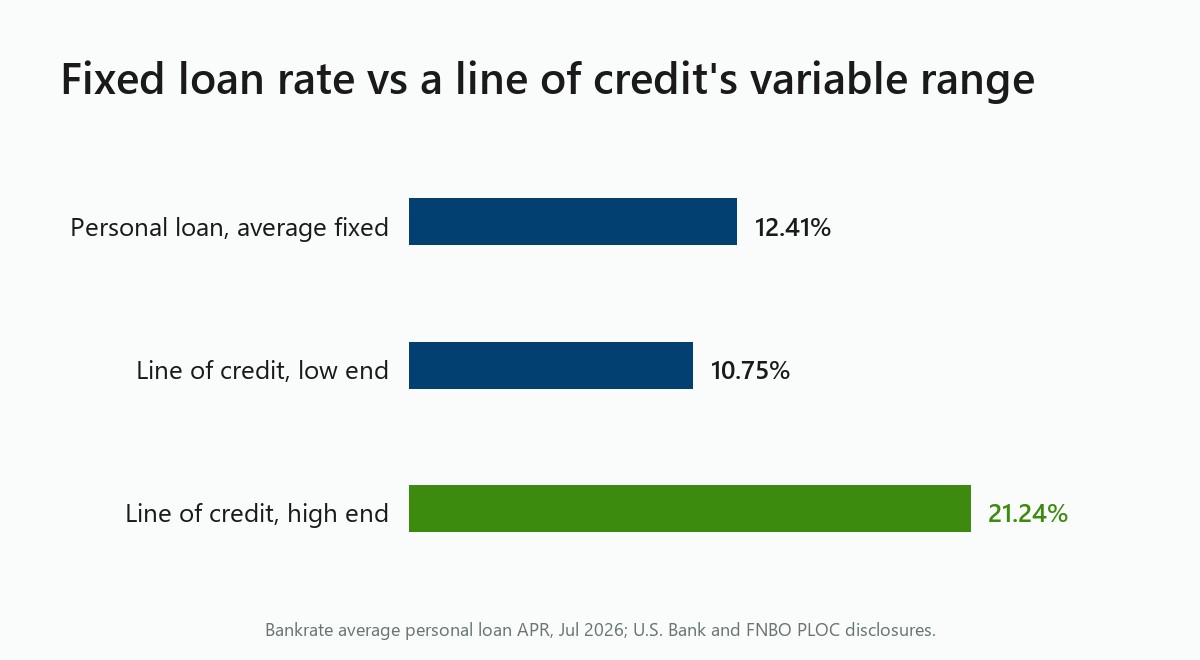
The personal loan: $10,000 borrowed at a fixed 12.4% APR, Bankrate's average, over a three-year term. That average was measured on a $5,000 loan, but APR is a rate rather than a dollar figure, so it's a reasonable stand-in for a $10,000 example. Run the amortization and the fixed monthly payment comes to about $334. Over 36 payments, you'd pay back roughly $12,026 total, meaning about $2,026 in interest, and the balance hits zero exactly on schedule.
The line of credit: a $10,000 limit, drawn in stages the way a renovation actually happens. Say $3,000 to start, another $4,000 in month four when the next phase begins, and a final $3,000 in month nine. The borrower makes interest-only minimum payments the whole way through, at a variable rate somewhere in that 15% to 21% range.
Walk through what that does to the bill, one stage at a time:
- Months one through three: only $3,000 is drawn, so interest accrues on $3,000 alone, about $37.50 a month at 15% or $52.50 a month at 21%. Compare that to the loan, already accruing about $103 in the first month on its full $10,000 balance.
- Months four through eight: the balance grows to $7,000 after the second draw. Interest on that runs about $87.50 to $122.50 a month, depending on where the variable rate lands.
- Months nine through thirty-six: the full $10,000 is drawn. Interest runs about $125 to $175 a month for the remaining 28 months, and none of it reduces the balance, because the minimum payment is interest only.
Add it up over the same 36 months it took the loan to pay off in full, and the line of credit's interest-only payments total somewhere between $4,050 at the low end of the rate range and $5,670 at the high end, roughly double to nearly triple the loan's $2,026 in interest. And at the end of those 36 months, the loan owes nothing. The line of credit, paid only at the minimum, still owes the full $10,000.
Here's the part a features table never shows you: the line of credit genuinely costs less in the first few months, when less money is drawn. Its real cost over time depends on two things nobody can predict in advance: whether the borrower pays more than the interest-only minimum, and where the variable rate moves next.
Pay only the minimum and the balance never shrinks. Pay above it and the whole picture changes. There's no single cheaper option here, only a set of numbers that respond to how the money actually gets used.
When a Line of Credit Actually Fits
A line of credit earns its keep when the need itself is staged rather than a one-time hit. Three situations where that's genuinely true:

- A home renovation completed in phases, where you draw for demolition, then again for materials, then again for finishing work, instead of borrowing the full project cost before the first contractor shows up.
- Freelance or commission income with real gaps between paychecks, where a line of credit covers the lean months and gets repaid once a larger invoice clears.
- Ongoing medical costs billed in installments, where the total isn't known upfront and a lump-sum loan would force you to guess at it.
In each case, the borrower draws only what's needed, repays it at a reasonable pace, and treats the line of credit as a tool with an end date, not a permanent balance.
When a Line of Credit Becomes a Trap
The interest-only minimum payment is the single feature that gets borrowers into trouble. It keeps the required payment low and comfortable every month, and it does nothing to the balance underneath it. A borrower can make every minimum payment on time for years and still owe the full amount they originally drew.
Three ways this goes wrong in practice:
- Paying only the interest-only minimum for the entire draw period, then facing what the industry calls "payment shock" once the repayment period starts and the bill suddenly includes principal (LendingTree).
- Carrying a balance through a stretch of rising rates on a variable-rate line, where the higher rate applies to money you already owe, so the payment climbs even without any new draws.
- Treating an open credit line like a convenient credit card, redrawing the moment the balance drops instead of letting it close out.
None of that means a line of credit is badly designed. It means the feature that makes it flexible, low required payments during the draw period, is the same feature that lets a balance quietly sit there for years if nobody pays it down on purpose.
How to Decide Between the Two
Use the shape of your need, not the label on the offer email, to make this call.
- One-time, known amount, and you want a predictable payment: a fixed personal loan fits, since your rate and term are locked from day one.
- Staged or irregular need, and you have the discipline to pay down draws instead of just servicing the minimum: a line of credit fits, with eyes open to the variable rate.
- Unsure how much you'll actually need: a line of credit's flexibility outweighs a loan's certainty here, as long as you're honest with yourself about paying above the minimum once you draw.
Whichever direction you lean, look closely at the numbers to compare before signing. Read the actual offer before deciding anything: your Truth in Lending disclosure is where the APR and payment schedule are spelled out in full, for either product.
Frequently Asked Questions
What's the main difference between a line of credit and a loan?
A personal loan gives you one lump sum with a fixed rate and a fixed monthly payment until it's paid off. A line of credit gives you revolving access up to a limit, where you draw, repay, and can draw again, with interest charged only on the portion you've actually drawn.
Is a personal line of credit's interest rate fixed or variable?
Unsecured personal lines of credit are typically variable. U.S. Bank's runs 10.75% to 20.75% APR and FNBO's runs 15.24% to 21.24% APR, both tied to an index like the Wall Street Journal Prime Rate plus a margin, meaning the rate can move after you open the account.
What happens when a line of credit's draw period ends?
You stop being able to borrow against it, and the lender sets a repayment schedule so the remaining balance gets paid off (CFPB). Payments often rise sharply at this point, because principal joins interest in the bill for the first time.
Is an unsecured personal line of credit as risky as a HELOC?
Not in the way that matters most. A HELOC is secured by your home, so falling behind risks foreclosure. An unsecured personal line of credit carries no collateral, so falling behind damages your credit and can lead to collections, a real problem, but a different one than losing a house.
Can I redraw money I've already repaid on a line of credit?
Yes, that's the defining feature of revolving credit during the draw period. Repaying part of your balance frees up that portion of your limit to borrow against again, unlike a personal loan, where repaid principal is gone for good and getting more money means applying for an entirely new loan.