

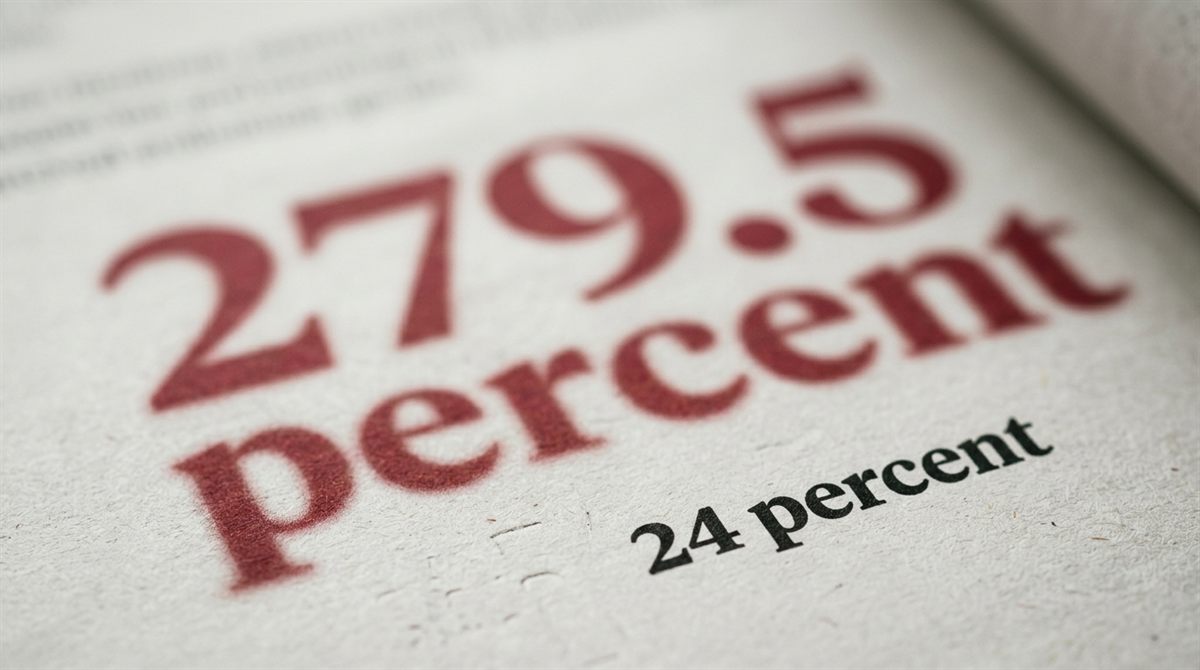
The paperwork says 24%. That number is true, and it is close to useless, because Tennessee law lets the lender charge a second price on the same money: a fee of 0.7% of your balance every single day. Put the two together and a Tennessee flex loan runs about 279.5% a year. One contract, two prices, and only the small one makes it into the ad.
Nobody's lying to you at that counter. The state wrote the rules that way. Understanding how they fit together takes about ten minutes, and it's the cheapest ten minutes you'll spend all year.
What a Flex Loan in Tennessee Actually Is
A flex loan is open-end credit. That is the legal category, and it matters more than anything on the brochure. The Tennessee Department of Financial Institutions (TDFI) defines a flex loan plan as a line of repeated loans for personal, family, or household purposes with no fixed maturity and no limit on the length of the term, prepayable in whole or in part at any time without penalty.
Read that middle part again. No fixed maturity. An installment loan has an end date printed on it: make 36 payments and you're done. A flex loan ends when you zero it out, when the lender calls it in default, or when the lender sues you.
The product came out of the Tennessee Flexible Credit Act, passed in 2014, with lender licensing opening January 1, 2015. It was sold as the safer, more flexible cousin of payday lending. The statute caps the outstanding principal at $4,000 at any one time.
The 24% Is Real. So Is the 0.7% Daily Customary Fee.
Here is where the Tennessee flex loan interest rate stops being one number. Tenn. Code Ann. 45-12-111(b) lets a licensee charge a periodic interest rate of up to 24% per year. Then subsection (c)(2) authorizes something else entirely, a "customary fee," and says this about it:
The fee "shall not be deemed interest for any purpose of law and shall not exceed a daily rate of seven-tenths of one percent (0.7%) of the average daily principal balance in any billing cycle."
That sentence is the whole ballgame. The legislature took the expensive part of the price and placed it outside the definition of interest. So the lender can tell you 24% and be telling the truth under state law, while the bulk of what you pay rides along in a category the law refuses to call interest.
Do the annual arithmetic yourself:
- 0.7% per day x 365 days = 255.5% per year in customary fee alone
- 255.5% + 24% periodic interest = 279.5% per year combined
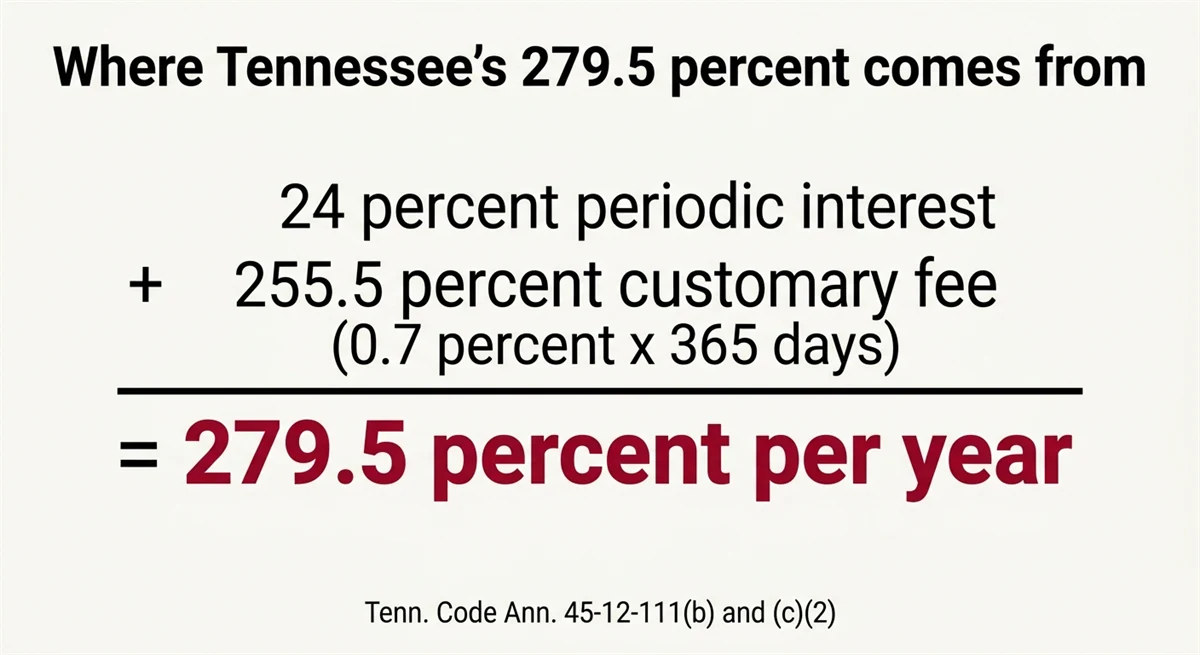
That 279.5% isn't my editorial estimate. TDFI itself walked reporters at NewsChannel 9 through the same breakdown when the product was new, and ProPublica has since printed real borrower loan documents showing the number on the page. It's a simple, non-compounded annual rate, the way it appears on Tennessee flex loan agreements. Treat 279.5% as the honest ceiling here. You may see a 450% figure on aggregator sites. There's no statutory path to it, so ignore it.
Run the Math on a $1,000 Tennessee Flex Loan Balance
Abstract percentages never scare anybody. Dollars do. Say you carry $1,000 on a flex loan through one 30-day billing cycle, and the lender charges the maximum the statute allows:
- Customary fee: $1,000 x 0.007 x 30 days = $210.00
- Periodic interest: $1,000 x 0.24 x (30/365) = $19.73
- Required principal reduction (3% per calendar month under 45-12-111(e)): $30.00
- Minimum payment: $259.73
Of that $259.73, exactly $30 touches your balance. The other $229.73 is cost. That is 88 cents of every dollar gone before your debt moves an inch.
Stretch it out and the picture gets worse. Carry $500 for a full year without paying anything down and the fee alone runs $500 x 0.007 x 365 = $1,277.50, plus $120 in periodic interest. Total cost of borrowing $500 for one year: $1,397.50. At the $4,000 statutory ceiling, a single 30-day cycle runs $840 in customary fees, $78.90 in periodic interest, and $120 in required principal reduction: a minimum payment of $1,038.90, of which $918.90 is pure cost.
Why the Minimum Payment Never Moves the Balance
The 3% monthly principal reduction was the borrower protection lawmakers pointed to in 2014. On paper it guarantees the balance shrinks. In practice, 3% of a shrinking balance is a shrinking number, and it takes forever.
Watch what that does to $500 over three years. Reduce the principal by 3% every month for 36 months and you get $500 x 0.97^36, which is $167.01 still owed. The average balance across those three years works out to roughly $309, and $309 charged at 279.5% for three years is about $2,587 in fees and interest. ProPublica reported the same scenario at more than $2,600 in charges with $167 of principal outstanding. Two roads, same destination.
So you pay for three straight years, hand over more than five times what you borrowed, and still owe $167 on a $500 loan.
Then there is reborrowing, which is where the 3% rule quietly stops working at all. ProPublica's companion investigation found that borrowers routinely draw money back out right after making a payment, which resets the balance and erases the reduction they just paid for. Of 14 borrowers the newsroom interviewed, all but one reborrowed at least once. One of them reborrowed roughly 80 times in 18 months on an initial $175 loan.
Borrowers in that reporting describe the same trap: a monthly payment the size of a car note, and a balance that never moves.
Flex Loan vs Payday Loan in Tennessee: The Alternative Costs More
Now the part that should decide this for you. The flex loan was pitched as the alternative to payday lending. Compare a flex loan against a Tennessee payday loan on identical money over an identical stretch of time, and the alternative loses.
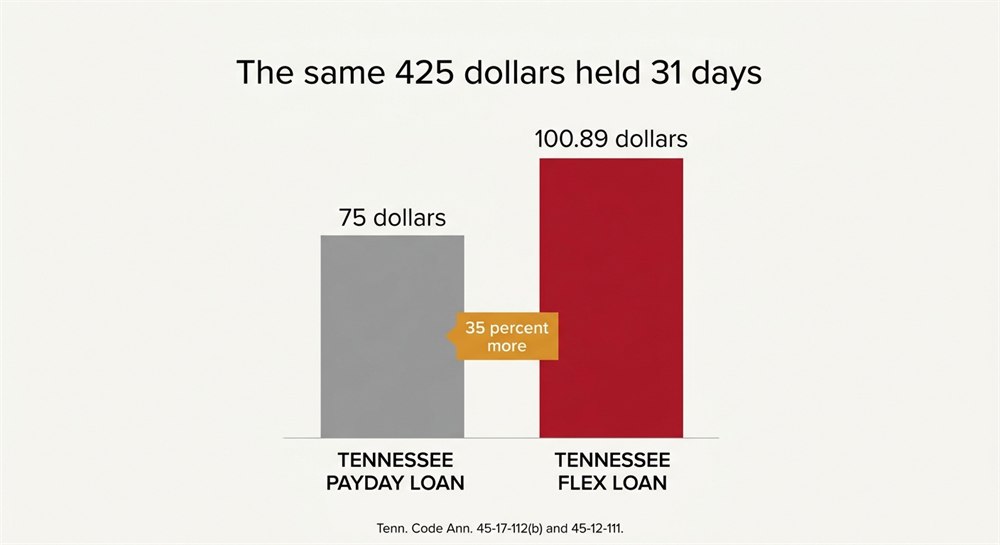
Tennessee payday lending runs under a separate statute, the Deferred Presentment Services Act. The fee is capped at 15% of the face amount of the check under Tenn. Code Ann. 45-17-112(b), combined outstanding checks are capped at $500, and the term maxes out at 31 days. Write a $500 check, walk out with $425, and the lender keeps $75.
Carry that same $425 on a flex loan for the same 31 days:
- Customary fee: $425 x 0.007 x 31 = $92.23
- Periodic interest: $425 x 0.24 x (31/365) = $8.66
- Total: $100.89
Payday loan: $75. Flex loan: $100.89. The flex loan costs about 35% more for the same money over the same month, and unlike the payday loan it has no expiration date forcing a reckoning. The 2014 law also raised the ceiling from $425 to $4,000 in principal, about nine times the old limit. Bigger balances, higher daily cost, no maturity date. That's the trade Tennessee made, and it's why identical borrowers get different prices in different states.
What Tennessee Court Records Show
Price is one thing. What happens when people fall behind is another, and Tennessee has the receipts. ProPublica and the Tennessee Lookout published a court-record analysis on June 26, 2025 covering the 59 Tennessee counties with electronic records, home to more than four-fifths of the state's population. Their findings on a single flex lender:
- More than 110,000 lawsuits filed against Tennesseans since 2015, about 22,000 in Davidson County alone
- Roughly one lawsuit for every 50 residents in the counties studied
- More than $200 million in judgments won since 2015
- About 40% of cases ending in wage garnishment
ProPublica and the Tennessee Lookout also found that Tennessee flex lenders as a group reported around $880 million in operating income in 2022, up from roughly $730 million in 2019, while TDFI logged just 91 consumer complaints from 2020 through the reporting period. Unhappy flex borrowers, the newsroom noted, end up in a courtroom rather than in a regulator's complaint queue.
One more thing, since you'll find articles hinting otherwise: the Flexible Credit Act has not changed since 2014, and no confirmed reform sits in front of the legislature. Don't sign something expensive on the theory that Nashville is about to fix it.
Where to Look on Your Paperwork Before You Sign
Tennessee can declare the customary fee "not interest" for state purposes, but federal law doesn't care what the state calls it. Under the Truth in Lending Act and Regulation Z, that fee counts in the finance charge. Which is why the APR box on a real Tennessee flex loan agreement shows a number near 279.5% while the contract language talks about 24%.
Before you sign, work down this list:
- Find the APR box in the federal disclosure block. If it reads anywhere near 279%, the fee is doing the work.
- Check the credit limit against what you actually need. The daily fee is charged on your average daily principal balance, so every extra dollar you draw costs 0.7% a day for as long as it sits there.
- Read the minimum payment formula. Confirm how much of it is principal. If it's 3% of the balance, you now know what three years of that looks like.
- Ask whether personal property secures the loan. Some flex loans in Tennessee are unsecured and some take a vehicle title. Get the answer in writing.
- Read the default terms. The statute permits attorney's fees, collection costs, and court costs only where the matter is referred to an attorney and the loan agreement allows it. TDFI's position is that the customary fee cannot be charged after default at all.
Cheaper Alternatives to a Tennessee Flex Loan
Nothing here is free, and I'm not going to pretend a credit union will hand you $800 tomorrow. But 279.5% is a low bar to beat.
Payday Alternative Loans at a federal credit union. The National Credit Union Administration caps interest on PALs at 28% and the application fee at $20. PAL I runs $200 to $1,000 over one to six months and requires a month of membership. PAL II goes to $2,000 over one to twelve months with no wait. Be honest about the math: the CDFI Fund notes that a 28% rate plus a $20 application fee can compute above 36% APR under TILA methodology on a small, short loan. It still isn't in the same universe as 279.5%.
Earned wage access, but only if your employer already offers it. If DailyPay, Payactiv, or similar is already set up through your payroll, pulling wages you've earned costs far less than a flex loan. Signing up for a consumer app on your own is a different product with different economics.
Community development financial institutions. Pathway Lending, a Tennessee CDFI, lists offices in Nashville, Chattanooga, Knoxville, and Memphis on its own site. Its published focus skews to business and larger-dollar lending rather than small emergency loans, so call and ask about consumer products before you count on one.
Attack the bill before you borrow. Most Tennessee hospitals publish a financial assistance policy, and many will set up a payment plan if you ask. Utility providers often run deferred payment programs. Those conversations are uncomfortable and all of them beat 0.7% a day.
If You Already Have a Flex Loan
The single most useful move is to stop drawing on it. Every redraw resets the balance the daily fee is calculated on, the mechanism ProPublica documented and the reason so many balances never fall.
Pay it above the minimum, and pay it before any other debt you carry at a lower rate. TDFI confirms a flex loan plan is prepayable in whole or in part, with no prepayment penalty. A card at, say, 27% and a flex loan at 279.5% are not remotely the same emergency. Put every spare dollar on it until it's at zero, then close the line.
If a lender charged the customary fee after declaring default, misstated your balance, or is not properly licensed, complain in writing to the Tennessee Department of Financial Institutions. The consumer complaint form is online, the phone number is (615) 741-2236, the email is TDFI.Contact@tn.gov, and the mailing address is 312 Rosa L. Parks Avenue, Nashville, TN 37243. TDFI has limits: it cannot act as your attorney, give legal advice, or take a complaint on a matter already in court. If you've been sued, you need a lawyer or your local legal aid office, not a regulator.
None of this is legal advice, and Cash Zella is a publisher and lender-matching service, not a lender. The arithmetic above comes straight from the statute, and you can rerun every line of it on your phone at the counter. Do that before you sign, not after the third payment lands and the balance hasn't budged.
Frequently Asked Questions
Is a flex loan legal in Tennessee?
Yes. Flex loans are authorized by the Tennessee Flexible Credit Act, Tenn. Code Ann. Title 45, Chapter 12, passed in 2014 with licensing beginning January 1, 2015. Lenders must be licensed through the Tennessee Department of Financial Institutions on the Nationwide Multistate Licensing System (NMLS). The law permits a 24% periodic interest rate plus a customary fee of up to 0.7% daily.
What is the maximum Tennessee flex loan amount?
Tenn. Code Ann. 45-12-111(d) prohibits any flex loan plan from carrying an outstanding principal balance above $4,000 at any time. At that ceiling, one 30-day billing cycle at the maximum allowable charges produces about $840 in customary fees plus roughly $78.90 in periodic interest, before the required 3% principal reduction of $120.
How much does a $500 flex loan cost in Tennessee?
Carried for one full year without paydown, $500 costs $1,277.50 in customary fees plus $120 in interest, totaling $1,397.50. Paid at the minimum for three years, the charges exceed $2,600 and roughly $167 of principal still remains, a result ProPublica documented and that the statutory math independently reproduces.
Can a flex loan lender garnish my wages in Tennessee?
Not directly. Under Tennessee garnishment procedure, a creditor must first sue you and win a judgment, then apply to the court for a garnishment order. ProPublica and the Tennessee Lookout, reviewing Tennessee court records, found that roughly 40% of one flex lender's collection cases ended in wage garnishment, out of more than 110,000 suits filed since 2015.
Can I pay off a Tennessee flex loan early without a penalty?
Yes. TDFI states that a flex loan plan is prepayable in whole or in part at any time without penalty. Because the customary fee accrues daily on your average daily principal balance, paying extra reduces what you owe going forward.
Is a flex loan the same as a payday loan in Tennessee?
No, they run under separate statutes. Payday loans fall under the Deferred Presentment Services Act, with fees capped at 15% of the check, a $500 limit, and a 31-day maximum term. On $425 held 31 days, the payday fee is $75 while the flex loan costs $100.89, about 35% more.