

You have two payday loans rolling, a relief company's number open in another tab, and maybe ten days before the next withdrawal clears. Let me save you the discovery process: a payday loan consolidation program is not one product. It is four different arrangements wearing the same name in the ads. Three are cheap or free. One can take thousands from you and leave the original debt exactly where it was.
The borrowers I watched get hurt worst were almost never the ones who made a bad loan decision. They were the ones who made a bad relief decision after the loan went sideways. That is the part nobody warns you about.
What a "Payday Loan Consolidation Program" Actually Means
The four things sold under one name
Type that phrase into a search bar and four categories of offer come back mixed together. They are not variations of each other. Different costs, different legal rules, wildly different odds of working.
- A consolidation loan. You borrow once at a lower rate, pay off the payday loans yourself, and make one payment. A credit union payday alternative loan or a small personal loan is the usual shape.
- A nonprofit debt management plan. A credit counseling agency negotiates with your creditors, you send the agency one monthly payment, and the agency distributes it.
- An extended payment plan from the payday lender itself. In sixteen states, your lender is required by statute to convert your loan to installments, at no extra charge, if you ask.
- A for-profit debt settlement or "relief" program. You stop paying the lender, pay into an account instead, and the company eventually tries to settle for less.
The fourth one is the only one that routinely asks for money before it does anything for you. It also has the biggest ad budget. "Consolidation" tests better in a headline than "settlement," so that is the word the industry bought.
The Rollover Math You Are Trying to Escape
The $300 loan that costs $360 and still isn't paid
Start with the price tag. A payday finance charge commonly runs $10 to $30 per $100 borrowed, and at the typical $15 per $100 that works out to an annual percentage rate of almost 400 percent on a two-week loan, according to the Consumer Financial Protection Bureau's explainer on payday loan costs and fees. That is why the fee meter runs faster than your paycheck does.
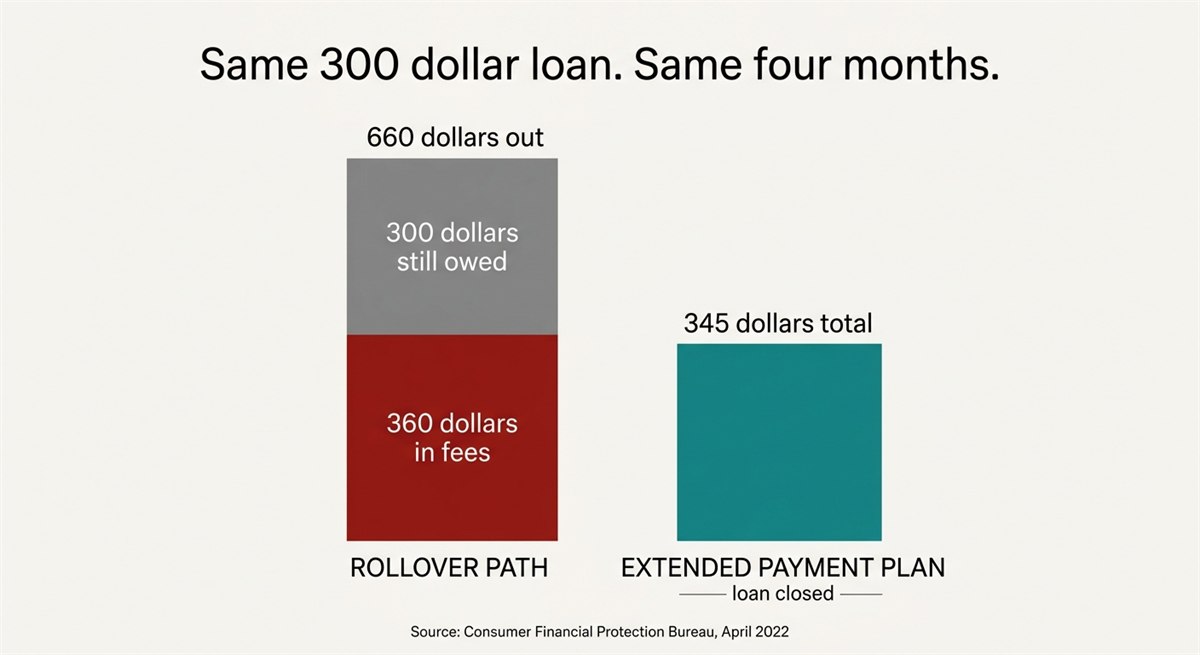
Now the part worth memorizing. On a $300 payday loan, a borrower who keeps rolling it over pays roughly $45 in fees every two weeks. Four months in, that borrower has handed over $360 in fees and still owes the original $300. The same borrower who converted to an extended payment plan at the first rollover pays $345 total and walks away clean, according to the CFPB's April 2022 extended payment plan market snapshot.
Why two rolling loans sink you faster
One rolling loan is a fee problem. Two on staggered due dates is a cash flow problem, and cash flow is what actually sinks people. You cover Loan A by shorting Loan B, then borrow to cover B.
CFPB research on payday borrowing found that more than 80 percent of these loans get rolled over or renewed within 14 days, that only about 15 percent of borrowers pay off without re-borrowing within two weeks, and that roughly 20 percent default at some point. Fair warning on that data: it comes from the Bureau's 2013 to 2014 research cycle. Still the most-cited federal read on the rollover cycle, still hosted by the Bureau, but not a 2026 snapshot.
For current scale, the Center for Responsible Lending's February 2025 report found that single-payment and payday installment loans drained more than $2.4 billion in fees in a single year across more than 20 million loans, with Texas borrowers alone paying over $1.3 billion of that. CRL is an advocacy organization, not a regulator, so weigh it accordingly. Their fee totals rose 22 percent in Texas, 20 percent in California, and 17 percent in Florida between 2021 and 2022. The drain is getting bigger, not smaller.
Route One: The Extended Payment Plan Your Lender May Already Owe You
Sixteen states, no extra cost, on request
Here is the option almost nobody mentions, because nobody makes money on it. According to that same CFPB market snapshot, 16 of the 26 states where payday lending was permitted require lenders to offer a no-cost extended payment plan, covering more than 12 million payday loans a year.
Usage is dismal. Washington has the highest take-up rate in the country and it sits at 13.4 percent of eligible borrowers. During 2019 to 2020, payday volume fell by as much as 65 percent nationally while extended payment plan enrollment stayed flat everywhere except California, where it more than doubled. Borrowers are not declining the free option. They have never heard of it.
What Washington's law actually says
Washington's statute is the clearest example of what one of these rights looks like in practice. Under RCW 31.45.084, if you tell the lender you cannot repay, it must convert the loan to an installment plan on request: not less than 90 days for loans up to $400, not less than 180 days for larger ones.
The charges are locked down too. The licensee "may not assess any other fee, interest charge, or other charge on the borrower as a result of converting the small loan into an installment plan." The only permitted charge is a one-time $25 fee if you default on the plan itself, and the lender has to disclose the plan in the loan agreement.
Your state's version may be shorter, longer, or nonexistent, and some states cap how often you can use it. Check your own state financial regulator's licensee page before you assume anything. That is also where you find out how state rate caps change what a lender can charge you in the first place, which is worth knowing before you borrow again.
How to ask, in writing, before the due date
Timing matters more than wording. In most states with this right, you have to invoke it before the loan defaults, often before the due date on the current term. Once it rolls again, you may have burned the window.
Send an email or a portal message, not a phone call. State that you cannot repay on the due date, that you are requesting the extended payment plan available under your state's small loan law, and ask them to confirm the new schedule in writing. Save the timestamp. If a lender refuses, that written record is what your state regulator will want to see.
Route Two: A Nonprofit Debt Management Plan
What a debt management plan does and what it will not do
A credit counseling agency reviews your budget, negotiates with creditors, and sets up one monthly payment the agency distributes. The CFPB draws a clean line between credit counseling and debt settlement, noting that settlement firms "usually can't get better terms than you could get by negotiating with your lenders and debt collectors yourself" and that a lower monthly payment often just means paying longer.
One warning before your hopes get up: many payday lenders do not participate in debt management plans. Ask that exact question on the first call, before you fill out a single form. If the answer is vague, it is a no.
How to check an agency before you call back
"Nonprofit" is a tax classification, not a quality seal, and predatory operators have used it as cover for decades. Verify against a government list: the U.S. Trustee Program publishes the roster of agencies approved for pre-bankruptcy counseling, a meaningful screen even if bankruptcy is nowhere in your plans. Then check your state financial regulator for the license. The National Foundation for Credit Counseling says most member agencies offer a free session, and that a plan may carry a small setup fee plus a modest monthly fee set by agency and state law. Ask for the fee schedule in writing.
Route Three: An Actual Consolidation Loan
Payday alternative loans at credit unions
Federal credit unions make a product built specifically to pull people out of the payday cycle, and the terms sit in federal regulation, not in a salesperson's discretion. A PAL I (payday alternative loan) runs $200 to $1,000 over one to six months and requires a month of membership; a PAL II goes up to $2,000 over one to 12 months with no minimum membership period. Both cap the application fee at $20, limit you to three loans in any rolling six-month period, and flatly prohibit rollovers. Pricing is capped too: PAL interest cannot exceed 1,000 basis points above the general federal credit union rate ceiling, and the NCUA Board extended the temporary 18 percent ceiling through September 10, 2027, which puts the PAL cap at 28 percent APR. Set that beside roughly 400 percent on a rolled-over payday loan.
When a personal loan works and when it does not
If your credit is still in decent shape and your debt-to-income ratio has room, prequalify at two or three lenders, read the Truth in Lending disclosure on each offer, and take the best one. Nothing complicated about that. Three weeks into a rollover cycle, though, your bank statements show the overdrafts an underwriter is going to read line by line, and that is the reader most articles ignore. When a new loan is off the table, and the denial notice has to tell you why, your real options are the extended payment plan, a counseling agency, direct negotiation, and the other ways to consolidate debt without taking a new loan.
Route Four: For-Profit "Payday Loan Relief," and the Rule That Governs It
The advance-fee ban in plain English
Carry this into the phone call. Under the Federal Trade Commission's Telemarketing Sales Rule (TSR), 16 CFR 310.4(a)(5)(i), a debt relief company that signs you up over the phone cannot request or receive any fee until it has actually altered the terms of at least one of your debts under a valid agreement and you have made a payment on those new terms. A "retainer," a "processing charge," or a first monthly draft before that point breaks a federal rule. Not bending it. Breaking it. Hang up, then report it to the FTC and your state attorney general. The shape of it matches the red flags that mark a loan offer as a scam: your money moves first, and nothing moves back.
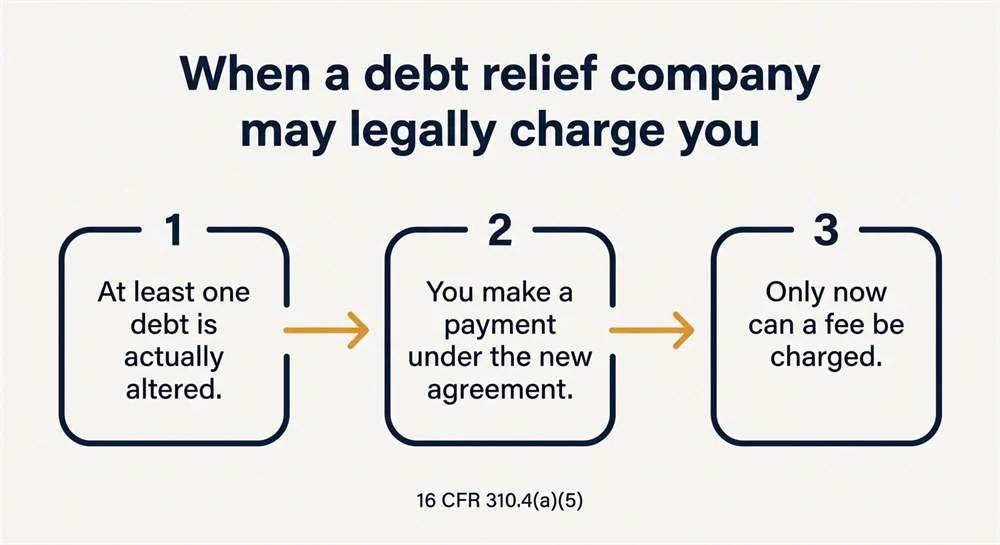
The ban took effect October 27, 2010. It is not new, and every legitimate operator knows it cold.
One honest caveat: the Telemarketing Sales Rule governs sales made by phone, which is how nearly all of these outfits close. A company that meets you face to face may sit outside the TSR, though it still falls under your state's debt adjuster law. Many states license or restrict for-profit debt adjusters, New Jersey's Debt Adjustment and Credit Counseling Act limits the business to nonprofit agencies, and Washington's Attorney General says a for-profit debt relief company operating there cannot charge total fees above 15 percent of the total listed debt. Federal law is the floor, not the ceiling.
Whose money is in the dedicated account
Most settlement programs park your monthly deposits in a "dedicated account" while they negotiate. The same rule, at 310.4(a)(5)(ii), sets terms on that account, and they favor you more than most enrollees realize. The funds must sit at an insured financial institution, and you own the funds and any interest they earn.
The administrator has to be independent of the debt relief company, not affiliated with it and not paid by it. You may withdraw at any time without penalty, and your remaining money must come back within seven business days. If a company controls the account, owns the interest, or claims a penalty for pulling out, the arrangement is out of compliance. Ask who holds the account before you fund it.
Four Questions to Ask Before You Pay a Payday Loan Relief Company
Keep this list next to the phone. Any company that dodges one of these has told you what you need to know.
- What is your fee, and when exactly do you collect it? You want a dollar figure and a trigger event, not a percentage and a shrug.
- Are you licensed in my state, and what is the license number? Write it down and check it against your state financial regulator's lookup while you are still on the call.
- Who holds my dedicated account, and are you affiliated with them? The administrator has to be independent. If the rep does not know, that answer is a no.
- Are you telling me to stop communicating with my lenders? The CFPB is direct: legitimate credit counseling never advises you to stop paying your debt. Instructions to cut contact and reroute your payments are the clearest fraud signal there is.
What to Do in the Next 48 Hours
You do not need a program today. You need a sequence, and all of it is free.
- Inventory the loans. One sheet of paper: lender, principal, fee, due date, and the account each one draws from. Most borrowers I sat with had never seen it all in one place, and the total is usually smaller than the dread.
- Document every withdrawal. Screenshot your transaction history weekly. If a lender keeps drafting after you revoked authorization, that record is your complaint.
Cash Zella is a publisher and lender-matching service, not a lender, a law firm, or a credit counseling agency, and nothing here tells you to stop paying a specific creditor. State rules vary, so confirm the details with your own state regulator before you act.
The core of it is this. Almost everyone selling you a payday loan consolidation program is selling the most expensive of the four routes. The cheapest one is usually a written request to a lender you already owe. Send that first, then see what is left to solve.
Frequently Asked Questions
Is payday loan consolidation legit?
Some versions are, some are not. Credit union payday alternative loans, nonprofit debt management plans, and state-mandated extended payment plans are legitimate and cheap. For-profit debt settlement marketed as "consolidation" is legal only when it follows the federal advance-fee rule. Verify the company's state license first.
Can a payday loan consolidation program charge an upfront fee?
No. Under 16 CFR 310.4(a)(5), a debt relief company that enrolls you by phone cannot collect any fee until it has altered the terms of at least one of your debts and you have made a payment under that new agreement. Retainers and processing charges violate the rule too.
Does payday loan consolidation hurt your credit?
It depends on the route. An extended payment plan from your existing lender only restructures a loan you already have, so it opens no new account and triggers no hard inquiry. A new consolidation loan adds an inquiry and a tradeline. A settlement program can damage your credit badly, because it typically involves going delinquent on purpose.
Which states require payday lenders to offer an extended payment plan?
CFPB reported that 16 of the 26 states permitting payday lending require lenders to offer a no-cost extended payment plan, covering over 12 million loans annually. The Bureau did not publish a plain state list, so confirm your own state's rule with your state financial regulator or attorney general.
What is the difference between payday loan consolidation and payday loan settlement?
Consolidation replaces several debts with one payment, usually through a new loan or a managed plan, and you repay the full balance. Settlement means you stop paying, let the debts go delinquent, and a company tries to negotiate a reduced payoff. Settlement costs more, takes longer, and damages your credit.
Can I negotiate with a payday lender myself?
Yes, and you often get the same result a paid company would. CFPB notes that settlement firms usually cannot obtain better terms than you can get on your own. Start by requesting your state's extended payment plan in writing, then ask for a hardship arrangement if no statutory plan applies.