


A 29-year-old on a family finance forum described refusing to lend money again after a $3,500 loan to a relative was never repaid. In another case, adult siblings ended up fighting over a $37,000 loan their parent had handed out and never formally documented before death. Neither loan had a document behind it, which meant neither had a clear answer to the question that mattered most once things went sideways: was this a loan or a gift?
That's what a personal loan agreement template is for. It settles the loan-or-gift question before it becomes a fight. This piece walks through one clause by clause, explains what each clause actually protects against, and covers the part most templates skip entirely: the IRS rules on below-market interest, the gift-tax mechanics that can turn a favor into a filing obligation, and the state usury caps that decide what rate you're even allowed to charge.
This is not legal or tax advice. It's a guide to what the document needs and why, so you know when a form is enough and when it's time to call a lawyer or a CPA. (If a collector rather than a family member is asking you for money, this site's debt validation letter template is the document you want instead.)
What a Personal Loan Agreement Needs to Include
A usable personal loan agreement sample covers nine things: who the parties are, how much is being lent, what interest rate applies, how and when it gets repaid, what happens if a payment is missed, what happens if the borrower stops paying altogether, whether early payoff is allowed, which state's law governs the deal, and how it gets signed. Skip any one of these and you've left a gap that an argument, a lawsuit, or the IRS can walk through.
Clause-by-Clause Walkthrough
Parties
Name both people, in full, with current addresses. This sounds obvious until a loan needs to be enforced or comes up in probate years later, and "my nephew Dave" isn't a legal identifier a court or an estate attorney can act on. If either person is signing on behalf of a trust or an LLC rather than as an individual, say so here, because that changes who's actually on the hook.
Loan amount
State the exact principal, in numbers and in words, and note the date the money changed hands. If the loan came in installments rather than one lump sum, list each disbursement with its date. This clause is what separates a loan from a gift on paper, and it's also what prevents a later dispute over whether a partial repayment already happened or whether some of the money was actually meant as a gift from the start.
Interest rate
This is the clause that does the most legal work, and it's the one most templates handle worst. Two forces bear on it at once: the IRS wants to know whether you charged enough interest, and your state wants to know whether you charged too much.
On the low end, the IRS applies Section 7872 of the Internal Revenue Code to below-market loans between individuals. Charge less than the Applicable Federal Rate (AFR) and the IRS treats the shortfall as "forgone interest," a gift from lender to borrower, followed by an imputed interest payment back to the lender for tax purposes, under 26 U.S.C. Section 7872. There's a floor: gift loans between two individuals are exempt from this rule entirely if the total outstanding balance between them doesn't exceed $10,000, unless the money is used to buy or carry income-producing assets like stocks.
The high end works differently: your state's usury cap sets the ceiling on what you can legally charge at all, and that number is different in every state (see how state rate caps work), which is why the rate clause and the Governing Law clause have to agree with each other.
The rate itself should reference the current AFR by name and by month, since the IRS republishes it monthly and last month's number isn't this month's number.
Repayment schedule
Set the payment amount, the frequency, and the due date. This clause is the difference between a loan and an open-ended favor. If the IRS or an estate ever questions whether money that changed hands was a loan or a disguised gift, a documented repayment schedule with actual payments against it is the strongest evidence you have. An agreement that just says "pay me back when you can" won't hold up nearly as well.
Late payment and fees
Spell out what happens when a payment is missed: a grace period, a flat late fee or a percentage penalty, and when it kicks in. Check whether your state counts late fees or penalty interest toward its usury cap, and keep the combined rate under it.
Default
Define what counts as default (typically a payment missed by a set number of days) and what happens next: usually the right to demand the full remaining balance immediately, known as acceleration. Without this clause, a lender generally can only pursue each missed installment as it comes due, not the full remaining balance at once, which can slow down collection considerably if the borrower stops paying for good.
Prepayment
State plainly that the borrower can pay early or pay extra without penalty. Most family and friend loans should include this outright. There's rarely a reason to penalize someone for paying you back faster, and leaving the clause out creates ambiguity where none needs to exist.
Governing law
Name the state whose law controls the agreement. This matters most when lender and borrower live in different states, because usury caps are set state by state, not federally, and a rate that's perfectly legal in one state can exceed the cap in another. Naming the governing state up front is what lets both people check the deal against the right rule before signing, rather than discovering a problem with the rate after money has already changed hands.
Signatures, witnesses, and notarization
Both parties sign and date the agreement. Under UCC Article 3, Section 3-104, which every state has adopted in some form, a document qualifies as a negotiable promissory note based on its terms, an unconditional written promise to pay a fixed sum, and requires the maker's signature. Most states enforce a signed, unnotarized promissory note between private individuals without issue.
Notarization is worth the extra step when the loan is large, when the lender expects to need to prove the document in court or probate later, or when the loan crosses state lines. If real property is pledged as collateral, the security instrument tied to the note (a mortgage or deed of trust) typically does require notarization and recording under state real-property law, and that requirement varies by state, so check it locally before you rely on real estate as security.
The IRS Side Nobody Mentions
Here's where an interest-free "favor" quietly becomes a tax question. Say a parent lends an adult child $30,000, interest-free, for five years. That's a mid-term loan under IRS rules, and the October 2026 mid-term AFR is 4.61% annual, compounded annually, per Revenue Ruling 2026-19, Table 1.
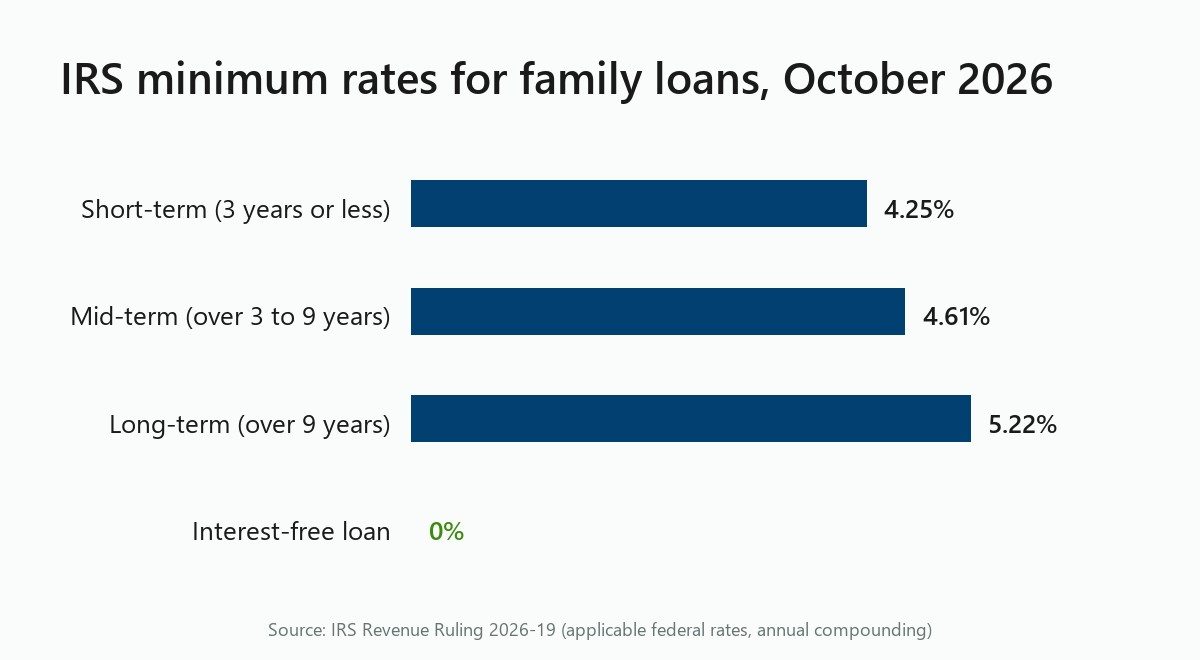
Charging 0% instead of 4.61% means the IRS calculates roughly $1,383 a year in forgone interest on that $30,000 balance, and because the balance is above the $10,000 de minimis threshold, Section 7872 applies. That $1,383 also counts as part of any gift the parent makes to the child that year, which matters against the annual exclusion described below.
Because the loan is under $100,000, though, the rule softens: imputed interest for income-tax purposes is capped at the borrower's net investment income for the year. If the adult child in this example has little or no investment income, little or no imputed interest actually applies, even though the $30,000 balance triggered the rule in principle. Above $100,000, that cap disappears and the full AFR-based imputed interest applies no matter what the borrower's investment income looks like.
There's a second layer worth knowing about: the gift tax annual exclusion. In 2026, one person can gift up to $19,000 to another person in a year. Both spouses of a lending couple can each use their own exclusion on the same recipient, which raises the combined figure to $38,000, per the IRS FAQs on gift taxes. If a lender later forgives part or all of a loan, or the forgone interest plus other gifts to that person exceed $19,000 in a year, the excess counts against the lender's lifetime gift and estate tax exemption ($15,000,000 for 2026, under Public Law 119-21) and may require filing IRS Form 709.
That usually doesn't mean gift tax actually gets owed, since the lifetime exemption is large, but it does create a filing obligation that a lot of families never realize applies to them. (The IRS treats other loan-adjacent situations just as literally; see how the IRS treats an installment agreement versus a personal loan for a comparable example.)
State Usury Limits: Why the Cap Depends on Where You Live
Usury law is state law, not federal law, and California, New York, and Texas show how differently three large states treat it.
In California, the default rate when parties haven't agreed to one in writing is 7%. If the loan agreement specifies a rate in writing and the money is used primarily for personal, family, or household purposes, the cap rises to 10% per annum. A loan used to buy, build, or improve real property doesn't qualify for that personal-use exemption and falls under a different, floating-rate cap instead, under the California Constitution, Article XV, Section 1.
New York sets a civil usury cap of 16% APR under General Obligations Law 5-501 and Banking Law 14-a. Above 25% APR, Penal Law 190.40 makes charging that rate a Class E felony.
Texas sets a constitutional usury baseline of 10% absent a written contract specifying a different legal rate, with the state's Finance Code laying out various contract-rate ceilings depending on the type of loan.
The takeaway: a $10,000 family loan at 12% sits under New York's 16% civil cap but over California's 10% cap for a written personal-use loan, and would need checking against Texas's baseline too. This is exactly why the Governing Law clause exists: "just copy a loan agreement template you found online" is risky without adjusting the rate to match whichever state actually governs the deal.
When to Actually Hire a Lawyer
A clause-by-clause template covers the routine family loan. It stops being enough once the deal gets complicated. Bring in an attorney or a CPA when the loan is roughly $50,000 to $100,000 or more, when real estate is pledged as collateral (the recording and notarization rules get state-specific fast), when lender and borrower live in different states with different usury caps, when the loan overlaps with forgiveness or estate planning, such as a parent who intends the loan to eventually convert into an inheritance advance, or when a family is structuring repeated "loans" that could look to the IRS like disguised gifts.
None of those situations are things a fill-in-the-blank form was built to handle, and the cost of a short consultation is small next to the cost of an unenforceable document, a state usury violation, or a surprise tax bill nobody in the family expected. (A formal lender has to hand you a Truth in Lending disclosure spelling out every one of these terms; an informal family loan only gets that protection if the agreement itself spells it out.)
Frequently Asked Questions
Do I need a lawyer to write a personal loan agreement for a family member?
Not for a routine loan. A clause-by-clause personal loan document template covering parties, amount, interest, repayment, default, and signatures is generally enough for loans in the low tens of thousands of dollars. A lawyer becomes worth the cost once the loan involves real estate collateral, crosses state lines, or overlaps with estate planning.
What happens if I lend money interest-free to a family member?
Balances of $10,000 or less between two people are generally exempt from the IRS imputed-interest rule under Section 7872. Above that, the IRS calculates what you should have charged at the Applicable Federal Rate; loans under $100,000 cap the imputed interest at the borrower's net investment income for the year.
Does a promissory note need to be notarized?
Most states enforce a signed, unnotarized promissory note between private individuals. It's worth adding when the loan is large, crosses state lines, or may need proving in court later. Real estate collateral typically requires its own notarized, recorded security instrument, and the rules vary by state.
What interest rate can I legally charge on a personal loan to a friend?
It depends entirely on your state's usury cap. California allows up to 10% per annum on a written, personal-use loan; New York's civil cap is 16% APR with a criminal threshold at 25%; Texas sets a constitutional baseline of 10% absent a different written rate. Check the cap in whichever state the loan agreement's Governing Law clause names.
What's the current IRS Applicable Federal Rate for family loans?
As of October 2026, per Revenue Ruling 2026-19, the short-term AFR (loans of 3 years or less) is 4.25%, the mid-term AFR (more than 3 up to 9 years) is 4.61%, and the long-term AFR (more than 9 years) is 5.22%, all annual compounding. The IRS republishes these rates monthly, so confirm the current figure before finalizing a loan agreement.