


Search "2000 loan" and you'll land on a wall of lender roundups that treat the number as incidental, a stand-in for whatever amount you happen to need. It isn't incidental. Many online personal loan lenders set their published minimum at $3,000, $5,000, or higher, which means a borrower who needs exactly $2,000 often gets routed into taking more than they asked for, or gets bounced toward a payday-style product that was never built for someone with a defined, moderate need. This article starts from the $2,000 figure and asks which sources actually serve it, at what published or regulatory terms, and what each route costs over its repayment schedule.
Four categories cover the field: online personal loan lenders whose minimums reach down to $2,000, federal credit union PAL II loans, credit card cash advances, and state-licensed installment lenders. Each operates under a different pricing logic, and none of them compete on the same axis. One is capped by federal regulation, one is priced by state law that varies by hundreds of basis points depending on where you live, and one has no grace period at all. Knowing which is which matters more than knowing which one has the friendliest landing page.
Online Personal Loan Lenders Whose Minimum Reaches $2,000
Many national online lenders don't publish a minimum anywhere near $2,000. Their floors typically sit at $3,000 or $5,000, which pushes a $2,000 borrower into an amount they didn't ask for, with interest accruing on the difference for the life of the loan. Avant is the cleanest exception: its published range runs $2,000 to $35,000, with APRs from 9.95% to 35.99% and terms of 24 to 60 months, directly stated on Avant's personal loans page. If your need lands exactly at $2,000, Avant's floor is built to catch it rather than round you up.
One detail worth flagging before you sign anything: Avant charges an administration fee of up to 9.99%, typically deducted from the loan proceeds rather than billed separately. That means a borrower who needs $2,000 in hand may need to request a slightly larger loan amount to net the full $2,000 after the fee comes out, or accept less than $2,000 actually landing in the account. It's a mechanical detail, easy to miss when comparing headline APRs, but it changes the number you walk away with.
Other lenders are commonly reported to reach lower. LendingPoint's minimum is commonly reported as low as $1,000, though it runs higher in some states. OneMain Financial's minimum is commonly reported at $1,500, which would put $2,000 comfortably inside its range. Both figures are commonly reported; confirm current terms with the lender before applying.
Federal Credit Union PAL II Loans: Built for Exactly This Amount
Few borrowers know this product exists, and that's a gap in most $2,000-loan content. PAL II, short for Payday Alternative Loan II, is a federal credit union product created specifically to serve loan amounts up to $2,000. Note the qualifier: federal credit union, not credit union broadly. State-chartered credit unions may offer comparable products under separate state rules that can differ, so PAL II eligibility depends on being a member of a federally chartered institution.
The regulatory structure is unusually specific for a consumer lending product. PAL II loans can run for a minimum of one month up to a maximum of twelve, with an application fee capped at the credit union's actual processing cost, not to exceed $20. The interest rate ceiling is set at 28% APR, a figure derived from 12 CFR 701.21's rule allowing PAL loans 1,000 basis points above the general federal credit union usury ceiling; the NCUA Board has extended that general ceiling at 18% through September 10, 2027. The term, fee, and rate-cap rules themselves are codified at 12 CFR 701.21, finalized through the PAL II rulemaking.
That 28% figure is a maximum, not a quoted rate. A federal credit union's actual PAL II rate can land anywhere at or below 28%, but never above it, and that asymmetry matters when comparing this product against a representative rate elsewhere in this article. Rules govern more than pricing here, too: PAL loans cannot be rolled over, and a federal credit union may not extend more than three PAL loans (PAL I and PAL II combined) to one borrower within any rolling six-month period, with only one PAL loan outstanding at a time, per 12 CFR 701.21(c)(7).
The catch is membership. You have to already belong to, or be eligible to join, a federal credit union that offers PAL II before you can borrow against it. For someone with no existing credit union relationship, that's a barrier, even though the product itself is the most tightly regulated and, at its ceiling, one of the least expensive routes to $2,000 on this list.
Credit Card Cash Advance: Fastest Access, No Grace Period
A cash advance moves fastest of any route here, but it's structured to be the most expensive way to hold $2,000 for very long. Two mechanics separate it from a purchase balance. First, an upfront cash-advance fee is charged immediately and separately from any interest. Second, interest begins accruing from the moment of the transaction; there is no grace period the way there is on ordinary purchases.
Cash advance APRs vary by issuer and card, and figures should be confirmed on your own card's terms rather than assumed from a competitor's rate sheet. There's a regulatory wrinkle that compounds the cost, too: under Truth in Lending Act payment-allocation rules (12 CFR 1026.53), any payment above the required minimum must be applied to the balance carrying the highest APR first. Because cash advance APRs typically outrank purchase APRs on the same card, a cash advance balance can sit at the back of the payment queue, sometimes for months, even while you're paying more than the minimum every cycle.
State-Licensed Installment Loans
"State-licensed" is doing real work in that heading. Unlike PAL II's single federal ceiling, installment lender pricing on a $2,000 loan is governed by whatever your state's law allows, and that range is wide. The National Consumer Law Center's December 2025 fact sheet on APR caps for $500, $2,000, and $10,000 installment loans found that 43 states plus DC impose some cap on a $2,000, two-year loan, while Delaware and Missouri impose no cap at all. NCLC treats 36% as a commonly cited ceiling for small-dollar loans generally, while arguing that figure runs too high once loan size climbs toward $2,000 and beyond.
Rates vary by state; check your state's cap. Most states cap this loan size, two don't, and your actual rate depends entirely on where you live and which licensed lender you're borrowing from.
Mariner Finance is a commonly cited example of a state-licensed installment lender in this space. Mariner Finance's APR range is commonly reported at 15.99% to 35.99% across 12 to 72-month terms. Treat that range as commonly reported and confirm current terms before applying.
Side-by-Side: $2,000, Four Ways
The table below runs the same $2,000 principal through each route's structure, using the standard amortization formula (M = P x r(1+r)^n / [(1+r)^n - 1], where r is the monthly rate and n is the number of payments). The PAL II figure uses the 28% regulatory ceiling; the installment loan, cash advance, and Avant-style figures use representative, illustrative APRs drawn from the middle of each category's published or reported range, since none of these is a single fixed nationwide rate. None of these are loan offers. They're a way to see what the same principal costs depending on which door you walk through.
- Federal credit union PAL II: 28% APR (hard regulatory ceiling), 12-month term, $193.01 monthly payment, $316.14 total interest, $336.14 total cost of credit including the application fee.
- State-licensed installment loan: 30% APR (representative), 24-month term, $111.83 monthly payment, $683.82 total interest and total cost of credit.
- Credit card cash advance: 29.99% APR (representative) plus a 5% upfront fee, 12-month payoff, $194.96 monthly payment, $339.57 total interest, $439.57 total cost of credit including the fee.
- Online lender at its published minimum, Avant-style: 24% APR (representative), 36-month term, $78.47 monthly payment, $824.77 total interest, before Avant's administration fee of up to 9.99%.
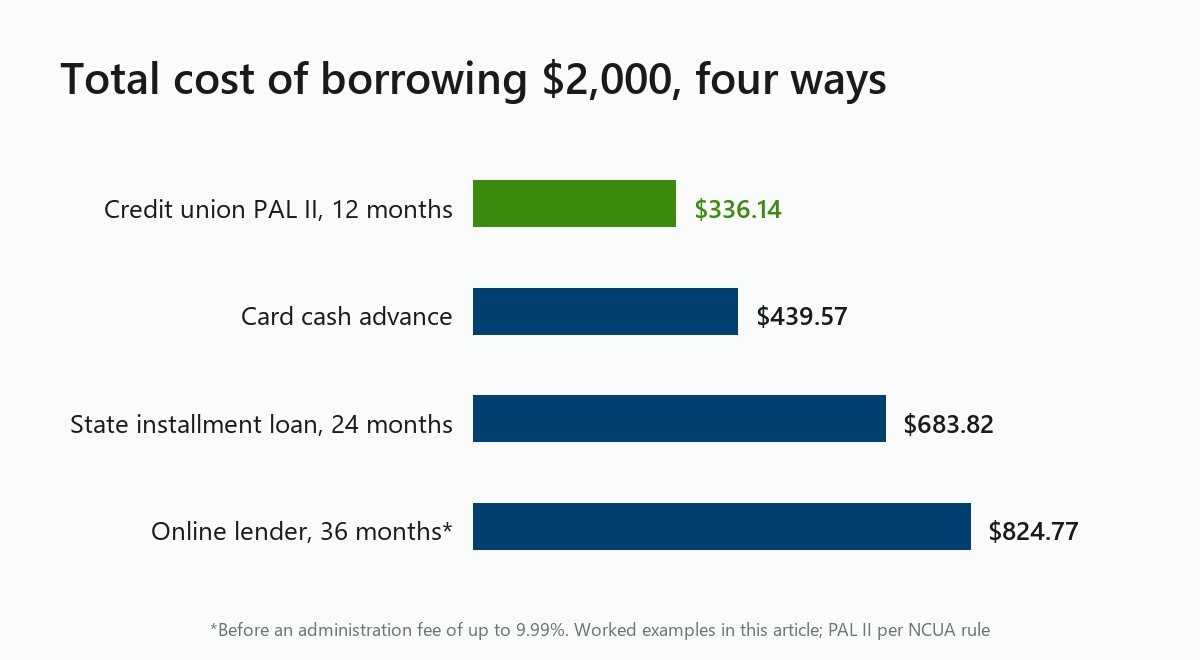
A few things stand out once the numbers sit next to each other. PAL II's total cost of credit, $316.14 in interest plus up to $20 in application fees for $336.14 total, is the lowest on the list, a direct product of its 28% regulatory ceiling and short twelve-month term. The cash advance route charges $100 in fees upfront, then adds $339.57 in interest over just twelve months, a cost pattern that reflects the no-grace-period mechanics described above. The Avant-style online lender carries the highest total interest of the four, $824.77 before its administration fee, but that's a direct consequence of spreading the same $2,000 over 36 months instead of 12 or 24: a longer term buys a smaller monthly payment, $78.47 versus PAL II's $193.01, at the price of more months of interest on the outstanding balance.
Which Route Fits Which Borrower
If you're already a member of a federal credit union, or eligible to join one that offers PAL II, this is usually the strongest option on the list: the lowest modeled total cost, a federally capped rate, and a structure explicitly built for this loan size. The tradeoff is the twelve-month repayment window and the membership requirement itself, which rules the product out entirely for anyone without an existing or accessible federal credit union relationship.
Avant fits a borrower with fair to good credit who wants the amount to land exactly at $2,000 without being pushed into a larger loan they didn't ask for. Its 24 to 60-month term range gives more flexibility on monthly payment size than PAL II's twelve-month cap, though total interest rises accordingly, and the administration fee deserves a second look before you sign.
A cash advance suits emergencies where the money needs to move today and you have a realistic plan to pay it down within a month or two, before the no-grace-period math has time to compound. It's the wrong tool for anyone expecting to carry the balance for six months or more.
State-licensed installment lenders serve borrowers who don't qualify for a bank-grade rate and don't have credit union access. The responsible move is to check your specific state's rate cap and your lender's license before assuming the representative 30% figure used here applies to you. Delaware and Missouri residents, in particular, face no state ceiling at all, so a licensed lender in those states can price meaningfully above what a capped-state lender is permitted to charge.
If your actual need runs smaller than $2,000, the calculus shifts again. Cashzella has published a full walkthrough comparing personal loans, payday loans, and cash advances at the $1,500 mark. That piece works through the same three product types at a slightly smaller amount and is worth a read if $1,500, not $2,000, is closer to what you actually need.
Frequently Asked Questions
What is the easiest way to get a $2,000 loan?
A cash advance is fastest with available credit, though it carries an upfront fee and no grace period. For lowest cost, a federal credit union PAL II loan wins, with a 28% APR ceiling and $336.14 total cost over twelve months, but it requires membership. Avant is the most direct online route, no membership needed.
Can I get a $2,000 loan with bad credit?
State-licensed installment lenders and some online lenders serve borrowers with fair or limited credit history, generally at higher APRs than a bank or credit union offers. Avant's published range runs 9.95% to 35.99% APR depending on credit profile, and Mariner Finance's APR range is commonly reported at 15.99% to 35.99%. Confirm your qualifying rate directly with the lender before applying.
What is a PAL II loan and how is it different from a payday loan?
PAL II is a federal credit union product created under NCUA rules to serve amounts up to $2,000, with a 28% APR ceiling, a $20 application fee cap, and one-to-twelve-month terms, all under 12 CFR 701.21. PAL loans cannot be rolled over, and a borrower can hold only one PAL loan at a time.
Does every state cap the interest rate on a $2,000 installment loan?
Most do, but not all. According to the National Consumer Law Center's December 2025 fact sheet, 43 states plus DC impose some APR cap on a $2,000, two-year installment loan, while Delaware and Missouri impose no cap at all. Your actual rate ceiling, or lack of one, depends entirely on your state of residence.
Is a credit card cash advance cheaper than a personal loan for $2,000?
Not typically, once you look past the speed of access. A cash advance charges an upfront fee, and interest accrues immediately with no grace period. Modeled over twelve months at 29.99% APR plus a 5% fee, a $2,000 cash advance costs $439.57 combined, more than PAL II's $336.14 total over the same term.