

The Federal Reserve's G.19 consumer credit release dated August 7, 2026 puts the average 24-month personal loan at commercial banks at 11.86 percent. Stack up everything the IRS charges a taxpayer on an installment agreement (interest, penalty, and setup fee) and the carrying cost lands near 10 percent a year. So the honest answer to the IRS payment plan vs personal loan question, for a borrower with average credit, is the one nobody expects: the IRS is the cheaper lender.
That surprises people because the IRS feels like the most dangerous creditor in the room. It has collection powers no bank has. What it doesn't have is a pricing desk trying to earn a spread on you, and that shows up in the arithmetic.
Below is the full run on a $7,000 balance over 24 months, both routes, in dollars. Then a single threshold you can hold your loan offer against.
What the IRS Actually Charges You
Most articles quote one number and stop. There are three separate charges, they accrue on different bases, and two of them change depending on what you did and how you applied.
The interest rate, and why it moves every quarter
Underpayment interest for individuals is set by formula: the federal short-term rate plus three percentage points, compounded daily. For the quarter running July 1 through September 30, 2026, that rate is 7 percent, according to the IRS quarterly interest rates table.
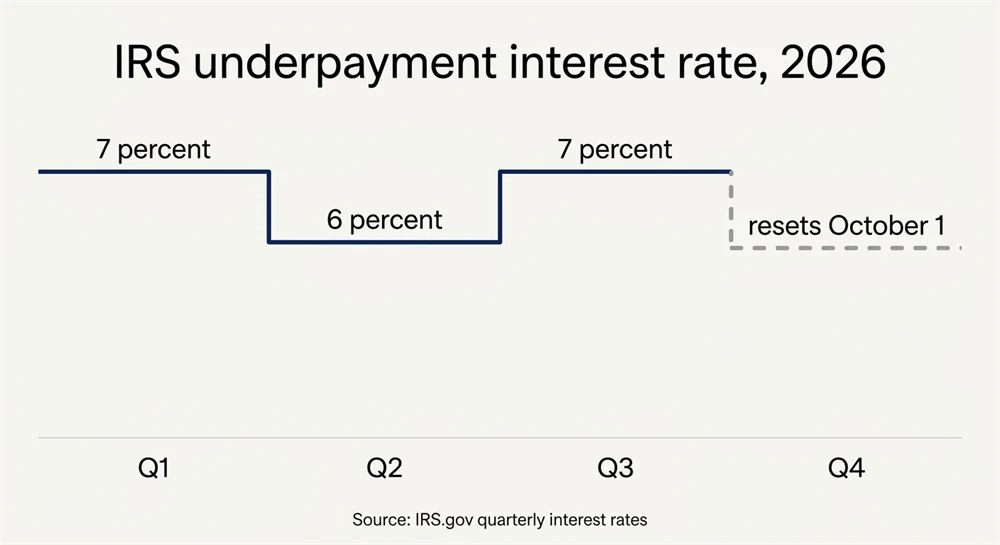
It moves. In 2026 alone the individual underpayment rate ran 7 percent in Q1, dropped to 6 percent in Q2, and came back to 7 percent in Q3. The next reset lands October 1, and the IRS typically announces it in early September. Check the current quarter before you rely on any figure you read anywhere, including this one.
Interest is statutory. It cannot be waived for reasonable cause the way a penalty sometimes can. If your balance sits, it accrues.
The failure-to-pay penalty, and the half rate you only get if you filed on time
On top of interest comes the penalty. The IRS failure-to-pay penalty page puts it at 0.5 percent of the unpaid tax per month or part of a month, capped at 25 percent in aggregate. Get an installment agreement approved and that rate drops to 0.25 percent per month, but only if you filed your return by the due date including extensions.
Read the condition carefully, because the statute is narrower than the forum advice suggests. Under 26 U.S.C. 6651(h), published by Cornell Law School's Legal Information Institute, the reduced rate applies to months when an agreement "under section 6159" is in effect. A section 6159 agreement is the long-term installment agreement. A short-term payment plan (up to 180 days, no setup fee) is a different animal, so don't assume the 0.25 percent rate follows you onto one. If the reduction matters to your math, confirm it against your specific plan type before you count on it.
One more correction worth making, because it circulates constantly in taxpayer forums: an installment agreement doesn't cut your carrying cost in half. Only the penalty halves. The 7 percent interest keeps running at full speed.
And if you haven't filed yet, stop reading and file. Under 26 U.S.C. 6651(a)(1), the failure-to-file penalty runs 5 percent of the unpaid tax per month, ten times the failure-to-pay rate, reduced only to 4.5 percent in months where both penalties apply. Filing late also forfeits the 0.25 percent reduction entirely. Filing without paying is cheap; not filing is expensive.
The setup fee, from $0 to $178 depending on how you apply
The fee schedule on the IRS page for payment plans and installment agreements, last updated June 28, 2026, breaks down like this:
- Short-term plan (180 days or less): $0
- Long-term plan, applied online with direct debit: $22
- Long-term plan, applied online without direct debit: $69
- Long-term plan, applied by phone, mail, or in person with direct debit: $107
- Long-term plan, applied by phone, mail, or in person without direct debit: $178
- Low income (AGI at or below 250 percent of the federal poverty guidelines) with direct debit: waived
- Low income without direct debit: $43, which may be reimbursed if certain conditions are met
- Revising an existing plan: $10 online, $89 by phone or mail, $0 to change an existing direct debit agreement
Applying online with direct debit costs $22 instead of $178. That's a $156 difference for using a web form and a bank account, and it is the single easiest saving in this entire comparison. One caveat on the number: IRS.gov is currently inconsistent about this fee across pages, so treat $22 as the figure as of August 2026 and confirm what the application flow quotes you before you submit. If your income qualifies, request the low-income waiver on Form 13844 if the IRS hasn't already flagged you.
Turning the IRS Charges Into One Comparable Rate
The cost of an IRS payment plan: roughly 10 percent a year, plus $22
To compare the IRS against a loan you need one number, not three. Here is the conversion, with the method stated so you can rerun it when the rate changes.
Take the Q3 2026 underpayment rate of 7 percent. Add the reduced failure-to-pay penalty of 0.25 percent per month, which annualizes to 3 percent. That gives roughly 10 percent a year on a declining balance, plus the $22 one-time setup fee.
The approximation is close but not exact, and you should know where it bends. IRS interest compounds daily on tax, penalties, and accrued interest together, while the failure-to-pay penalty accrues on the unpaid tax only. Adding the two into a single nominal annual rate slightly overstates the penalty component late in the term and slightly understates the compounding. Every dollar figure below is a worked estimate built on those inputs, not an IRS-published amount.
The Same $7,000 on a Personal Loan to Pay Taxes
What the average 24-month rate is right now
The Federal Reserve's G.19 series tracks the average rate on 24-month personal loans at commercial banks. Its August 7, 2026 release (reference month June 2026) reports 11.86 percent, up from 11.36 percent the prior quarter. Across the four most recent readings the series ran 11.14 percent in Q3 2025, 11.63 percent in Q4 2025, 11.36 percent in Q1 2026, and 11.86 percent in Q2 2026.
Treat that as a benchmark, not a quote. G.19 surveys roughly 90 reporting commercial banks, so it reflects bank-branch pricing. Online lenders and marketplace offers to near-prime borrowers routinely price well above it, which only strengthens the conclusion for the median applicant. If you want context on where personal loan rates sit in 2026 before you shop, the direction of bank pricing over the past four quarters is the better guide than any advertised "rates from" number.
Where an origination fee changes the answer
A quoted interest rate is not the cost of a loan. An origination fee comes out of the amount you receive rather than the amount you repay, so you have to borrow more than you owe just to net the IRS its $7,000, and a large enough fee flips which route is cheaper. What matters here is that the fee shows up in the scenarios below.
The Crossover: About 10.3 Percent APR
Four scenarios side by side
Same $7,000 balance. Same 24 months. Standard amortization, equal monthly payments. Everything is an estimate built from the rates cited above.
- IRS long-term plan, applied online with direct debit. About $323 a month. Roughly $752 in combined interest and penalty, plus the $22 setup fee, for about $774 all in.
- Personal loan at 8 percent APR, no origination fee. About $317 a month and about $598 all in. The loan wins by roughly $176.
- Personal loan at 11.86 percent APR (the G.19 average), no origination fee. About $329 a month and about $897 all in. The IRS plan wins by roughly $123.
- Personal loan at 11.86 percent APR with a 5 percent origination fee (borrowing $7,368 to net $7,000 to the IRS). About $346 a month and about $1,313 all in. The IRS plan wins by roughly $539.
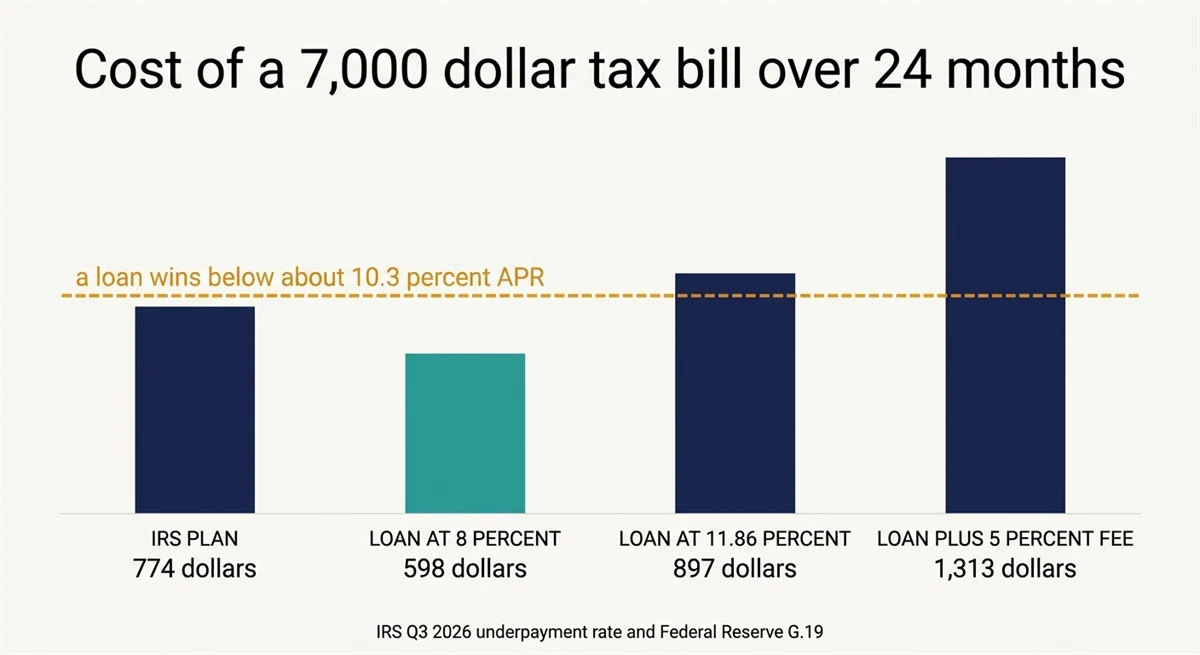
Run those against each other and the break-even sits at about 10.3 percent all-in APR on a 24-month, $7,000 balance, inclusive of the IRS's $22 setup fee. Below roughly 10.3 percent, borrowing is cheaper. Above it, the IRS is cheaper.
Here is why that threshold is directly usable rather than academic. Regulation Z, the rule implementing the Truth in Lending Act and administered by the Consumer Financial Protection Bureau, requires the APR box on your Truth in Lending disclosure to fold in origination and other prepaid finance charges, not just the note rate. Compare that number to 10.3 percent and you have your answer in about four seconds. No spreadsheet, no amortization schedule.
How the crossover shifts when the IRS rate resets
The threshold is not fixed, and the asymmetry matters. Your loan rate locks at signing. The IRS rate floats every quarter.
At a 6 percent underpayment rate, where Q2 2026 sat, the IRS carrying cost falls to about 9 percent and the crossover drops to roughly 9.3 percent. A full percentage point off the IRS rate moves the break-even by about a point. If you're sitting near the line, that quarterly reset is a real variable, and it can cut either way over a 24-month term.
The Costs That Are Not on Either Rate Sheet
Liens, credit reports, and what each route puts at risk
Rate is not the only currency here. An unpaid federal tax balance can produce a Notice of Federal Tax Lien, which the IRS files after assessment, a Notice and Demand for Payment, and continued non-payment. In its guidance on understanding a federal tax lien, the IRS states that a filed notice may limit your ability to get credit, and that the lien attaches to present and future assets. A personal loan carries no such claim.
Two things soften that risk. The Taxpayer Advocate Service, the independent watchdog inside the IRS, described in a March 2026 blog post the agency's current "simple payment plan" framing for balances under $50,000, which generally involves no lien filing and no financial disclosure. And under the Fresh Start provisions, a filed notice can be withdrawn if you owe $25,000 or less, are on a direct debit agreement that pays in full within 60 months, have made three consecutive direct debit payments, and are otherwise compliant. Direct debit is doing a lot of work in both cases, which is another reason to choose it.
On the tax side of the ledger, there is no thumb on the scale. Under 26 U.S.C. 163(h), personal interest is not deductible for an individual, and that covers IRS underpayment interest and personal loan interest alike. This is a clean rate-to-rate comparison.
The compliance trap: next year's bill on top of this year's payment
An installment agreement carries a condition most borrowers underestimate. The IRS payment plans and installment agreements page requires you to file and pay all future returns on time while the agreement runs, so a new balance next April can default it and pull the whole amount back into collection.
Tax attorney Stephen A. Weisberg makes the parallel point about borrowing, and it is the sharpest argument against a rushed loan. Paying the IRS with a personal loan doesn't erase the debt. It swaps one creditor for another with very different collection mechanics, less flexibility, and no hardship provisions. Nothing about the loan fixes the withholding or estimated-payment gap that created the bill, so next April's balance lands on top of a fixed monthly loan payment you can't renegotiate.
A loan is also rigid in a way an IRS agreement is not. Lose income and the IRS has options: revised agreements, currently-not-collectible status, or an offer in compromise if you genuinely cannot pay. The Taxpayer Advocate Service covers both of the latter two in detail, and either is worth investigating before you sign a note. A lender will offer you a hardship program if you are lucky, and a charge-off if you are not.
How to Decide in the Next Week
- File the return, today, if you haven't. The 5 percent monthly failure-to-file penalty dwarfs everything else in this article, and filing on time is a precondition for the reduced 0.25 percent penalty rate.
- Get a real APR, not an advertised range. Prequalify with a soft credit check so shopping does not cost you score points, and get the number in writing.
- Read the APR box, not the interest rate. Of the five numbers that decide whether a loan is worth taking, that is the one to compare here.
- Compare it to roughly 10.3 percent after confirming the current quarter's IRS underpayment rate. Below the line, take the loan. Above it, take the IRS plan.
- If the IRS wins, apply online and choose direct debit. That is $22 instead of $107 or $178, and it is the qualifying condition for lien withdrawal under Fresh Start.
- Check whether you qualify as low income. AGI at or below 250 percent of the federal poverty guidelines waives the fee entirely on a direct debit agreement. Form 13844 is the request.
- Fix the withholding that caused this. Otherwise you repeat the exercise next April with a payment already committed.
One boundary on all of the above: this is published analysis, not tax advice, and cashzella.com is a publisher and lender-matching service rather than a tax advisor or a lender. The rates and fees cited are current as of August 2026 and the IRS resets its rate quarterly. Confirm your own figures with the IRS or a licensed tax professional before you commit to either route.
Frequently Asked Questions
Is an IRS payment plan cheaper than a personal loan?
For a borrower at average rates, yes. An IRS long-term plan carries roughly 10 percent a year (7 percent interest plus a 0.25 percent monthly penalty) plus a $22 online setup fee. The Federal Reserve's G.19 average for a 24-month personal loan is 11.86 percent. Below about 10.3 percent APR, the loan wins.
What is the IRS interest rate on a payment plan right now?
The underpayment rate for individuals is 7 percent for the quarter running July 1 through September 30, 2026, compounded daily. It equals the federal short-term rate plus three percentage points and resets every quarter, with the next change effective October 1. Verify the current quarter on the IRS quarterly interest rates page before relying on it.
Does an IRS payment plan hurt your credit?
The exposure worth watching is a Notice of Federal Tax Lien, which the IRS says may limit your ability to get credit and attaches to present and future assets. Balances under $50,000 on a standard plan generally do not trigger a lien filing, and a filed notice can be withdrawn under the Fresh Start criteria.
How much is the IRS payment plan setup fee?
As of August 2026, a long-term plan costs $22 online with direct debit, $69 online without it, $107 by phone or mail with direct debit, and $178 by phone or mail without it. Short-term plans of 180 days or less are free. Direct debit applicants at or below 250 percent of the federal poverty guidelines pay nothing.
Can I pay my taxes with a credit card instead?
You can, through an IRS-authorized processor, but the economics are poor unless you clear the balance fast. The IRS page on paying by debit or credit card lists Pay1040 at 1.75 percent and ACI Payments at 1.85 percent on credit cards. The G.19 average rate on card accounts assessed interest is 22.15 percent, roughly double the IRS carrying cost.
What happens if I miss a payment on an IRS installment agreement?
A missed payment can default the agreement, which reinstates full collection and returns the failure-to-pay penalty to 0.5 percent per month. The IRS failure-to-pay penalty page adds that once a notice of intent to levy goes unanswered for 10 days, the rate climbs to 1 percent monthly. Contact the IRS to revise the plan before you miss, not after.