


Is National Debt Relief legit? By the public record, yes: it's a BBB-accredited, A+ rated debt settlement company, and no federal enforcement action against National Debt Relief, LLC turned up in this research. But "legit" and "right for you" are different questions, and the fee structure, the timeline, and what happens to your credit while you're enrolled matter more than the legitimacy question alone.
Scroll to the bottom of nationaldebtrelief.com and you'll find a footer disclaimer, the kind of text most visitors never read before they fill out the enrollment form above it. That footer is where National Debt Relief discloses its own fee structure, its own program length, and its own savings math. It's also the closest thing to a primary source the company publishes about how its program actually works.
What a Debt Settlement Program Actually Does
Debt settlement and debt consolidation get confused constantly, and they work in opposite directions. A consolidation loan pays off your existing balances and replaces them with one new loan, usually at a lower rate. A settlement program does something different: you stop paying your creditors directly, you instead deposit money into a dedicated account, and the settlement company negotiates with each creditor to accept less than the full balance once enough has accumulated.
Cashzella's debt relief vs. debt consolidation guide walks through how the two paths diverge, including which one fits which financial situation, in more depth than this article has room for. What matters here is the settlement side, because that's the program National Debt Relief sells.
What National Debt Relief (NDR) Charges, and When You Pay It
National Debt Relief charges up to 25% of your enrolled debt as its settlement fee, according to the fee disclaimer on the company's own homepage footer, nationaldebtrelief.com. The exact percentage "varies by state and the amount of your debt," the disclaimer states, so two clients with identical balances in different states could see different fee percentages.
The timing is the detail worth sitting with. National Debt Relief's fee is contingent: the company only collects it after a specific debt is settled and the client has approved the settlement, not upfront and not as a monthly service charge. That structure is consistent with the FTC's Telemarketing Sales Rule, which bars debt-relief companies that solicit by phone from collecting a fee before a debt is settled and the client has agreed to the settlement.
How Long the Program Runs, and What "Success" Looks Like in NDR's Numbers
National Debt Relief's own disclaimer states that clients who complete the program do so "over 24 to 48 months," meaning two to four years from enrollment to having all enrolled debt settled, per the same footer disclosure cited above. That's the company's own stated range, not an independently audited average completion time.
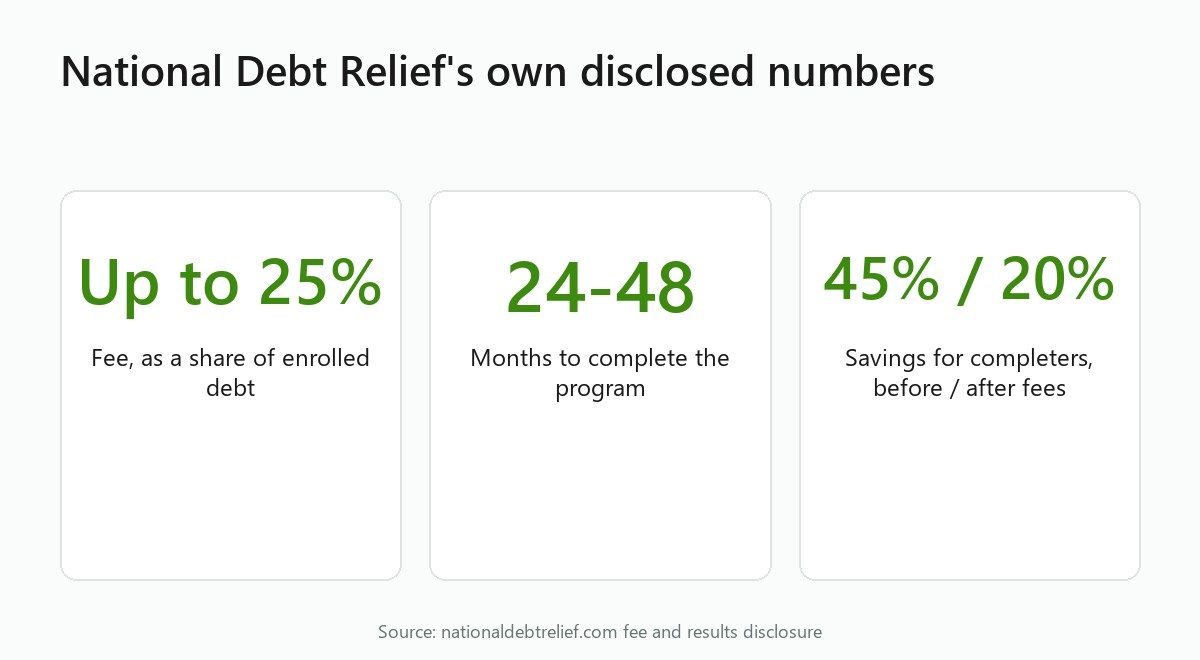
The savings figure attached to that timeline is where the disclaimer gets specific, and where it also gets careful with its own language. NDR states: "Clients who are able to stay with the program and get all their debt settled realize approximate savings of 45% before fees, or 20% including our fees, over 24 to 48 months."
As an illustrative calculation from NDR's own percentages, on $20,000 of enrolled debt, a 45%-before-fees settlement works out to roughly $9,000 saved before the company takes its cut. A 20% net savings figure works out to roughly $4,000 net saved after NDR's fee comes out; the gap between those two numbers, about $5,000 on this example, is approximately what the settlement fee consumes.
Here's the qualifier that matters most, and it comes from NDR itself: "not all clients complete the program." The 45%-before-fees and 20%-net figures apply only to clients who stay enrolled long enough to get every debt settled. They represent the company's own best-case number for people who finish, not a promise, an average across all enrollees, or a typical outcome.
Your Credit and the Calls That Keep Coming While You're Enrolled
Debt settlement programs generally require you to stop paying creditors directly while money builds up in a dedicated settlement account, and that pause has consequences that show up long before any debt gets settled. Missed payments get reported to the credit bureaus, and your credit score can drop during the early months of enrollment, before any negotiated settlement has closed. National Debt Relief's disclaimer is explicit that the company will not make monthly payments to creditors on a client's behalf and will not assume the client's consumer debt, which means the client, not NDR, is the one whose name is on the missed-payment history.
Collections activity doesn't pause just because you've enrolled in a settlement program, either. Creditors and the collection agencies they assign accounts to can keep calling, and in some cases can still sue over an unpaid balance while a settlement account is being built. If a collector contacts you during this stretch, Cashzella's debt validation letter template explains when and how you can require it to validate the debt.
National Debt Relief's BBB Rating and Complaint Record
National Debt Relief, LLC, based in New York, has been a BBB Accredited Business since February 5, 2013, and currently holds an A+ rating, according to the company's BBB business profile. As of this writing, that profile shows roughly 5,669 customer reviews and 542 complaints closed in the last three years. Those figures are a snapshot dated to this research; a BBB profile updates continuously, and both counts will have moved by the time you read this, so treat them as a point-in-time reading rather than a permanent record.
It's worth checking the live profile yourself before enrolling, since the complaint themes on a page like that shift over time and are more useful read fresh than summarized secondhand. The review count and complaint total will have shifted again by the time you check, and that's exactly why a live look beats a cited snapshot.
The Regulatory Record, and the Case That Isn't About National Debt Relief
This is the part where search results get genuinely misleading, so it's worth being direct. No CFPB enforcement action against National Debt Relief, LLC specifically was found in this research. According to the CFPB's enforcement action, the agency's well-known 2019 debt-settlement case, which resulted in $20 million in restitution and a $5 million penalty, was brought against Freedom Debt Relief, LLC, a separately owned company. That case does not involve National Debt Relief.
A second mix-up shows up commonly in search results tied to this exact query. A 2017 FTC case resulted in a $9 million judgment, with $510,000 actually collectible, over exaggerated savings claims and "debt-free in 36 months" solicitations, filed in the Eastern District of Texas. According to a 2017 case summary from Goodwin Procter, the defendant was United Debt Counselors, LLC, an entirely different company.
Low-quality aggregator sites frequently attach that case to "national debt relief" because of the keyword overlap in the company name. This case does not involve National Debt Relief, LLC either, and repeating that attribution error is exactly how a false record spreads.
No state attorney general cease-and-desist, consent order, or lawsuit naming National Debt Relief, LLC specifically was found in this research pass. Other debt-settlement companies have faced state and federal action in recent years, including Strategic Financial Solutions, sued by the CFPB and seven state attorneys general in January 2024 according to the CFPB's enforcement action, but none of those actions name National Debt Relief. No such action against National Debt Relief turned up in this specific research pass; that reflects what this research found, not a guarantee of a clean record everywhere.
One more thing worth naming honestly: reliable, company-specific complaint volume from the CFPB's Consumer Complaint Database could not be verified for National Debt Relief in this research pass, so no specific complaint count appears in this article. If you want that number, the CFPB's own complaint database lets you search it yourself, and checking it directly before you sign anything is a better move than trusting any third-party summary, including this one.
The Tax Bill Nobody Mentions in the Sales Pitch
When a creditor agrees to settle for less than you owed, the difference between what you originally owed and what you actually paid generally counts as taxable income under federal law. Per IRS Topic 431, a creditor that cancels or forgives debt generally reports the forgiven amount to the IRS as income, usually on a Form 1099-C, unless an exception applies. Two exceptions matter most for settlement clients, and neither is automatic; both require filing Form 982 with your tax return. The first covers debt discharged in Title 11 bankruptcy, and the second covers debt canceled while you were insolvent, meaning your total liabilities exceeded your total assets immediately before the cancellation.
National Debt Relief's own disclaimer tells clients to consult a bankruptcy attorney and a tax professional about the tax consequences of settlement, and it explicitly states the company does not provide tax, bankruptcy, accounting, or legal advice. It's an acknowledgment that the settlement itself can generate a tax bill the sales conversation rarely mentions upfront. If you're weighing this program, get a tax professional's read on your specific numbers before you enroll, not after the 1099-C shows up.
How This Compares to Freedom Debt Relief's Documented Record
Freedom Debt Relief is the company that actually faced the 2019 CFPB action described above, and Cashzella has covered its documented record, including that enforcement history, separately. If you're comparing debt settlement providers, "Is Freedom Debt Relief Legit? Here's the Documented Record" lays out that company's fee structure and enforcement history on its own terms, and it's worth reading alongside this one rather than assuming the two companies share a regulatory history. They don't.
Bottom Line: Who This Program Actually Fits
National Debt Relief meets the basic legitimacy markers regulators track: it's BBB accredited, A+ rated, and no CFPB, FTC, or state AG action against the company specifically turned up in this research. That establishes legitimacy. Whether the program fits your specific situation is a separate question. The program works best, by the company's own numbers, for people who can stay enrolled the full 24 to 48 months and get every debt settled, since the 45%-before-fees and 20%-net savings figures apply only to that group.
It requires you to stop paying creditors directly, which means your credit takes a hit during the early months and collectors may keep calling or even suing while your settlement account builds. And the debt it eventually resolves for less than face value will likely generate a tax bill unless bankruptcy or insolvency applies to your situation. Those tradeoffs sit alongside the legitimacy question, and a sales call is unlikely to walk you through them in full. Read the fee disclosure yourself, check the live BBB profile before you sign anything, and talk to a tax professional about the 1099-C before you assume settlement is the cheaper path.
Frequently Asked Questions
Is National Debt Relief a legitimate company? Based on public records, yes in the narrow sense regulators track: National Debt Relief, LLC has been BBB accredited since February 5, 2013, holds an A+ rating, and no CFPB, FTC, or state attorney general enforcement action against the company specifically was found in this research.
How much does National Debt Relief charge? Up to 25% of your enrolled debt, according to the company's own fee disclaimer. The exact percentage varies by state and debt amount, and the fee is contingent, meaning it's only charged after a debt settles and you approve the settlement.
Was National Debt Relief sued by the CFPB or FTC? No CFPB or FTC action against National Debt Relief, LLC specifically was found in this research. The 2019 CFPB case sometimes confused with this company was against Freedom Debt Relief, LLC, and a 2017 FTC case was against United Debt Counselors, LLC. Neither involves National Debt Relief.
How long does the National Debt Relief program take? National Debt Relief's own disclaimer states that clients who complete the program do so over 24 to 48 months, or two to four years, from enrollment to having all enrolled debt settled. That range applies only to clients who stay enrolled long enough to get every debt settled; not all enrollees complete the program.
Will I owe taxes on debt National Debt Relief settles? Generally, yes. Per IRS Topic 431, forgiven debt counts as taxable income and is usually reported on Form 1099-C. The two exceptions that matter most here, debt discharged in bankruptcy and debt canceled while you were insolvent, are not automatic; you must claim them by filing Form 982 with your return.
What is National Debt Relief's BBB rating? National Debt Relief holds an A+ rating and has been BBB accredited since 2013. As of this writing, its profile shows roughly 5,669 reviews and 542 complaints closed in the past three years, though those figures shift as the profile updates.